

When Traders Ask AI Which Broker to Choose, Will Yours Exist?

The following is a guest editorial courtesy of Elena Kupriianova, who provides an advisory practice for CEOs who want marketing accountable to revenue. Elena was previously CMO of Spotware Systems and held senior marketing roles at CFI, Capital.com, and Exness.
For over twenty years, broker search strategy was relatively straightforward.
A trader typed “best forex broker UAE” into Google. Google returned comparison sites, advertisements, Reddit threads, and broker pages on sites like FNG, Trader’s Union, WikiFX, etc. The trader opened several tabs, encountered six identical claims about tight spreads and superior technology, and eventually produced a shortlist, registered on several websites, and tested with demo or small investment. The rest was up to the sales and product.
That journey has not disappeared. But it now has another participant.
A trader can ask ChatGPT, Gemini, or Claude:
I live in Dubai and mainly trade gold. Compare three properly regulated brokers with TradingView, low total trading costs, and an Islamic account. Exclude brokers with recurring withdrawal complaints.
That is no longer a keyword. It is a research brief.
The AI assistant can interpret the trader’s circumstances, investigate several criteria, reject unsuitable companies, and present a shortlist. The broker may never receive a website visit before the first round of elimination takes place.
For marketing teams, this creates a new and slightly brutal question.
When traders ask AI which broker to choose, will yours be included in the answer?
Traders Are Already Using AI to Make Investment Decisions
Direct research into CFD traders’ use of generative AI remains limited. There is much more data on retail investors, general AI adoption and AI-assisted product discovery than on people asking chatbots to compare leveraged-trading providers.
That distinction matters. Someone using AI to summarise an earnings report is not necessarily allowing it to choose investments, and neither behaviour proves that they are using it to select a broker.
Still, the direction is difficult to miss.
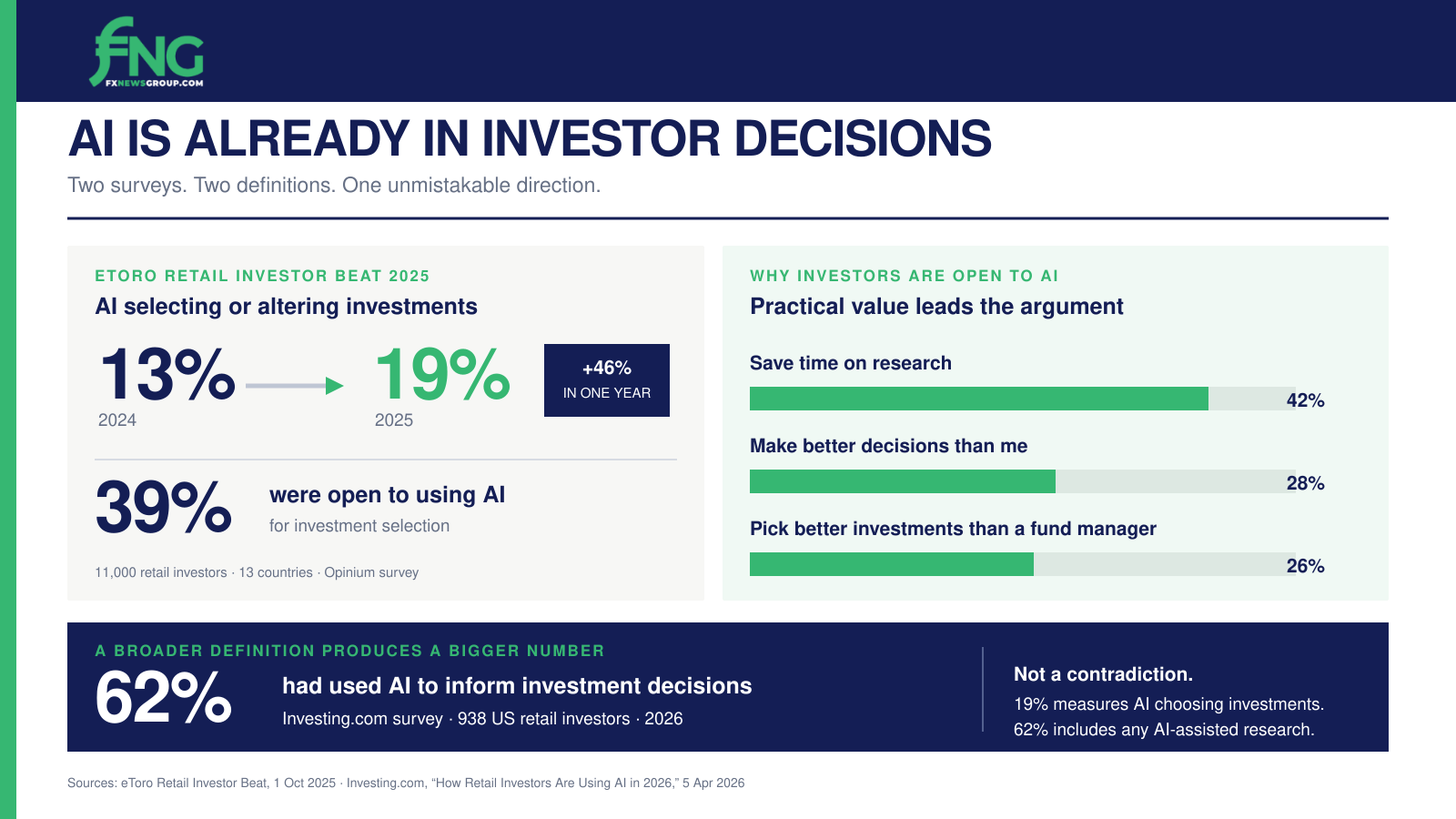
eToro’s 2025 Retail Investor Beat surveyed 11,000 investors across 13 countries. It found that 19% were already using AI to select or alter investments, up from 13% a year earlier. Another 39% were open to using it.
The leading reasons were practical. Forty-two percent said AI could save them research time. Twenty-eight percent thought it would make better decisions than they would, while 26% believed it could select better investments than a fund manager. AI-powered investment strategies also became the subject investors most wanted to learn about.
Other surveys have produced much higher adoption figures by using a broader definition of AI assistance. A 2026 Investing.com survey of 938 US retail investors found that 62% had used AI to inform investment decisions. Respondents used it to research assets, understand financial news, generate trading ideas, and assist with portfolio decisions.
The meaningful conclusion is that AI has entered the investor’s research process. Once traders become comfortable asking it what to trade, asking where to trade is hardly a conceptual leap.
Europe: Established Use, Higher Demand for Regulatory Precision
Europe provides some of the best available investor-level evidence because the eToro study included the UK, Germany, France, Italy, Spain, the Netherlands, Denmark, Poland, Romania and the Czech Republic.
The study did not publish one clean adoption percentage for the EU as a whole, but it showed that AI-assisted investing was no longer confined to a small experimental group. Adoption had increased across countries, ages, portfolio sizes, and levels of experience.
Broker-selection prompts in Europe are likely to be heavily shaped by regulation and jurisdiction.
A global broker may operate several entities with different products, protections, platforms, and account conditions. If its website does not make those distinctions clear, the AI system must resolve them using third-party sources. It may reach the wrong conclusion, recommend a competitor with clearer information, or omit the broker entirely.
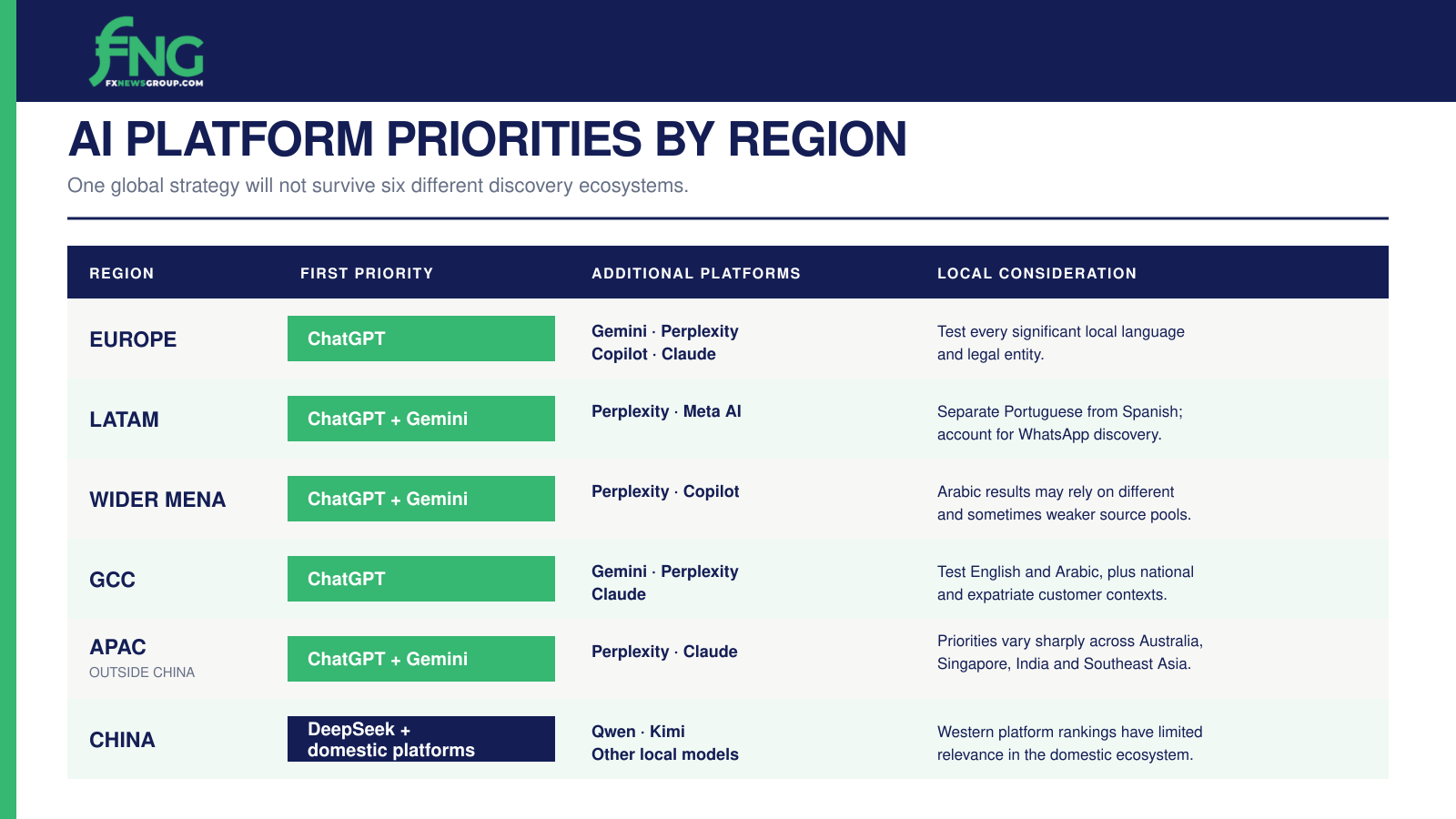
In Europe, ChatGPT should remain the first platform tested, followed by Gemini, Perplexity, Microsoft Copilot and Claude. But local-language testing is essential. A broker’s shortlist position in English cannot be assumed to carry into German, French, Italian, Spanish or Polish.
LATAM: A Mobile-First Opportunity with a Data Problem
There is no credible region-wide study showing what proportion of LATAM CFD traders use AI to select brokers. General AI adoption is rising quickly, particularly in larger digital markets such as Brazil and Mexico, but direct investor-level evidence remains thin.
The market conditions nevertheless make AI-assisted broker discovery highly plausible. LATAM traders often need to evaluate several practical constraints at once:
- Whether the broker accepts clients from their country
- Local deposit and withdrawal methods
- Minimum deposits
- Currency-conversion costs
- Spanish or Portuguese support
- Platform quality on mobile
- Regulatory status
- Withdrawal reputation
This is precisely the kind of complicated comparison for which conversational search is useful.
A trader does not need “ten best brokers in Latin America.” They need to know which broker accepts clients in Mexico, supports convenient local payments, offers MT5, has tolerable gold-trading costs, and does not appear to treat withdrawals as an escape-room challenge.
ChatGPT and Gemini should be the first AEO priorities in LATAM. Perplexity also matters for citation-led research. Meta AI deserves attention because its integration with WhatsApp gives it distribution that conventional AI website-traffic studies may understate.
Portuguese and Spanish must be treated separately. A translated English page may be linguistically correct while still failing to answer the questions Brazilian or Mexican traders actually ask.
MENA Is Not One AI or Trading Market
MENA is routinely discussed as a single growth region, usually by people preparing one English campaign, one Arabic version and an ambitious media plan for seventeen very different countries.
AI behaviour is no more uniform.
North African traders, Levantine traders, Gulf nationals and expatriates living in the UAE may share an interest in the same markets while differing substantially in language, income, payment access, regulation, platform preferences and instruments. It is no secret that trading conditions for gold are key to success in the region.
Across the wider MENA region, likely broker prompts include:
- Which brokers accept clients from Egypt, Jordan or Morocco?
- Which forex broker provides reliable Arabic support?
- Which broker has the lowest minimum deposit?
- Is this broker regulated?
- Which brokers process withdrawals reliably?
- What is the best broker for trading gold?
- Does this Islamic account charge administration fees?
- Can I fund and withdraw through a local bank?
ChatGPT and Gemini are the broad priorities, with Perplexity useful for source-led comparison. Arabic testing is necessary, but so is English. In several Gulf markets, and especially within expatriate segments in the UAE, the English AI journey may be commercially larger than the Arabic one.
A regional digital-interaction survey found that 59.52% of respondents preferred Arabic when reading information and making decisions. Another 27.78% were equally comfortable in Arabic and English, while only 12.5% preferred English.
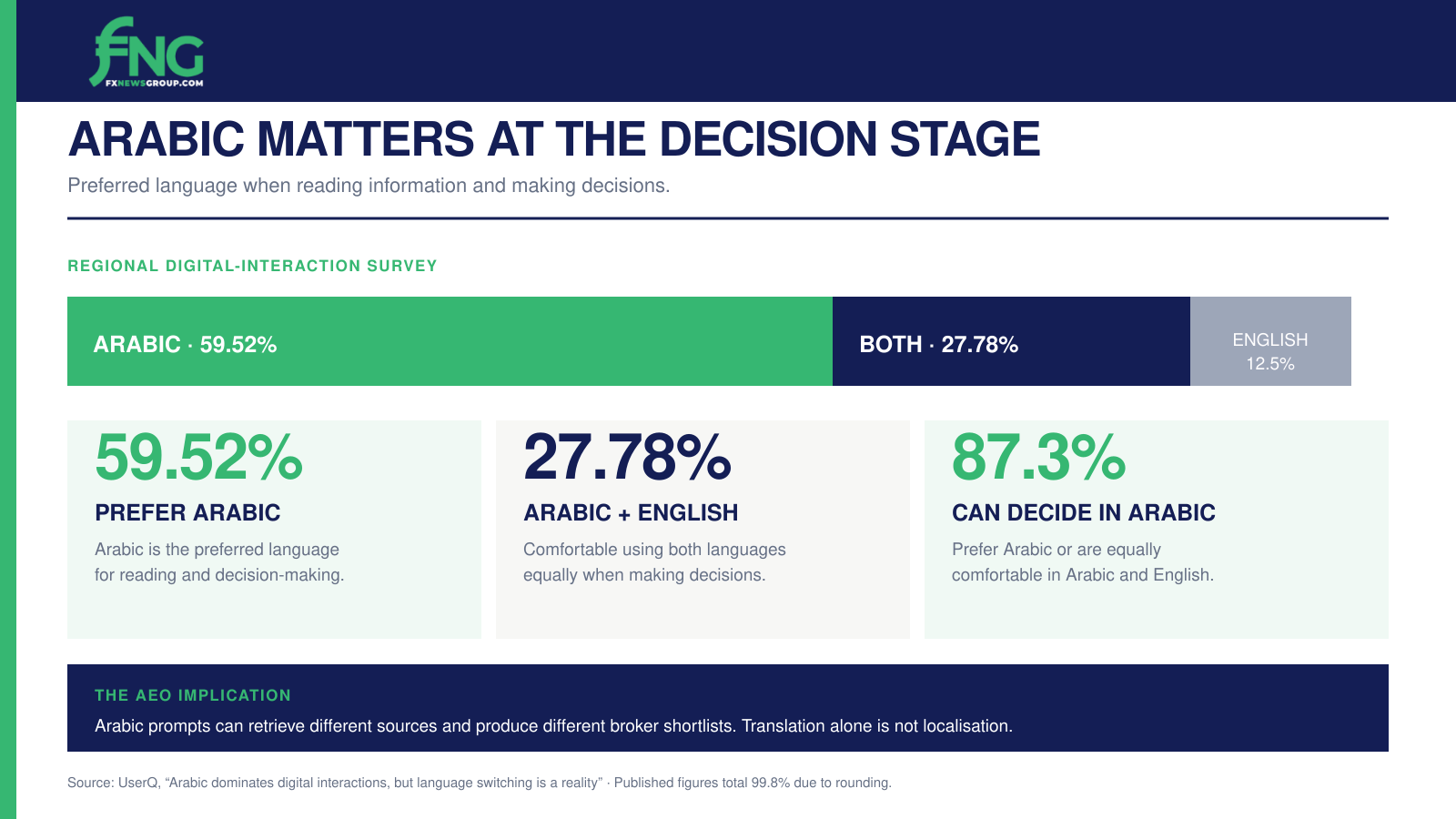
These figures do not prove that exactly 59.52% of Arab traders will prompt an AI assistant in Arabic. Trading terminology, education, professional background and location will all influence language choice. But they make one point difficult to dispute: a meaningful proportion of broker-selection conversations in MENA will happen in Arabic.
And the Arabic answer may be very different from the English one.
The GCC Should Be the Broker Industry’s AEO Test Market
The GCC deserves separate treatment because its general AI adoption is exceptionally high.
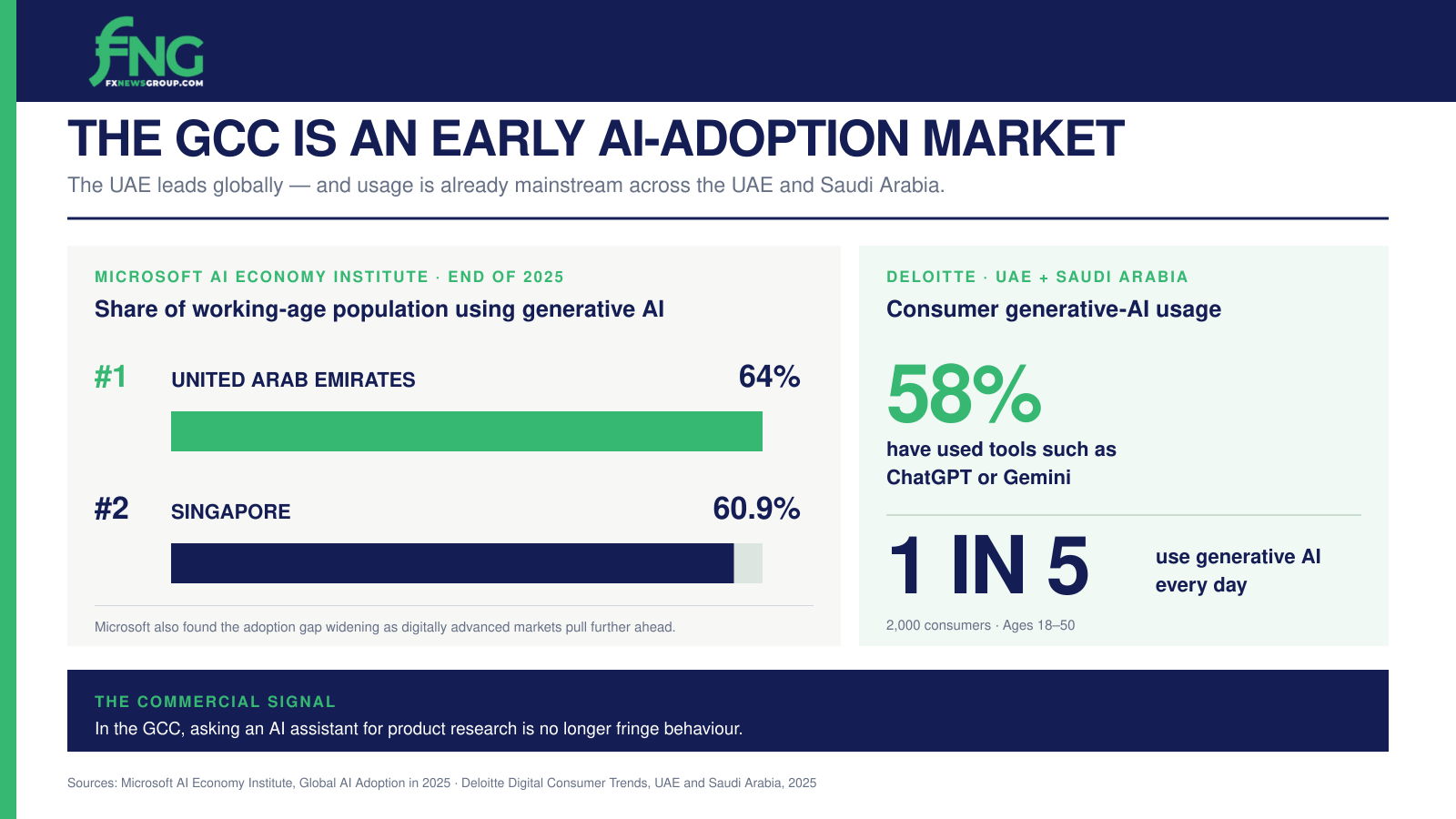
Microsoft’s AI Economy Institute estimated that 64% of the UAE’s working-age population used generative AI by the end of 2025, the highest measured rate globally. Singapore ranked second at 60.9%. The same research found a widening adoption gap between countries with strong digital infrastructure and those without it.
A separate Deloitte study covering 2,000 consumers aged 18 to 50 in the UAE and Saudi Arabia found that 58% had used generative AI tools such as ChatGPT or Gemini. One in five reported using generative AI daily.
This does not mean that 64% of UAE residents are asking ChatGPT to choose a broker. It does mean that using an AI assistant for research is already normal behaviour within a market containing:
- A large retail-trading audience
- Dozens of competing broker brands
- Several regulatory jurisdictions
- Heavy interest in gold
- A multilingual expatriate population
- Strong mobile and social-media usage
- Persistent concerns about financial scams
That combination makes the UAE an obvious early market for broker AEO.
High-intent prompts may be extremely specific:
- Which DFSA-regulated brokers offer TradingView?
- What is the best broker in Dubai for trading XAU/USD?
- Compare Islamic accounts from three UAE-regulated brokers.
- Which broker supports UAE bank transfers?
- Can a UAE resident open an account with this broker, and under which entity?
- Is this broker actually regulated in the UAE or merely operating from Dubai?
ChatGPT remains the first platform to test, followed by Gemini, Perplexity, and Claude. The essential split is not merely between English and Arabic. Brokers should also test different user contexts: Emirati, Arab expatriate, South Asian professional, Russian-speaking resident, and internationally mobile high-net-worth trader.
APAC: Several AI Ecosystems Hiding Inside One Acronym
APAC is even less useful as a single category.
Australia and Singapore are highly regulated, mature investment markets. India combines enormous AI usage with a mobile-first trading population. Southeast Asia contains widely differing languages, payment systems, and regulatory environments. China operates within a largely separate technology ecosystem.
The regional platform picture therefore changes by country.
Outside China, ChatGPT and Gemini should generally receive priority, followed by Perplexity and Claude. Gemini is especially important in Android-heavy markets. In China, DeepSeek, Qwen, Kimi and other domestic services matter far more than Western chatbot rankings.
Statcounter found ChatGPT to be the leading source of AI chatbot referrals in every G20 market except China, where DeepSeek led. Its global data placed ChatGPT first, followed by Gemini, Perplexity, Claude and Copilot.
Similarweb uses a different methodology and reports a smaller ChatGPT lead, with Gemini and Claude gaining ground. The disagreement is useful. It shows why a broker should not optimise for one assistant.
The Main Platforms Brokers Should Monitor
There is no reliable trader-only dataset ranking AI assistants by region. The following should therefore be treated as a practical AEO priority list, not a claim that a precise percentage of traders uses each platform.
What Traders Will Ask AI About Brokers
The major AI platforms do not publish dependable search-volume data for broker-selection prompts. Anyone presenting an exact list of the “most searched ChatGPT broker questions” is probably estimating, extrapolating, or being unusually imaginative with the definition of data.
What can be identified are the major commercial-intent prompt families.
Traditional broker searches already concentrate around categories such as “best forex broker,” “regulated forex broker,” “low-spread broker,” “forex trading platform,” “trading app,” and “MT5/cTrader broker.”
AI turns those keywords into detailed decisions.
Best broker in a specific country
What is the best regulated forex broker for a retail trader living in the UAE?
Safety and trust
Which CFD brokers have strong regulation and a reliable withdrawal record?
Direct comparison
Compare IG, Pepperstone and Capital.com for an active gold trader in Dubai.
Total trading cost
Which broker has the lowest total EUR/USD cost after spreads, commissions, and swaps?
Instrument suitability
What is the best broker for trading XAU/USD from Saudi Arabia?
Platform and functionality
Which regulated brokers offer both TradingView and MT5?
Experience and account size
Which broker is suitable for a beginner depositing $1,000?
Local deposits and withdrawals
Which brokers support UAE bank transfers and process withdrawals quickly?
Account structure
Which broker offers an Islamic account without hidden administration charges?
Complaints and red flags
Is Broker X properly regulated? Are there recurring complaints about withdrawals or account closures?
These prompts are longer than Google keywords because users expect the system to perform the comparison. Follow-up questions then narrow the shortlist further.
The trader is no longer asking the machine to find pages. The trader is asking it to make a judgment.
How an LLM Answers the Question
A conventional search engine and an LLM-based answer engine may use some of the same web content, but they do different jobs with it.
A traditional search engine crawls pages, extracts their content, and stores information in an index. At query time, it retrieves documents using signals such as term relevance, links, authority, location, freshness, and user context.
Older information-retrieval systems relied heavily on lexical matching and ranking functions such as TF-IDF and BM25. Modern search engines add semantic models, machine learning, behavioural signals and numerous proprietary ranking systems.
An LLM begins somewhere else.
During training, text is divided into tokens: small units that may represent words, word fragments, or punctuation. A transformer model learns statistical relationships among those tokens. Its attention mechanism allows it to weigh different parts of the input when predicting what should come next.
At its core, an LLM generates an answer one token at a time. It generates the next probable piece of language based on the prompt, patterns learned during training, and any information retrieved during the current session. The depth of the search may differ based on user settings of the model and performance complexity. For example, if a user has a setting of “Deep Research” in ChatGPT, or high performance on Fable 5 instead of Opus in Claude, the system will generate more complex and better answers.
Modern answer engines reduce this problem by adding retrieval-augmented generation, or RAG.
When a trader asks for a broker recommendation, the system may:
- Interpret the trader’s location, experience, instruments, and constraints.
- Decompose the request into several related searches, often described as query fan-out.
- Retrieve broker pages, reviews, regulatory records, and other documents.
- Divide those documents into smaller passages or chunks.
- Convert the query and content into numerical representations called embeddings.
- Use semantic similarity to locate relevant passages even when they do not contain exactly the same words.
- Rerank those passages based on relevance, apparent authority, freshness, and other quality signals.
- Place the selected evidence inside the model’s context window.
- Generate a synthesised recommendation.
- Attach citations where the interface supports them.
This creates several important differences from normal search.
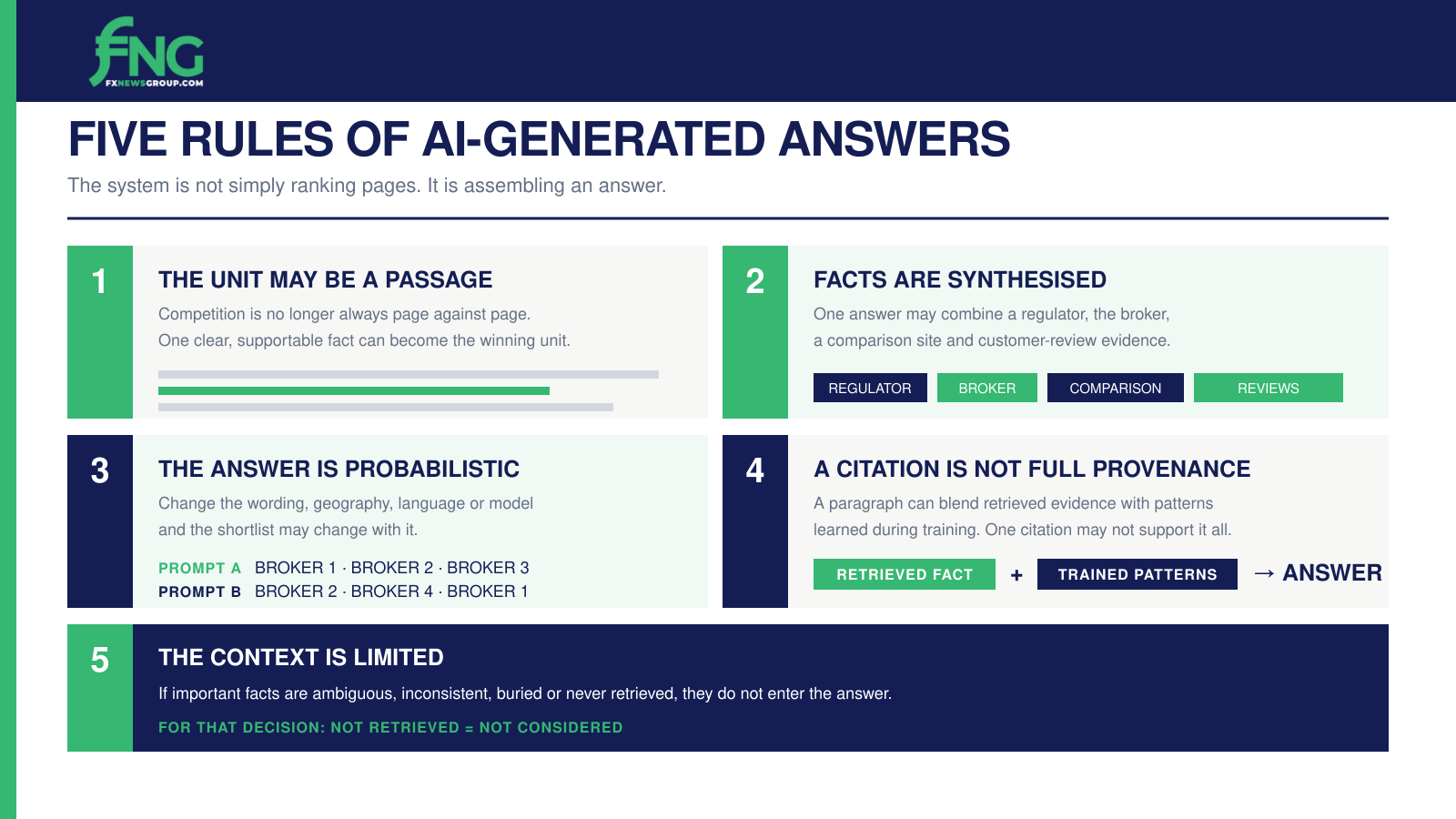
First, the unit of competition is no longer always the page. It may be a passage containing one clear, supportable fact.
Second, the system can combine facts from multiple sources. A regulator may confirm the licence, the broker may provide its platform list, a comparison site may discuss costs, and a review platform may influence the assessment of customer complaints.
Third, the answer is probabilistic. Small changes in wording, geography, language, or model version can produce a different shortlist.
Fourth, a citation does not necessarily mean that every statement in the paragraph came directly from that source. LLMs can combine retrieved evidence with information learned during training and present the result with considerably more certainty than the underlying material deserves.
Finally, the model is working with a limited context. If a broker’s most important facts are ambiguous, inconsistent or buried in documents the system did not retrieve, they may as well not exist for that answer.
This is why visibility in AI search is not simply a matter of ranking first.
It is a matter of being retrievable, understandable, credible and easy to justify.
From SEO to AEO
The most useful term for this work is Answer Engine Optimisation, or AEO.
SEO focuses primarily on earning visibility in a ranked set of search results. AEO focuses on whether a brand’s information is understood, selected, and used inside an answer produced by ChatGPT, Gemini, Perplexity, Google AI Mode, or another generative interface.
The objective is not merely to receive a link.
It is to be:
- Included in the shortlist
- Described accurately
- Associated with the right market and use case
- Supported by credible evidence
- Cited where possible
- Recommended for relevant trader profiles
Academic research into generative search has found that AI systems tend to rely heavily on authoritative third-party sources and that results vary by engine, language, freshness, and prompt construction.
Start with Ordinary SEO. Then Move Beyond It
AEO does not replace basic SEO.
Brokers still need crawlable HTML, sensible site architecture, descriptive headings, internal links, fast pages, accurate structured data, visible update dates, mobile usability, and content that can be indexed without requiring a login or executing an interpretive dance in JavaScript.
These are general search foundations. They help both conventional search engines and AI retrieval systems, but they are not an AI-specific strategy.
The more interesting work begins after those foundations are in place.
Ten AEO Actions Specifically for Broker Visibility
1. Build a Broker-Selection Prompt Map
Traditional keyword research begins with search volume. AEO research should begin with decisions.
Create a library of the questions traders might ask when choosing a broker. Vary:
- Country
- Language
- Regulatory preference
- Instrument
- Trading platform
- Account size
- Experience
- Deposit method
- Account type
- Cost sensitivity
- Competitor set
“Best broker UAE” is one prompt.
“Compare DFSA-regulated brokers offering TradingView for an experienced gold trader” is another. They may produce completely different sources and shortlists.
Run each prompt across several answer engines and record which brokers appear, how they are described, and which sources are cited. The result may surprise you.
2. Establish One Machine-Understandable Identity for Every Entity
LLMs struggle when a broker’s brand name, group name, legal entities, and domains are inconsistently connected. Many brokers create separate non-linked campaign LPs, which can confuse the LLM. For example, broker.com/campaignX is much better than campaignX.broker.com.
Create an authoritative entity record for every regulated company. It should clearly state:
- Legal name
- Trading name
- Regulator
- Licence number
- Registered address
- Official domain
- Countries served
- Products offered
- Client protections
- Relationship to the parent group
Then ensure that the same relationships appear consistently across regulatory directories, corporate profiles, app stores, LinkedIn, press coverage, and major comparison sites.
The goal is to make the statement “Brand X serves clients in Country Y through Entity Z” easy for a machine to verify.
3. Create an Answer-Ready Product Fact Layer
Most broker websites were written to persuade humans, not to supply answer engines with unambiguous product facts.
Develop clear, dated pages or tables covering:
- Platforms by legal entity
- Instruments
- Minimum deposits
- Typical and average spreads
- Commissions
- Overnight charges
- Islamic-account conditions
- Deposit methods
- Withdrawal methods and expected times
- Negative-balance protection
- Compensation arrangements
- Account eligibility by country
Each fact should be stated directly before being decorated with marketing language.
An LLM can use “Average EUR/USD spread during May 2026 was X” more confidently than “Experience razor-sharp institutional pricing.”
One is evidence. The other is adjectives that don’t matter.
4. Publish Information in Quotable Units
Answer engines frequently retrieve passages rather than whole articles. A useful passage should therefore make sense when separated from the rest of the page.
Place a direct answer near the beginning of each section. Define the subject explicitly. Include the jurisdiction and relevant conditions in the same passage.
For example:
The Islamic account offered by Broker X’s UAE entity does not charge overnight swap. An administration fee applies to specified instruments after five days.
That passage is safer to retrieve and reproduce than an FAQ answering “Does it cost extra?” with “In some circumstances, yes.”
Write for human clarity, but assume the paragraph may be removed from its original surroundings and handed to a machine with the attention span of a caffeinated squirrel.
5. Give the Model Evidence It Can Use to Justify a Recommendation
AI systems are more likely to include a broker when they can explain why it fits the request.
Replace unsupported claims with measurable evidence:
- Execution-speed methodology
- Order-fill statistics
- Slippage distribution
- Average spreads by instrument
- Platform uptime
- Withdrawal-processing performance
- Support response times
- Named awards with issuer and year
- Number of active clients, with methodology
- Clearly documented regulatory protections
“Fast execution” tells the model very little.
“Median execution speed of X milliseconds across Y orders during Q2” gives it a claim, a measurement and a reason for inclusion.
6. Earn Mentions in Sources Answer Engines Already Trust
A broker cannot create an authoritative recommendation entirely on its own website.
Answer engines often rely on regulators, established publishers, comparison sites, news organisations, research sources and credible user communities. Research into generative search suggests that third-party coverage has disproportionate influence over brand inclusion.
Identify which domains each platform cites for your target prompts. Then build a communications strategy around those sources:
- Original market research
- Transparent product testing
- Executive commentary
- Regulatory analysis
- Public operating data
- Independent interviews
- Credible awards
- Detailed third-party reviews
This changes the role of PR.
A strong article no longer provides only referral traffic and brand awareness. It may become evidence an AI system reuses whenever a trader asks for a recommendation.
Industry research into AI citations has similarly found that news and publisher sites, reviews and other third-party sources make up a substantial part of the source pool used by major answer engines.
7. Engineer Clear Brand-to-Attribute Associations
LLMs work through patterns and relationships. A broker is more likely to be recommended for a particular requirement when credible sources repeatedly associate the brand with that attribute.
If a broker wants to be considered for gold trading in the GCC, the web needs consistent evidence connecting:
- The brand
- Gold or XAU/USD
- Relevant GCC jurisdictions
- Trading costs
- Platform functionality
- Arabic or regional research
- Regulatory status
It means creating genuine, independently supported evidence that the broker has a relevant product strength.
8. Build a Local AEO Strategy, Not an English Strategy with Translations
A broker cannot assume that Arabic-speaking traders will ask AI questions in English simply because financial terminology often appears in English.
A regional digital-interaction survey found that 59.52% of respondents preferred Arabic when reading information and making decisions. Another 27.78% were equally comfortable in Arabic and English, while only 12.5% preferred English.
That does not mean 59.52% of traders will always prompt an LLM in Arabic. Trading vocabulary, professional background and location all affect language choice. English is particularly important among expatriates in the UAE.
But in Saudi Arabia, Egypt and other predominantly Arabic-speaking markets, a substantial proportion of broker-selection questions will inevitably be asked in Arabic.
This creates a specifically AI-related problem: the same question asked in Arabic and English may produce different brokers, facts and sources.
Compare:
What is the best broker in Saudi Arabia for trading gold through an Islamic account?
With:
ما أفضل وسيط في السعودية لتداول الذهب من خلال حساب إسلامي؟
The Arabic answer is not the English answer. The system may retrieve different regional publishers, Arabic affiliates, forum discussions, and local pages. It may interpret financial terminology differently, misunderstand whether a broker accepts Saudi residents, or confuse an offshore entity with a locally authorised company.
The availability of source material also changes by language.
Arabic is spoken by hundreds of millions of people, but it is estimated to account for only around 3% of online content.
This creates both a weakness and an opportunity.
An LLM answering in Arabic may have fewer authoritative sources available. Inaccurate affiliates and old translated pages can therefore exert disproportionate influence. Conversely, a genuinely useful Arabic source may face much less competition for retrieval than another generic English article about choosing a forex broker.
Brokers should create local answer environments covering:
- Regulatory status and account eligibility by country
- Gold, forex, and locally relevant instruments
- Islamic-account conditions
- Local deposit and withdrawal methods
- Arabic customer support
- Region-specific fees and restrictions
- Common complaints and misconceptions
- Comparisons based on the criteria local traders actually use
This should not be handled by sending English pages to a translator after the strategy is finished.
The Arabic team should research Arabic prompts, identify the sources cited in Arabic answers, and create content around regional decision-making. The same principle applies to Spanish, Portuguese, and significant APAC languages.
The broker should then test equivalent prompts in Modern Standard Arabic, relevant conversational wording, and English.
For a broker targeting MENA, localisation is no longer only about helping a human read the website.
It determines what the machine reads before recommending the broker.
9. Find and Correct AI Hallucinations Systematically
AI systems may describe outdated leverage, attribute the wrong licence, confuse two similarly named companies, or recommend an account unavailable in the trader’s country.
Create a recurring monitoring process for high-value prompts. Record factual errors and trace the sources that may have caused them.
Corrections may require:
- Updating the broker website
- Contacting a publisher
- Correcting an affiliate page
- Updating business directories
- Clarifying an entity relationship
- Revising contradictory terms
- Requesting correction from a review site
- Strengthening the accurate version across several authoritative sources
There is rarely a magical “tell the AI it is wrong” button. The durable solution is to repair the information environment from which the answer is assembled.
10. Measure Answer Share, Not Only Search Rank
AEO needs its own dashboard.
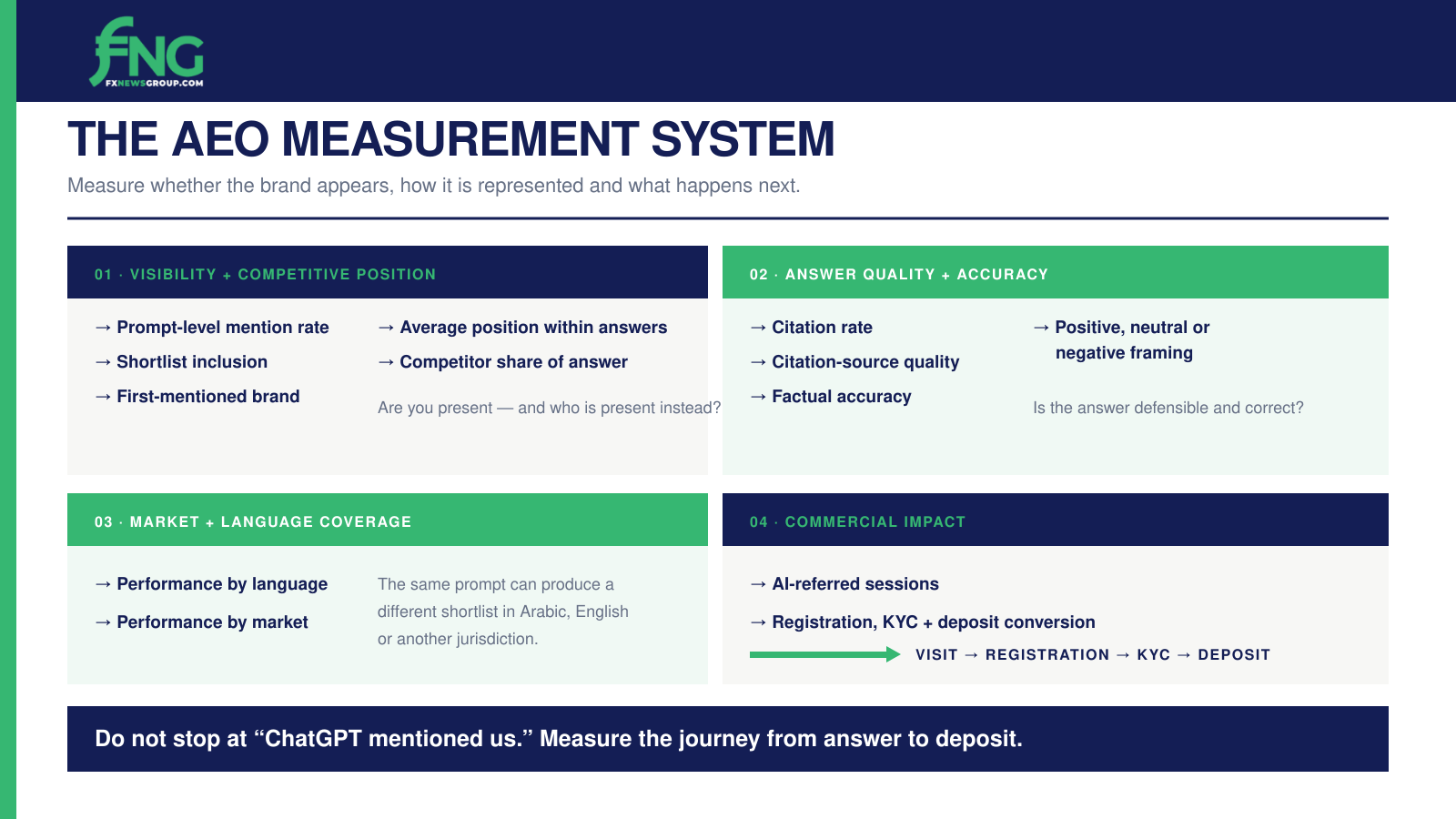
Track:
- Prompt-level mention rate
- Shortlist inclusion
- First-mentioned brand
- Average position within answers
- Citation rate
- Citation-source quality
- Factual accuracy
- Positive, neutral or negative framing
- Competitor share of answer
- Performance by language
- Performance by market
- AI-referred sessions
- Registration, KYC and deposit conversion from AI referrals
Results should be sampled repeatedly.
Research has shown substantial disagreement between AI platforms and inconsistency across recommendation prompts. A single result proves very little.
Unfortunately, tracking AEO performance is significantly more difficult than SEO performance.
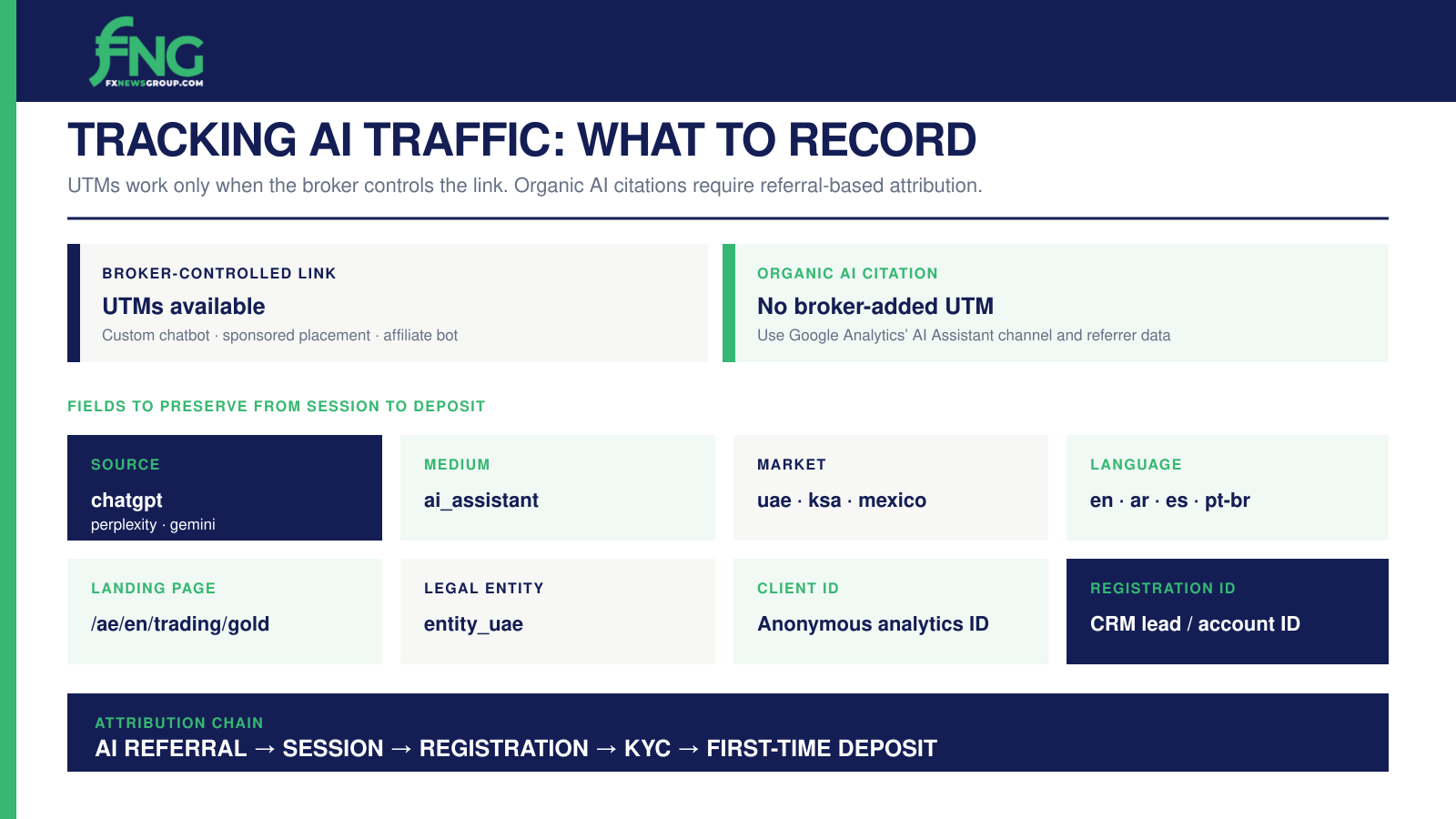
You cannot attach a UTM to a citation independently selected by ChatGPT, Gemini, or Claude. Instead, identify organic AI visits through referral data and the AI Assistant channel in Google Analytics, which groups traffic arriving from recognised AI platforms. The broker should preserve the detected source, market, language, landing page, legal entity and anonymous client ID when the visitor registers, then connect that session to KYC and deposit activity in its CRM. Even this will undercount AI’s influence: users who receive a recommendation but later visit directly or search for the broker on Google will rarely be attributed to the original AI interaction.
Another reliable source would be to implement a post-registration survey with a question like “How did you find us?” and see the attribution. This is less reliable, but still worth checking.
Brand-search correlation is another way to track AEO; however, because the volume of such traffic can be insignificant compared to organic search, it would be extremely hard to attribute it.
Ranking First Is No Longer the Only Competition
Google remains enormously important. AI search has not abolished the search engine, and brokers should be suspicious of anyone announcing the death of SEO while selling a replacement acronym by the hour.
What is changing is the layer between information and decision.
Previously, the search engine ranked possible sources and left the trader to compare them. An AI assistant can now retrieve those sources, interpret them, and complete much of the comparison itself.
That changes the role of the broker website. It is no longer only a destination for human prospects. It is also one component of the information environment from which machines form a view of the company.
A broker with clear entities, transparent product data, credible external coverage, and strong evidence can be understood and justified.
A broker with vague claims, conflicting legal information, and a website full of “empowering traders globally” may still rank. But when the AI is asked to choose, it has very little substance with which to defend that choice.
The industry spent twenty years fighting to rank first. The next competition is harsher.
Before the trader sees the landing page, compares the spreads, or enters the retargeting funnel, an AI system may have already decided which brokers deserve to be considered.
In conventional search, second place can still generate business.
In an AI-generated shortlist, omission means you never entered the race.