

Saxo survey: banks increasingly turn to external partners as AI pressures increase

Banks are increasingly turning to external partners to modernise their wealth management and brokerage offerings, according to a new study about the future of digital wealth released by Saxo today.
The study, which surveyed 332 senior decision-makers across banking, brokerage, and fintech across Europe, the Middle East and North Africa (MENA), and Asia-Pacific (APAC), points to an industry facing growing pressure to modernise.
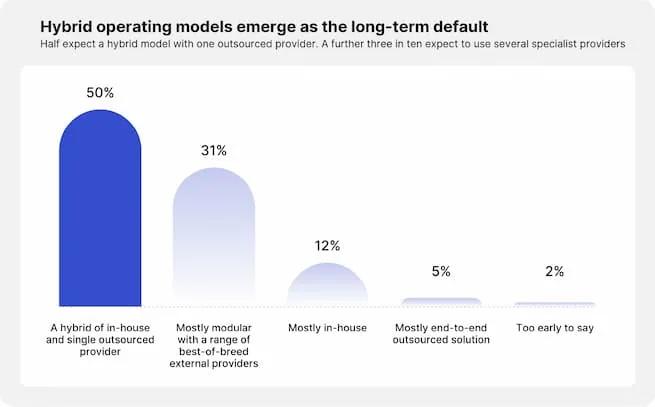
Against this backdrop, financial institutions are reconsidering how they build and deliver their digital wealth capabilities, with half (50%) of respondents favouring a hybrid operating model that combines internal expertise with a single outsourced provider for the long term.
Despite growing pressure to modernise, majority of the financial institutions acknowledged they are still far from digital maturity in the study. Fewer than one-third (28%) of respondents described their wealth and brokerage capabilities as advanced. Most (43%) classified themselves as fairly advanced, with some ability to personalise client experiences and a partially digitised value chain.
The findings suggest that while digital transformation remains a strategic priority, many institutions continue to grapple with the complexity of upgrading technology, integrating systems and scaling digital capabilities across their organisations.
Legacy technology remains a significant hurdle for these institutions. On average, respondents reported that their core wealth and brokerage technology stack is 6.7 years old, rising to 7.5 years among firms that manage these capabilities entirely in-house.
The findings also point to a gap between perception and reality. While three-quarters (75%) of respondents believe banks are well equipped to deliver digital wealth and brokerage propositions, nearly four in five (79%) say banks are launching new offerings without all the capabilities needed to support them.
The research also uncovered growing concerns over the impact of artificial intelligence (AI) on the competitive landscape. AI-driven robo-advisories and automated investment services emerged as the most-cited competitive threat (48%), ahead of Big Tech firms entering financial services (43%) and neo-brokers offering low- or zero-cost trading (36%).
Commenting on the research, Henrik Alsøe, Global Head of Institutional, Saxo Bank, said:
“Banks are operating in an environment where both the opportunity and the pressure have never been greater. Growth in global wealth is creating significant business opportunity but advances in AI keep raising the bar.
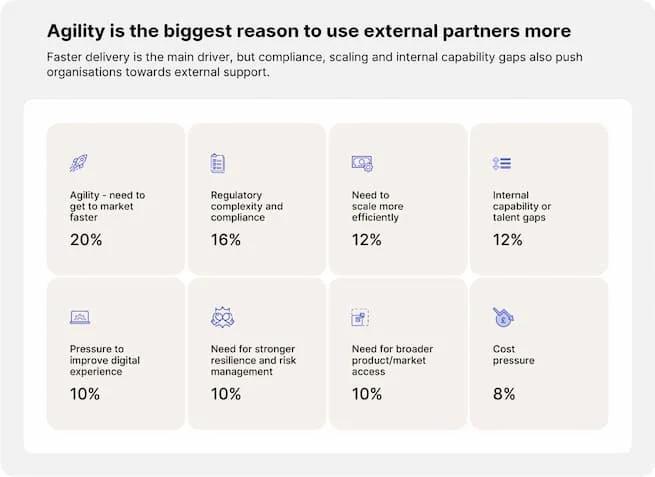
The challenge for many institutions is no longer recognising the need to modernise but modernising quickly enough to stay competitive. As a result, more are turning to strategic partners who can help them continually innovate, scale their offerings, and adapt to evolving client needs.”