
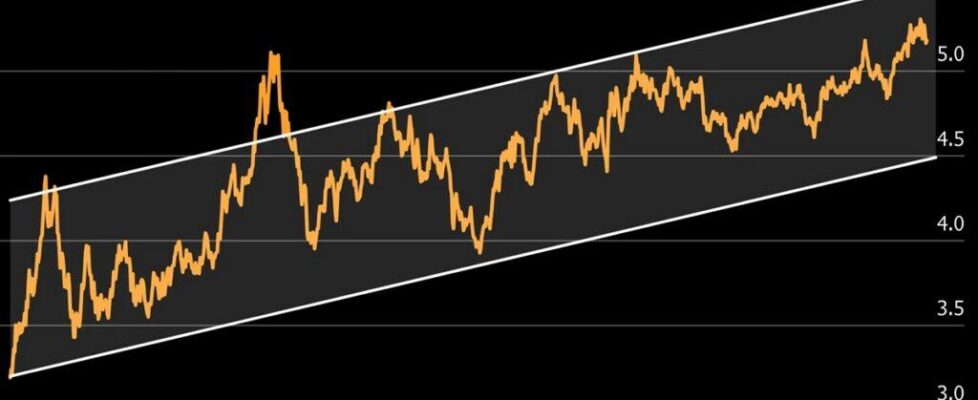
Do Rising Bond Yields Signal a Crash? (Part 1)

The following is a guest editorial courtesy of Carolane de Palmas, Markets Analyst at Retail FX and CFDs broker ActivTrades.
The sharp rise in government bond yields has become one of the most important risks facing global financial markets in late 2026. In the United States, the 10-year Treasury yield has climbed above 5.3%, reaching its highest level since 2002, while the 30-year yield has approached 5.7%. The move has occurred even as expectations for another Federal Reserve rate increase in October have fallen following weak US employment data.
The pressure is not confined to the US. Japan’s 10-year government bond yield is around 3.1%, while the Bank of Japan raised its policy rate to 1.25% last month, its highest level since 1995. In Europe, German 10-year Bund yields are around 3.5%, while French 10-year borrowing costs have approached 5%. The spread between French and German debt has widened significantly as investors reassess France’s fiscal and political outlook.
This raises an important question for investors: does the return of high bond yields signal that a stock-market crash is approaching? Not necessarily. Higher yields are certainly making the financial environment more demanding, but a crash normally requires more than an increase in the risk-free rate. The real danger arises when high yields combine with deteriorating economic growth, falling corporate earnings, widening credit spreads, excessive valuations or a liquidity shock.
Why are bond yields rising?
There is an important distinction between short-term interest rates and long-term bond yields.
Central banks largely determine short-term rates, but 10- and 30-year government bond yields depend on economic growth, inflation forecasts, national debt issuance, and the term premium investors require for long-term risk.
In the US, this distinction is particularly important. The Federal Reserve raised its policy rate to 3.75%-4% in September, but the recent rise in the 10-year Treasury yield has been much more pronounced. The Fed itself says economic activity remains solid, productivity growth is strong and capital investment is robust, while inflation remains elevated.
At the same time, the US government faces enormous financing requirements. The combination of large deficits, substantial Treasury issuance and uncertainty about future inflation means investors can demand a greater term premium to hold long-dated government debt. The result is that long-term yields can remain high even when markets expect the central bank eventually to ease policy.
Why higher yields matter for stock markets
The first transmission mechanism is valuation.
A company’s value is based on the present value of its future cash flows. When the discount rate rises, those future earnings become less valuable today. This creates particular pressure on companies whose valuations depend heavily on profits expected many years into the future.
This explains why high-growth technology companies can become more sensitive to rising Treasury yields. Even if companies such as Nvidia, Microsoft or Amazon continue to report strong earnings, investors may be less willing to pay exceptionally high valuation multiples when risk-free returns are substantially higher.
Higher bond yields also change the relative attractiveness of equities. Rising government bond yields force investors to demand higher prospective stock returns to compensate for equity risk.
However, there is an important counterargument. If yields rise because economic growth and corporate profits are strong, equities can continue to perform well. The problem therefore is not simply how high yields are, but why they are rising.
US stocks have indeed remained surprisingly resilient despite the bond sell-off, with the S&P 500 hovering around its August 13 record high and the Nasdaq setting a new record close yesterday. Boosted by gains in Nvidia and Microsoft, the tech index drew support as investors focused on falling oil prices and prepared for upcoming quarterly earnings reports. Meanwhile, the “Magnificent Seven” mega-caps reached a historic combined market capitalization of $24.836 trillion at Monday’s close.
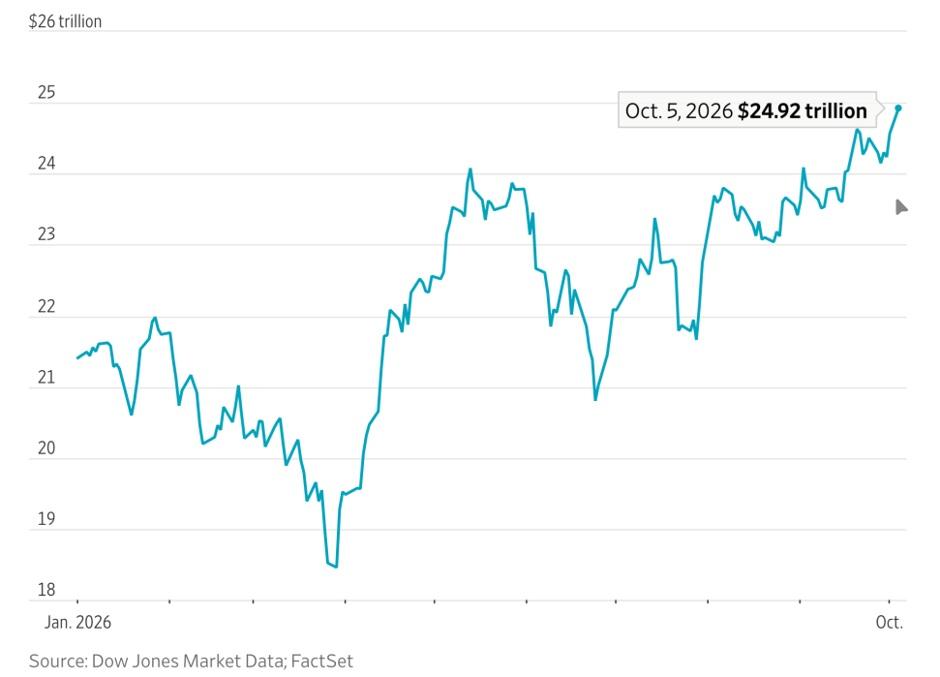
Magnificent Seven Market Cap – Source: Reuters
Europe presents a more complicated risk
Europe deserves particular attention because the rise in yields is occurring alongside significant fiscal and political vulnerabilities. The euro area’s aggregate debt position is manageable compared with some individual member states, but the differences between countries are substantial. France is the clearest example.
In May, the European Commission projected that French public debt would rise from 115.6% of GDP in 2025 to 118.1% in 2026, eventually surpassing 120% in 2027. The budget deficit was expected to hold at 5.1% of GDP this year before widening to 5.7% by 2027, driven in part by interest payments rising to 2.6% of GDP in 2026. By September, however, France’s finance ministry painted an even gloomier picture of the country’s public finances, updating its projections to a record debt level of 119.3% of GDP in 2026 and 121.7% in 2027.
Higher yields increase the cost of refinancing government debt. Higher interest expenditure makes it harder to reduce the deficit. A larger deficit requires additional borrowing, which can put further pressure on bond yields.
France is particularly exposed because its fiscal deterioration is occurring against a backdrop of weak economic growth and political uncertainty. The country is already subject to the EU’s Excessive Deficit Procedure, while the spread between French OATs and German Bunds has reached its widest levels in years. The euro has also fallen to a 17-month low amid concerns about French fiscal stability and political uncertainty elsewhere in the euro area.
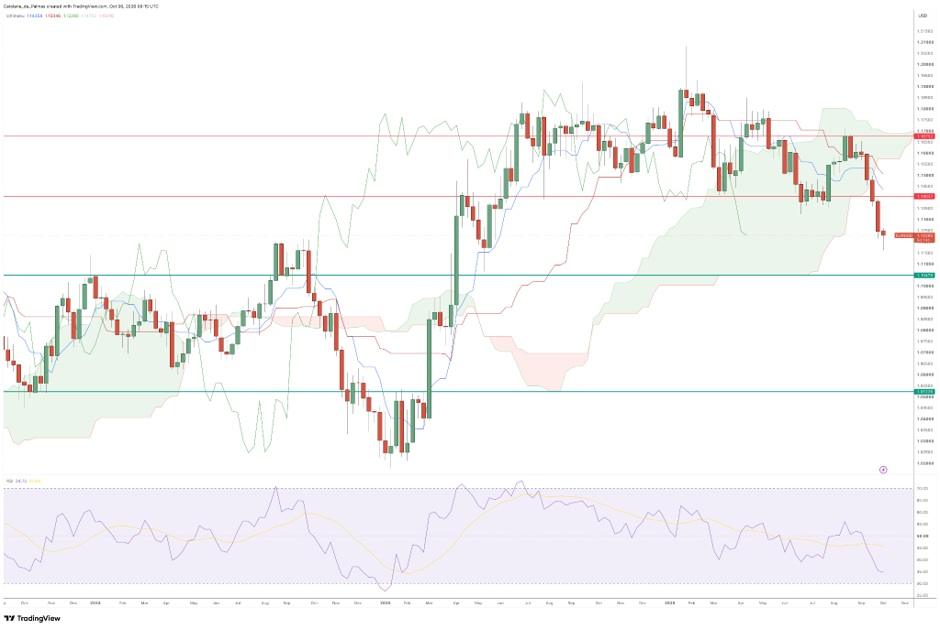
Weekly EUR/USD Chart – Source: TradingView
This does not mean that a new eurozone sovereign debt crisis is inevitable. The institutional architecture is stronger than during the 2010-2012 crisis, and the ECB has tools such as the Transmission Protection Instrument. But wider sovereign spreads can still tighten financial conditions and expose weaknesses in heavily indebted economies.
Germany faces a different challenge. Its debt position is stronger than France’s (65.8% of GDP in 2026 and 68% of GDP in 2027), but higher yields increase financing costs just as Europe is facing greater defence, energy and investment requirements. Across the euro area, the European Commission expects deficits to widen as higher interest expenditure, defence spending and measures designed to shield households and businesses from energy costs weigh on public finances.
Europe therefore faces a difficult policy combination: inflation is rising while growth remains relatively modest and fiscal space is limited.
Japan adds another source of global bond-market pressure
Japan is also becoming increasingly important for global bond markets.
The Bank of Japan raised its policy rate to 1.25% in September, the highest level since 1995, marking another step away from the ultra-loose monetary policy that defined Japan for decades. Rising wages, persistent inflation and higher import costs have given the central bank greater scope to normalise interest rates, while the weakness of the yen has added to domestic price pressures.
Japan’s 10-year government bond yield has also climbed to around 3.1%, a historically significant level for the Japanese market. This matters well beyond Japan because Japanese investors are major holders of overseas bonds.
As domestic yields become more attractive, the incentive to allocate capital to US and European debt can diminish. Continued monetary-policy normalisation could therefore contribute to changes in global capital flows and add another source of upward pressure on long-term yields.
Japan consequently represents another piece of the global bond-market adjustment. The US faces large financing requirements, Europe is dealing with fiscal and political vulnerabilities, while Japan is gradually moving away from its exceptionally low-rate environment.
Taken together, these developments suggest that higher bond yields are not simply a temporary market fluctuation. They reflect a broader repricing of the cost of capital across the global economy. The key question for investors is therefore what happens next: can markets absorb persistently higher yields, or could the bond-market adjustment eventually become a catalyst for a much broader correction? Let’s dive right in in Part 2 of this article.
Sources: Reuters, Yahoo Finance, The Wall Street Journal, European Commission, Eurostat, Federal Reserve, Bank of Japan, European Central Bank
The information provided does not constitute investment research. The material has not been prepared in accordance with the legal requirements designed to promote the independence of investment research and as such is to be considered to be a marketing communication.
All information has been prepared by ActivTrades (“AT”). The information does not contain a record of AT’s prices, or an offer of or solicitation for a transaction in any financial instrument. No representation or warranty is given as to the accuracy or completeness of this information.
Any material provided does not have regard to the specific investment objective and financial situation of any person who may receive it. Past performance is not a reliable indicator of future performance. AT provides an execution-only service. Consequently, any person acting on the information provided does so at their own risk. Forecasts are not guarantees. Rates may change. Political risk is unpredictable. Central bank actions may vary. Platforms’ tools do not guarantee success.