

Forex Marketing Ideas That Generate Valuable Traders

The following is a guest editorial courtesy of Charlotte Day, Creative Director at Contentworks Agency.
Forex brokers are no strangers to marketing. But are the marketing techniques they employ generating traders or just noise? The economics of trader acquisition are increasingly challenging. Competition for trader attention is driving up advertising costs, while high-value traders require more trust, research and engagement before they commit capital. The broker that gets the deposit is rarely the one a trader sees first but the one that builds credibility.
We’re sharing the strategies that help our brokers move beyond buying leads to start building a sustainable pipeline of valuable traders.
The Acquisition Money Trap
How much budget is being poured into short term acquisition and has your broker lost track of it? The economics of trader acquisition have become increasingly challenging because the most valuable clients, those with larger deposits, consistent trading activity and stronger lifetime value, are also the most expensive to acquire.
For high-net-worth and professional retail traders, customer acquisition costs typically range between $1,000 and $5,000 per funded client, depending on the region, acquisition channel, regulatory environment and level of competition. While these costs can be justified when measured against the long-term value of an active trader, the challenge is that acquisition is rarely a one-off investment.
A broker acquiring 100 high-value traders at an average acquisition cost of $3,000 per client represents an initial investment of $300,000 before factoring in retention, technology, compliance and operational costs. If acquisition efficiency declines by even a small percentage, the additional budget required to maintain growth can become significant. This creates what we call the acquisition money trap.
Another challenge is that high-value traders rarely convert after a single interaction. Before committing significant capital, they typically research multiple providers, compare trading conditions, assess regulatory credibility, review online sentiment and seek opinions from other traders through forums, communities and social channels.
The solution is not to eliminate paid acquisition, but to reduce dependence on it by developing marketing assets that compound over time. Brokers that invest in expert market analysis, educational resources, reputation management and thought leadership create multiple opportunities to engage traders before they are ready to open an account.
Now we’ve looked at the acquisition money trap, let us share some forex marketing ideas that generate traders.
Build Marketing Around Trading Intent, Not Search Volume
Many brokers still approach SEO as a traffic acquisition exercise, publishing endless articles explaining pips, leverage and currency pairs because these terms generate consistent search demand. They do, and educational content has an important role to play in forex marketing. But these searches are typically conducted by users in the earliest stages of research rather than those preparing to open an account.
More commercially valuable opportunities exist around moments of market intent.
Searches relating to Federal Reserve meetings, inflation releases, ECB policy decisions, Non-Farm Payrolls or geopolitical events often indicate that traders are actively preparing to make decisions. These audiences require market insight rather than introductory education, making them considerably more valuable from a HNW acquisition perspective.
Google’s emphasis on Experience, Expertise, Authoritativeness and Trust (E-E-A-T) has reinforced this shift. Financial services fall within Google’s “Your Money or Your Life” category, meaning authoritative analysis authored by market experts is increasingly favoured over generic content that exists on thousands of competing websites.
We frequently see FX firms producing generic marketing campaigns while investing very little in insightful content and proprietary market analysis. Yet it is often analyst-led content that attracts traders closest to making a funding decision because it addresses immediate market opportunities rather than general curiosity. AI search engines like ChatGPT, Claude and Gemini favour brokers who follow market trends and publish helpful content.
Research Has Become One of Marketing’s Most Valuable Assets
Many brokerage firms continue to treat research and marketing as separate functions. But market analysis has become one of the most effective forex marketing assets available.
Daily commentary, macroeconomic analysis and technical outlooks serve multiple commercial objectives simultaneously. They support search visibility, provide material for email campaigns, strengthen engagement on Twitter (X) and create opportunities for media coverage. All while establishing credibility with professional traders. Perhaps more importantly, they encourage habitual engagement.
Unlike promotional advertising, which relies on repeated media spend, valuable market analysis gives traders a reason to return voluntarily. Over time, this repeated exposure increases familiarity with the brand, an effect behavioural psychologists have consistently linked to higher levels of trust and preference.
For FX brands, this familiarity and trust can influence purchasing decisions long before a prospective client reaches the account registration page.
Region Matters When Acquiring High-Value Traders
Not all traders are equal, and geography plays a major role in determining both customer value and acquisition cost. A common mistake in forex marketing is treating global audiences as one market. In reality, trader behaviour, deposit capacity, regulatory expectations and lifetime value vary significantly between regions.
Brokers are often tempted by regions with low hanging fruit. That’s inexperienced individuals who can be easily influenced to making a deposit. But that’s short-term thinking that won’t be profitable over time. High-value traders are concentrated in markets with higher disposable income, stronger financial literacy and established investing cultures. These same regions are also the most competitive and expensive to target because major brokers are competing for the same audiences.
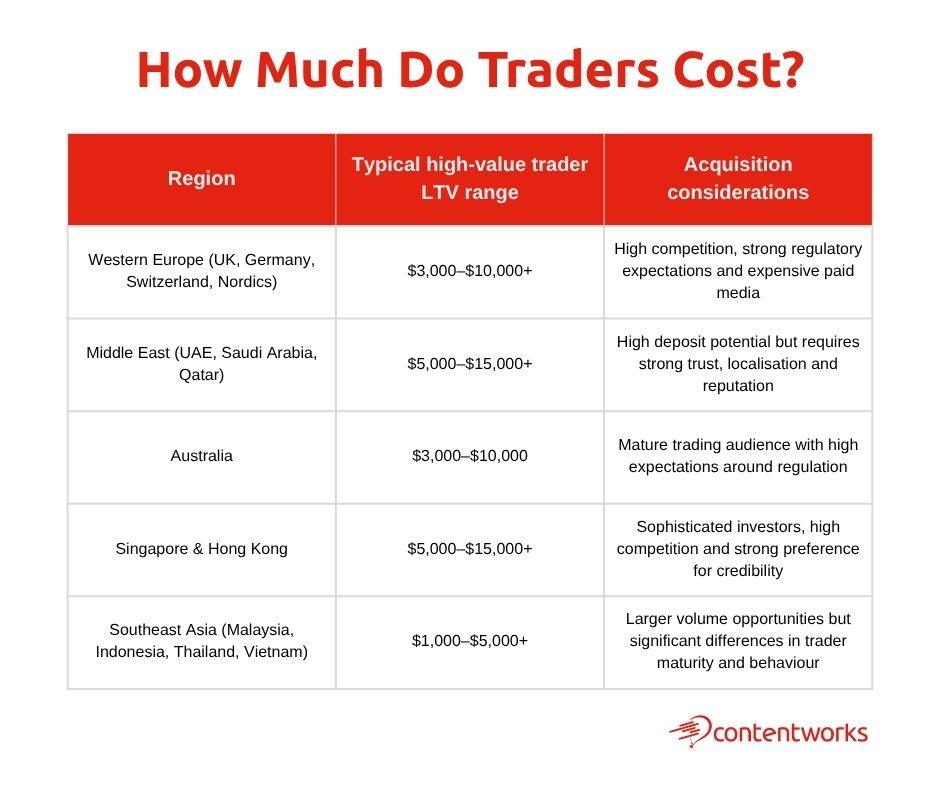
The regions with the highest potential lifetime value are often the regions where paid acquisition becomes most expensive. For example, targeting affluent traders in London, Dubai or Singapore through paid search can require significant investment because brokers are competing against established brands, affiliates, comparison platforms and financial advertisers with substantial budgets. A campaign may successfully generate clicks and registrations, but converting those prospects into funded, active traders requires a much deeper level of trust.
High-value audiences typically conduct more research before committing capital. They examine reputation, regulatory standing, expert content, reviews, market commentary and community sentiment. In these markets, credibility is a conversion requirement. This is why successful regional acquisition strategies cannot rely exclusively on paid advertising.
Reputation Matters More Than Pricing For Professional Traders
Most broker websites communicate the same core value propositions: competitive spreads, advanced trading platforms, fast execution and award-winning customer support. While these features remain important, they have increasingly become industry expectations rather than meaningful differentiators. In a competitive market, they rarely provide enough distinction to influence a trader’s final decision.
Increasingly, professional traders evaluate brokers through reputation. Before opening an account, they research beyond a company’s own website, reviewing independent platforms, trader forums, regulatory platforms, Reddit communities, YouTube commentary and online reviews to understand how a broker is perceived by the wider market. The question is no longer whether a broker claims to offer a strong service, but whether independent sources reinforce that message. Negative reviews, unanswered complaints or limited brand visibility can create friction, even when the underlying product offering is competitive.
At Contentworks Agency, we work with brokers to strengthen their reputation as a long-term growth asset rather than a reactive communications exercise. By understanding how traders perceive a brand, identifying reputation gaps and creating content that reinforces trust signals, brokers can improve confidence throughout the customer journey.
Refocus On HNW & LTV
High Net Worth (HNW) and Life Time Value (LTV) are marketing terms we need to focus on. As acquisition costs continue to rise and competition for trader attention intensifies, relying solely on paid media is becoming an increasingly expensive growth strategy. The brokers achieving sustainable results are shifting away from chasing lead volume and focusing instead on attracting traders with genuine intent, stronger engagement and higher lifetime value. The goal is not to generate the most registrations. It is to build an evergreen pipeline of quality traders through trust, expertise and meaningful engagement.
Book a Zoom call with our team to discuss your forex marketing strategy.