

Retail investors rank China ahead of US in global AI race, eToro survey reveals

Retail investors worldwide rank China ahead of the United States as the country best positioned to lead the global AI race, according to the latest quarterly Retail Investor Beat from online broker eToro.
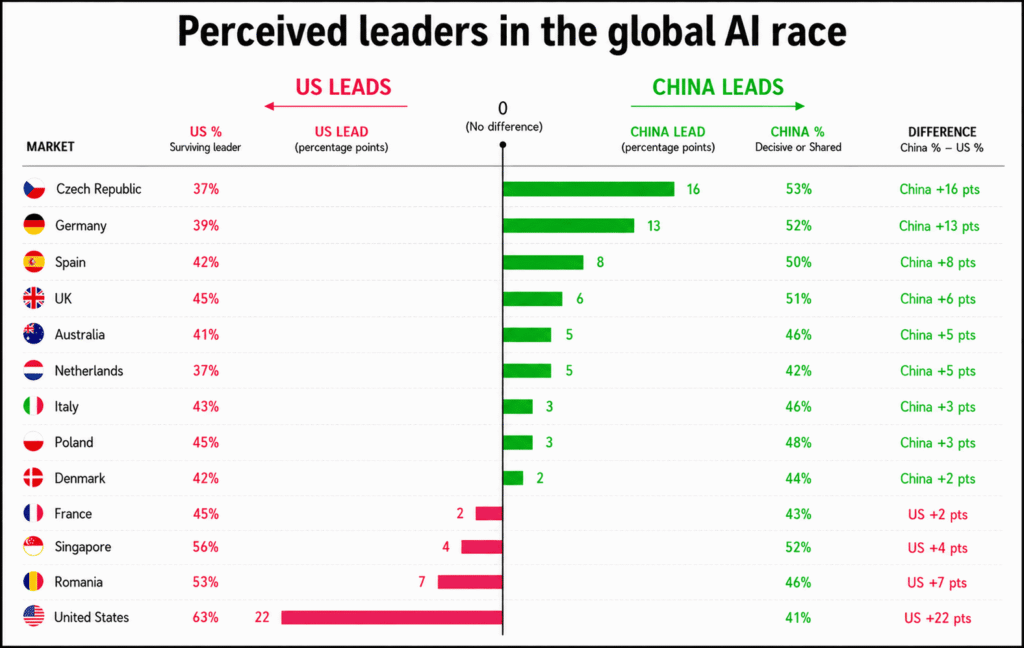
In a survey of 11,000 retail investors across 13 countries, 47% picked China against 46% for the US, almost a statistical dead heat which seemed unthinkable two years ago, and a sign that investors increasingly see AI as a global contest for technological and economic leadership, not just a US stock market theme.
eToro’s Global Market Strategist, Lale Akoner, comments:
“US mega-cap platforms and chipmakers remain at the heart of the AI trade, from Nvidia and Microsoft to Alphabet and Amazon. But investors are also recognising that China has built a powerful AI ecosystem of its own, with companies such as Alibaba, Tencent and Baidu, as well as scale in cloud infrastructure, advanced manufacturing and consumer applications. That helps explain why retail investors can remain exposed to the US while still seeing China as a credible contender for AI leadership.”
The headline figure, which combines responses from all 13 countries, masks a clear regional divide. In 9 of 13 countries, more retail investors selected China than the US as best positioned to lead the global AI race, including the UK, Germany, Spain, Italy, Poland, Denmark, the Netherlands, Czech Republic and Australia.
The US is the clearest counterpoint. Among US retail investors, 63% say the United States is best positioned to lead the global AI race, compared with 41% who select China.
China’s perceived AI lead comes as investors are also reassessing long-term market opportunities. Since Q4 2024, the share of retail investors who believe China will generate the strongest long-term stock-market returns has risen from 24% to 29%, while the share selecting the US has fallen from 45% to 35%. Over the same period, the US lead over China has narrowed from 21 percentage points to just 6.
The shift is also visible in portfolio exposure. The proportion of retail investors with exposure to Chinese stock markets has risen from 7% in Q2 2024 to 12% in Q2 2026, meaning exposure has almost doubled over the past two years.
Lale Akoner said:
“Retail investors increasingly see China not just as a tactical AI story, but as a longer-term market opportunity. The US remains the anchor of global equity portfolios, but its perceived lead on future returns has narrowed sharply, while exposure to Chinese equities has almost doubled from a low base.
“That suggests investors are beginning to take a more balanced view of where future growth may come from. AI may be the catalyst, but the broader story is that China is becoming more credible as a long-term allocation within global portfolios.”
Even as conviction in China grows, optimism about AI stock prices is cooling. The share of investors expecting AI-related stocks to rise has fallen from 55% in Q2 2025 to 44% a year later, while the share expecting them to fall has climbed from 11% to 17%.
Despite this moderation, investors continue to see opportunity across the AI value chain. When asked which part of the AI market is most likely to produce the strongest investment returns over the next five years, 31% selected large technology platforms integrating AI, followed by 29% who selected specialised AI-first companies and 28% who selected semiconductor and chipmaker firms.
Lale Akoner commented:
“The moderation in AI stock-price expectations shows investors are not simply buying into broad AI hype. They still see AI as a major structural theme, but they are becoming more selective, looking across platforms, AI-first companies, semiconductors and infrastructure to identify where the next phase of returns may be generated.”