

CFD Brokers vs Prop Firms: Why the Same Marketing Strategy Fails

The following is a guest editorial courtesy of Elena Kupriianova, who provides an advisory practice for CEOs who want marketing accountable to revenue. Elena was previously CMO of Spotware Systems and held senior marketing roles at CFI, Capital.com, and Exness.
At first glance, CFD brokers and retail prop firms look like close cousins.
They compete for overlapping traders, advertise the same markets, use familiar trading platforms, and fill their campaigns with the same charts, candles, and trading screens.
That resemblance creates one of the industry’s most persistent marketing mistakes: taking a broker strategy, changing the logo, adding a funded-account headline, and calling it a value proposition.
A CFD broker and a retail prop firm may operate in the same trading ecosystem, but they sell fundamentally different products.
A CFD broker sells access to markets. A retail prop firm sells a test: demonstrate that you can trade within its rules, and you may qualify for a larger allocation and payouts.
That difference changes the user journey and, hence, the message, funnel, content strategy, credibility signals, affiliate model, and brand.
The Trust Contract Is Different
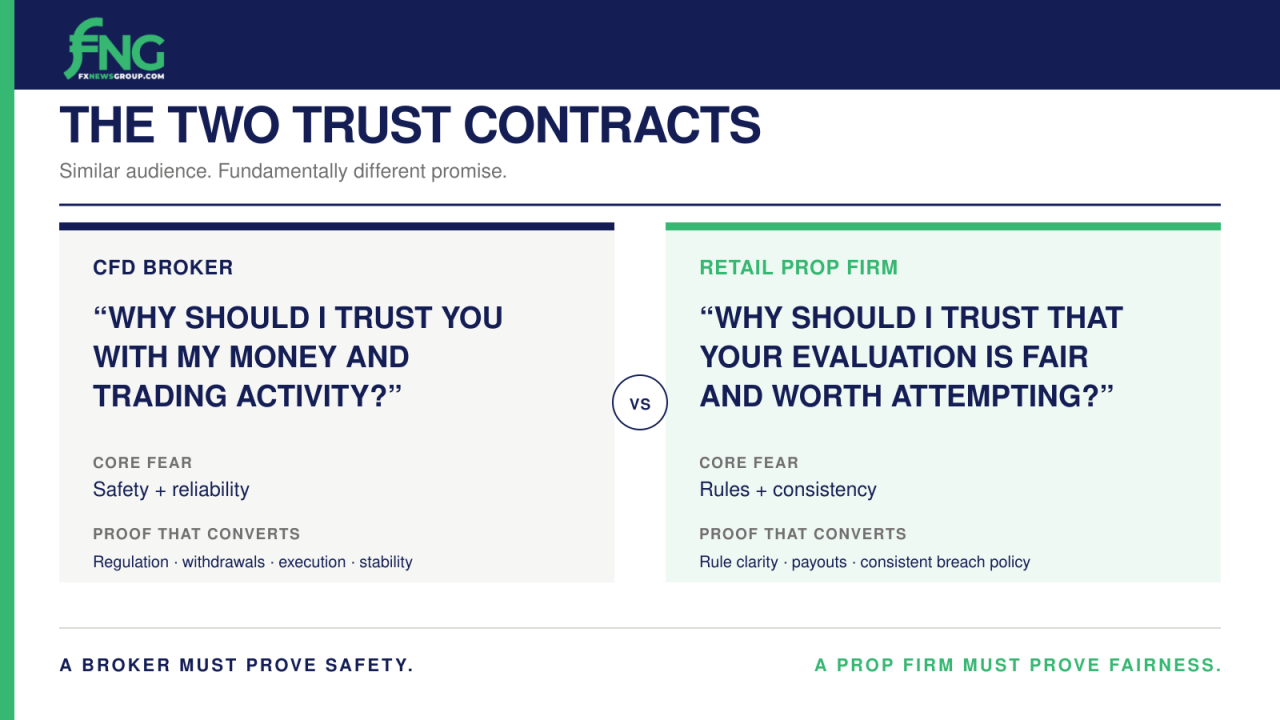
A CFD broker asks a client to deposit their own money, trade through its infrastructure, and trust its execution, pricing, withdrawals, platform, and support.
That is a significant commitment.
Before depositing, the client is asking:
- Is the company properly regulated?
- Will withdrawals be processed reliably?
- Are the spreads and commissions transparent?
- Is the platform stable?
- What happens when I need support?
- Which legal entity will hold my account?
Broker marketing therefore has to reduce financial and operational anxiety.
A retail prop firm asks for a different commitment entirely: pay an evaluation fee, follow a defined set of rules, meet the performance conditions, and potentially qualify for payouts.
The trader is not primarily buying market access. They are buying an opportunity to prove themselves.
It is a shot at a larger trading allocation, recognition, progression, and, eventually, payouts. Within retail trading culture, becoming “funded” can sound dangerously close to being knighted.
But the fear sitting underneath that ambition is different.
The prospective client is asking:
- Are the rules fair?
- Will the rules change after I purchase?
- How exactly is drawdown calculated?
- Are payouts real and reliable?
- Is the evaluation designed to identify disciplined traders or simply generate challenge fees?
- Can one poorly explained technicality invalidate the account?
A broker must prove safety and reliability. A prop firm must prove fairness and consistency.
Different Funnels Require Different Marketing Dashboards
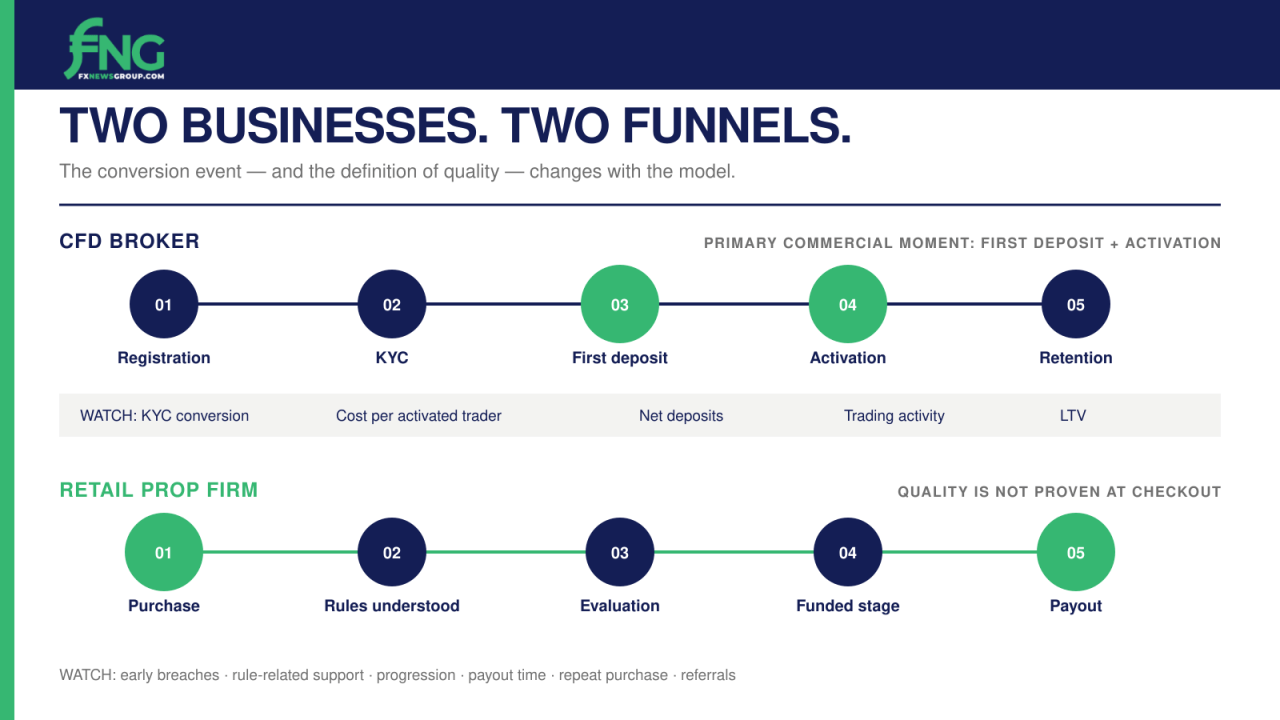
The typical CFD broker funnel looks something like this:
Awareness → Registration → KYC → First Deposit → First Trade → Repeat Trading → Retention → Reactivation
The decisive commercial moments are usually KYC completion, first-time deposit, and trading activation.
The marketing question is whether the broker can acquire suitable clients who deposit, trade, and remain active while maintaining healthy unit economics, compliant acquisition practices, and sustainable client outcomes.
A retail prop funnel follows a different sequence:
Attention → Belief → Challenge Purchase → Rule Understanding → Evaluation → Funded Stage → Payout → Repeat Purchase, Scaling or Referral
The first commercial conversion is the challenge purchase. But the quality of that conversion cannot be judged at checkout.
Did the trader understand the rules? How quickly did they breach? Why did they breach? Did they contact support? Did they progress? Were they paid? Did they purchase again or recommend the firm?
This means the two businesses should not be measured using the same acquisition dashboard.
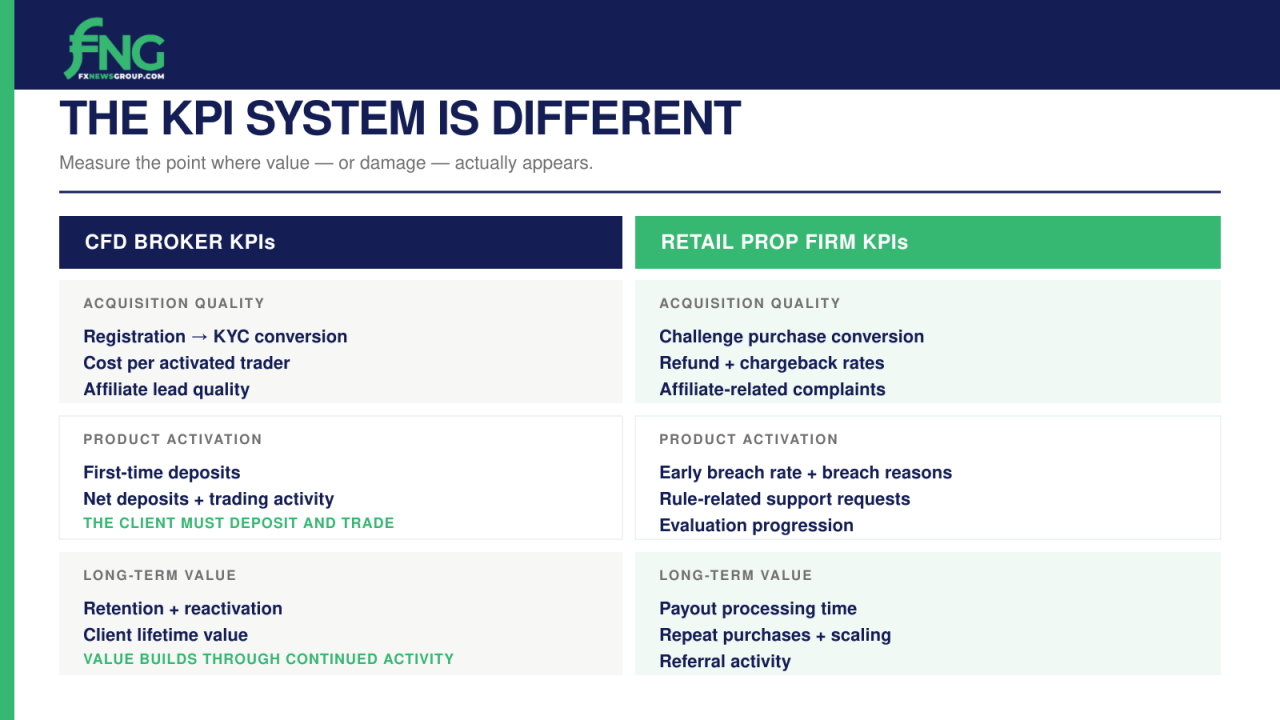
A broker will typically focus on metrics such as:
- Registration-to-KYC conversion
- First-time deposits
- Cost per activated trader
- Net deposits and trading activity
- Retention and reactivation
- Client lifetime value
- Affiliate lead quality
A prop firm should also monitor:
- Challenge purchase conversion
- Refund and chargeback rates
- Early breach rates and breach reasons
- Rule-related support requests
- Evaluation progression
- Payout processing time
- Repeat purchases and scaling
- Referral activity
- Affiliate-related complaints
A broker can generate thousands of inexpensive registrations that never deposit. A prop firm can sell large numbers of challenges while creating an equally large population of confused, frustrated, and extremely vocal former customers.
Neither is growth.
Credibility Is Built Differently
For CFD brokers, the strongest credibility signals usually include:
- Regulatory status and clear legal entities
- A credible operating history
- Reliable withdrawals
- Execution quality
- Transparent spreads, commissions and other costs
- Platform stability
- Client-fund protections
- Responsive customer support
- Professional market research and education
- Clear and compliant communications
For retail prop firms, the strongest signals are different:
- Clear evaluation rules
- Worked examples of drawdown calculations
- Transparent breach policies
- Consistent application of the rules
- Reliable and verifiable payout evidence
- Real trader case studies
- Clear payout schedules
- Transparent scaling conditions
- Visible and accountable leadership
- A trusted trader community
This is where many prop firms, unfortunately, undermine their own marketing.
They aggressively promote the headline allocation while treating the conditions attached to it as legal small print.
“Trade our $200,000 account” is an attractive campaign message. But experienced traders immediately want to know whether the drawdown is static or trailing, when it is calculated, what happens during news, how consistency rules are applied, when payouts become available, and what can invalidate the account.
For a prop firm, the rules page is one of the most important conversion pages on the website.
The trader is not only asking, “Can I succeed?”
They are also asking, “If I fail, will I have failed fairly?”
Broker Content Should Support Informed Trading
CFD broker content should help clients make better-informed decisions about the markets, products, and platforms they use.
That includes content covering:
- Market context and economic events
- Risk management
- Trading costs
- Platform tools and order types
- Product mechanics
- Volatility and liquidity
- Responsible use of leverage
- Portfolio construction
- Trading psychology
- Sustainable trading habits
The objective is not simply to acquire a registration. It is to attract suitable clients, activate them properly, and build a longer, healthier relationship.
This is commercially important as well as responsible. Regulators are paying increasing attention to financial promotions, fair value, incentives, suitability, and client outcomes.
A serious brokerage cannot build its long-term brand entirely around maximum leverage, a football sponsorship, and “lambo-gold bars-hot chicas” vibes.
It may work briefly. “Briefly” is doing a lot of work in that sentence.
Prop Firm Content Should Build Rule Mastery and Discipline
Prop-firm content has a different job.
Generic “What is forex?” material will not address the most important barriers preventing a trader from purchasing or completing an evaluation.
The content needs to explain:
- How drawdown rules work
- How to approach an evaluation without gambling
- How to manage risk under time and performance pressure
- Why traders breach accounts
- What consistency means in practice
- How news-trading restrictions are applied
- How payouts are calculated and processed
- How funded traders manage their psychology
- How scaling works
- Which behaviours can invalidate an account
The best prop content sits at the intersection of education, proof, and community.
It should communicate: this is difficult, these are the rules, this is how to approach the evaluation responsibly, and these are real examples of traders who progressed through the process.
That honesty is conversion, despite what many prop firms might think.
Traders already assume there may be traps hidden somewhere in the model. A brand willing to say “This is difficult, but fair” can build more durable trust than one promising quitting your 9-5 by Friday.
Channel Strategy and Affiliate Governance Must Also Change
Retail prop firms tend to over-index on creator-led and community channels such as YouTube, Discord, Telegram, TikTok and trader communities.
That makes sense. The proposition is emotional, competitive, social, and naturally suited to trader journeys, evaluation diaries, educational streams, and payout stories.
Broker distribution is typically broader and more structured, combining performance advertising, search, affiliates, introducing brokers, market content, partnerships, PR, and regional acquisition teams.
The regulatory exposure is also different.
Broker affiliates and IBs operate within a regulated acquisition environment (at least they should). Claims, landing pages, risk warnings, regional restrictions, incentives, and lead sources must all be governed carefully.
Prop-firm affiliates are often creators, educators, streamers, and community operators. They can generate powerful trader-to-trader trust, but they can also turn an evaluation into something resembling a lottery ticket.
When that happens, the brand inherits the damage.
A prop firm cannot distance itself from misleading affiliate promises while continuing to collect the resulting challenge purchases.
The smarter approach is to treat affiliates as distributed brand ambassadors rather than traffic taps. Give them approved claims, educational angles, clear disclosure requirements, and firm boundaries around payout representations and urgency.
The Brands Should Occupy Different Territory
A CFD broker brand should feel stable, capable, transparent, and trustworthy (and that doesn’t mean writing “you can trust us”, or “built on trust” and similar bs on your homepage). The firm can be energetic and modern, but it still needs institutional credibility.
Its core promise is:
“We are a reliable partner for your trading activity.”
A retail prop brand should feel ambitious, challenging, transparent, and community-driven. It should avoid both childish gamification and fake motivation.
Its core promise is:
“This is a serious test. If you trade seriously and meet the conditions, we will uphold our side of the agreement.”
One brand is primarily built around institutional trust. The other is built around earned community approval.
This distinction becomes especially important when a brokerage group launches a prop proposition.
The two businesses may share technology, operational resources, and even a parent brand. But they should not automatically share everything else.
Putting a different logo on the same marketing machine does not create a different strategy.
The Most Expensive Mistake Is Becoming Interchangeable
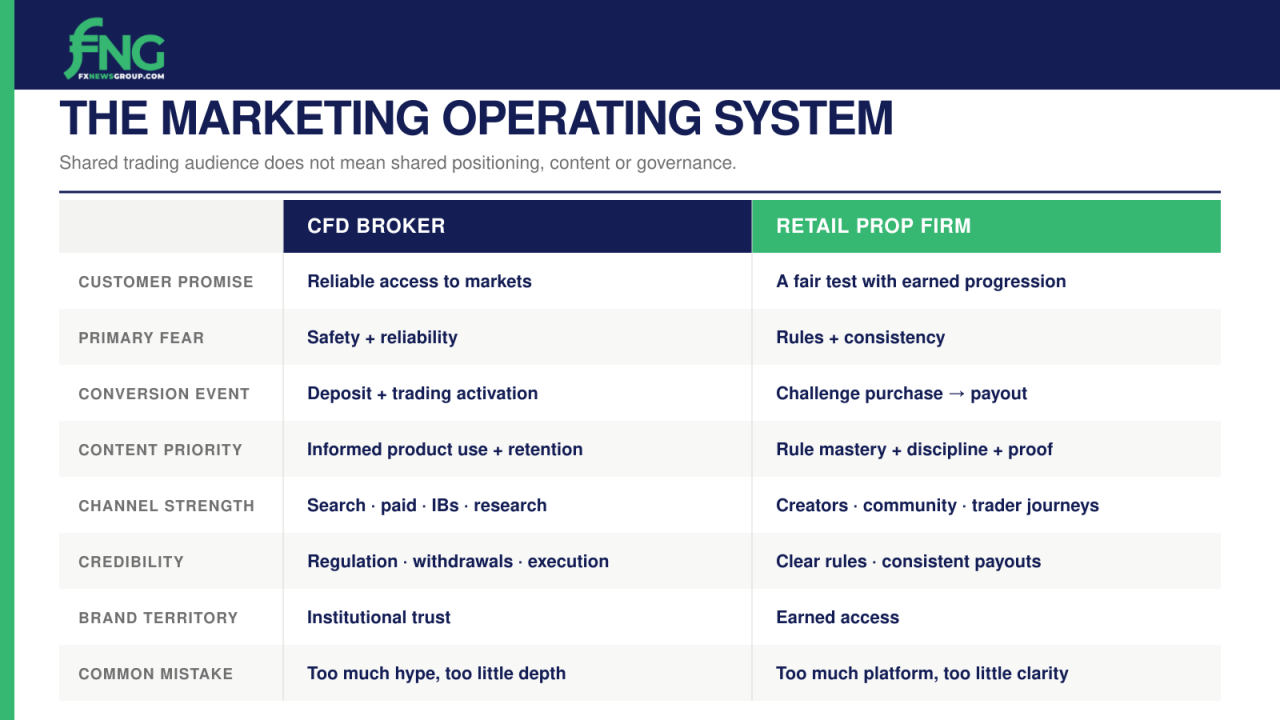
The biggest marketing mistake CFD brokers make is behaving like prop firms: excessive hype, artificial urgency, influencer-led promises, and too little attention to product depth, regulation, and trust.
The biggest mistake prop firms make is behaving like brokers: generic market-access language, endless platform features, and too little emphasis on evaluation psychology, rule clarity, payout credibility, and community proof.
Both approaches create brands that sound interchangeable.
In an industry where competitors already offer similar markets, platforms, and trading interfaces, “empowering traders globally” is not a positioning. It is placeholder copy with a media budget.
The distinction is straightforward.
CFD broker marketing must answer:
“Why should I trust you with my money and trading activity?”
Retail prop-firm marketing must answer:
“Why should I trust that your evaluation is fair and worth attempting?”
Different question. Different funnel. Different proof. Different brand.
There may be substantial overlap between the audiences, but these are not the same marketing machines.
The companies that understand the difference will not merely acquire more traders. They will acquire better-suited traders, create fewer avoidable disputes, and build brands capable of surviving after the latest acquisition campaign stops running.