
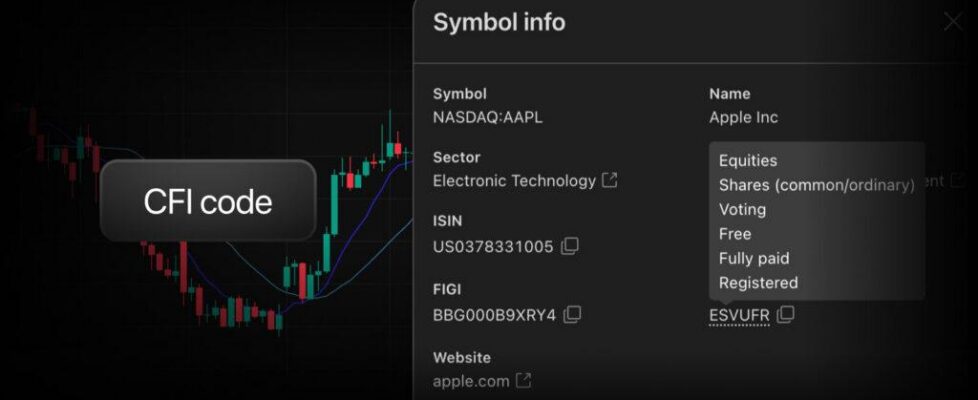
TradingView makes CFI codes available to its users

TradingView has made CFI codes – a global, standardized way to describe what a financial instrument actually is – available for stocks, bonds, and funds.
A CFI code (ISO 10962) is a six-letter classifier used across market infrastructure, reference data providers, and professional data environments. It covers equities, debt, and collective investment vehicles under one unified taxonomy.
Each of the six letters signifies something:
- 1st letter — top-level category: E for Equities, D for Debt, C for Collective Investment Vehicles
- 2nd letter — group within that category (common shares, preferred shares, bonds, medium-term notes, convertible bonds, ETFs, standard funds, …)
- 3rd-6th letters — structural attributes that apply to that group: voting rights and form for shares, interest type and redemption terms for bonds, distribution policy and underlying assets for funds.
CFI codes are now visible across the main places where you explore instruments:
- Symbol pages — in the About section, next to the main identifiers. Hover over the code, and TradingView will show a full breakdown of what each letter means. The explanation is localized into all supported languages, so the code is readable, not just raw reference data.
- Details — under Profile information, alongside other key metadata.
- Charts — in Symbol Info, available without leaving your chart.
- Mobile apps — in the About section, consistent with the desktop experience.
In the Stock, Bond, and ETF Screeners, CFI codes are available as columns and filters. That means you can actively use them to narrow down the instrument universe instead of just reading them.
For anyone who compares large sets of instruments — or builds watchlists with specific structural criteria — this turns a vague “type” field into a precise, standardized tool.
TradingView notes that this release is about improving the quality and usability of reference data on TradingView.
CFI codes help bridge the gap between TradingView and the way instruments are classified in broader market infrastructure. They add context, improve comparability, and make Screeners more precise for users who want a more structured way to work with instruments.