
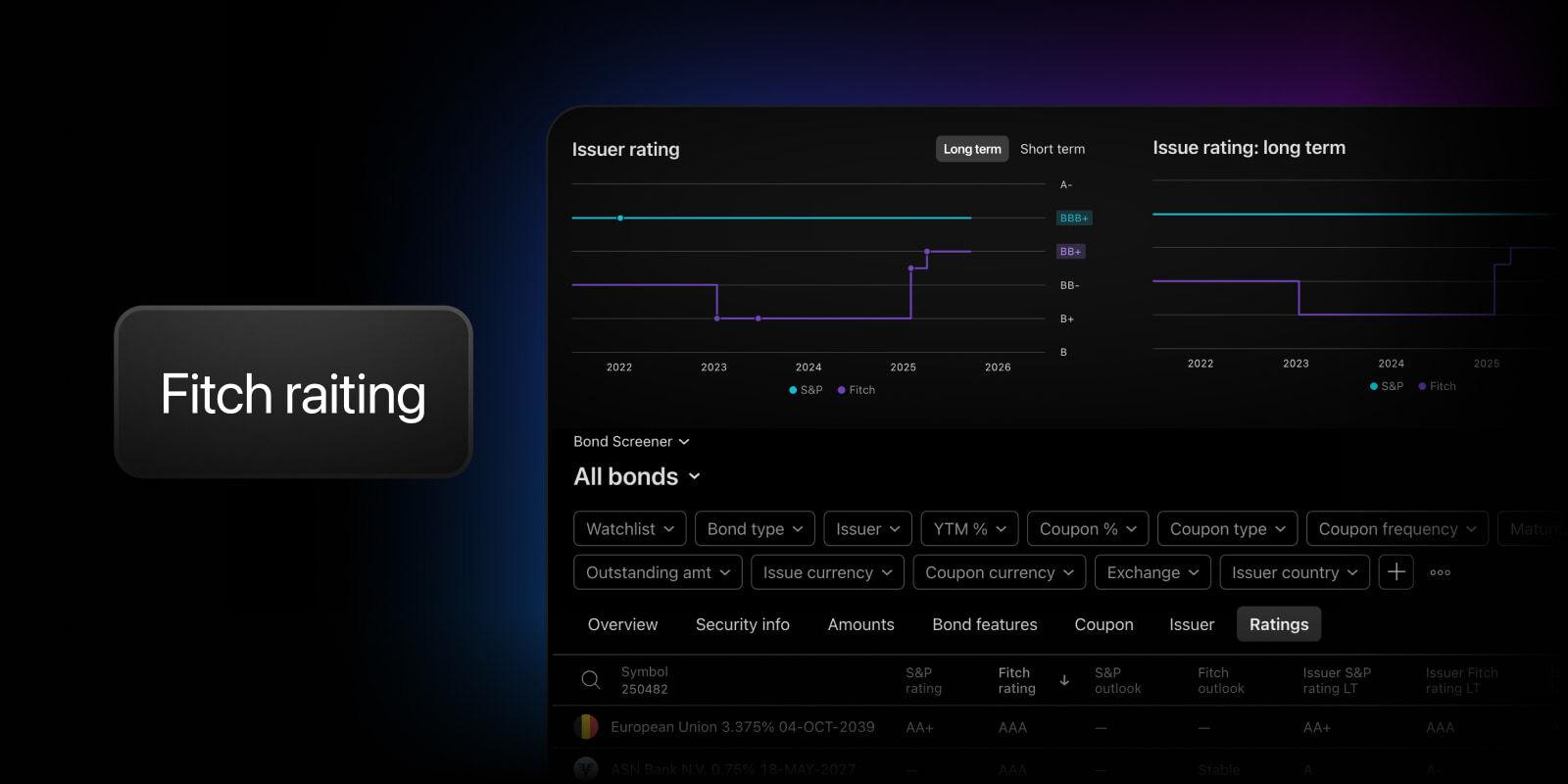
TradingView adds Fitch credit ratings

TradingView has added Fitch credit ratings – one of the “big three” global agencies.
With this integration, TradingView users can now see and compare Fitch and S&P ratings side by side, directly in their workflow.
With Fitch now integrated, you can:
- Compare issuer and bond-level ratings across agencies
- Spot differences in credit assessment
- Track how ratings evolve over time
- Access all the information on TradingView instead of switching tools.
Fitch ratings are now part of natural workflow — when you open a bond page, you immediately see its issue rating, now enriched with both Fitch and S&P.
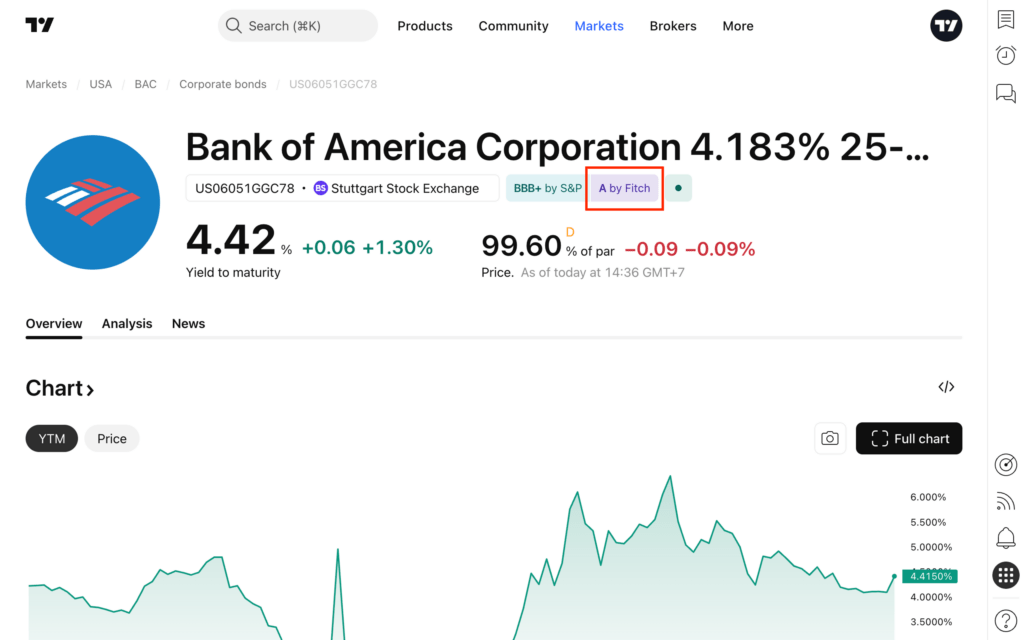
From there, you can dive deeper. Navigate to the Analysis tab to access historical graphs, where you can track how ratings change over time and, more importantly, how agencies may diverge at different points. A downgrade from one agency while another holds steady can be an early signal worth paying attention to.
Key rating information is also available in the Details panel below your watchlist. There, the issue rating widget now includes Fitch alongside S&P with historical values for quick reference — so you can assess credit risk without leaving your chart.
Issuer ratings are also available on the stock symbol page of the issuing company.
On the Bonds tab, you can see the Issuer rating alongside a table of the company’s bonds, which includes Issue ratings from both Fitch and S&P.
This allows you to view the company’s overall credit profile together with the ratings of its individual debt instruments in one place.
As you screen the market, ratings are embedded in your workflow. In the Bond Screener, issue ratings from Fitch and S&P are displayed by default on the Overview tab, so you can immediately see and compare credit quality without additional setup.
Moreover, there you’ll find a dedicated Ratings tab, with key corresponding fields already grouped together, including data from both Fitch and S&P. This gives you a ready-to-use view for comparing credit quality across bonds.
You can further customize your workflow by adding rating-based filters, selecting the fields you need, and sorting bonds by any rating column — making it easy to identify higher- or lower-quality issuers, spot discrepancies between agencies, and surface potential opportunities.
Not every bond will have a Fitch rating. Issuers decide which agencies rate their debt.
That means:
- Some bonds will have only S&P data
- Some only Fitch
- And some have both.
When both are available, differences between them are not a problem, they are a signal.