

Can Samsung and SK Hynix Keep Supporting KOSPI’s Explosive Rise?

The KOSPI is currently the undisputed leader of the global equity markets. Since the beginning of 2026, the index has surged by more than 88%, building on an already historic 75% gain in 2025 (its strongest annual performance since 1999). The Korean index is now up over 200% in a single year and has quadrupled (+300%) over the last decade.
This “vertical” ascent has been fueled almost entirely by the global AI revolution, which has turned South Korean hardware giants like Samsung Electronics and SK Hynix into $1 trillion pillars of the global supply chain. Despite the “parabolic” nature of the move, Wall Street remains surprisingly bullish. This week, JPMorgan Chase & Co. upgraded its KOSPI target, lifting its bull-case scenario to 10,000 points.
SK Hynix Nears $1 Trillion Milestone Following Samsung’s Lead: A New Era for Seoul?
The recent rally in South Korea’s equity market has become increasingly concentrated around a handful of semiconductor giants, with Samsung Electronics and SK Hynix emerging as the primary engines behind the surge in the KOSPI. Their explosive gains underline how closely the Korean market is now tied to the global artificial intelligence boom and the race for advanced memory chips.
The scale of their influence on the market is difficult to overstate. Samsung Electronics and SK Hynix accounted for nearly 40% of the KOSPI’s gains last year, highlighting how dependent South Korean equities have become on the semiconductor cycle. More broadly, the technology and industrial sectors generated around 70% of the returns in the MSCI Korea Index in 2025, reinforcing the idea that Korea’s market leadership is increasingly driven by AI infrastructure demand and the country’s advanced manufacturing ecosystem.
Memory-chip companies alone now represent roughly half of the weighting in Korea’s benchmark equity index and have contributed approximately 70% of the gains in 2026 so far. As a result, the KOSPI has transformed into a leveraged play on the expansion of artificial intelligence, cloud computing, and data-center investment worldwide.
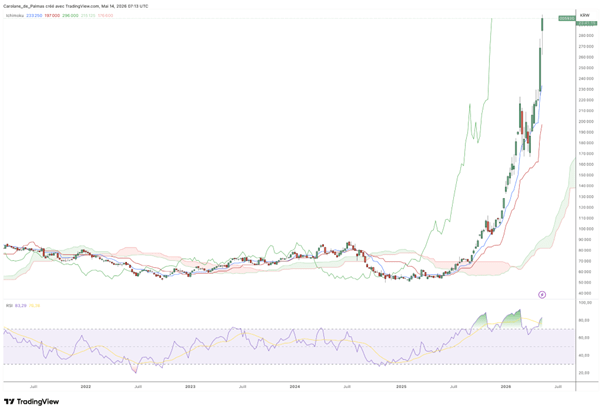
Weeky Samsung Electronics Chart – Source: TradingView
At the center of this rally stands Samsung Electronics, the world’s largest memory-chip producer. On May 6, 2026, the tech giant made history as its valuation surged past 1,500 trillion won ($1.03 trillion). This milestone solidifies Samsung’s position as a global titan, making it only the second Asian company—after TSMC—to ever break the $1 trillion market cap barrier.
Investor enthusiasm has been fueled by expectations that Samsung will remain one of the biggest beneficiaries of the AI-driven semiconductor cycle. Demand for advanced DRAM and NAND memory chips continues to accelerate as hyperscalers and cloud providers increase spending on AI servers and high-performance computing infrastructure. Samsung’s vertically integrated business model, global scale, and leadership in memory manufacturing have positioned the company at the core of this structural growth trend.
The stock’s performance reflects that optimism with Samsung Electronics shares having surged more than 145% since the start of the year (and they are up over 420% on a 12-month basis). On Thursday, May 14, the stock reached a fresh all-time high, extending one of the strongest rallies in the company’s history.
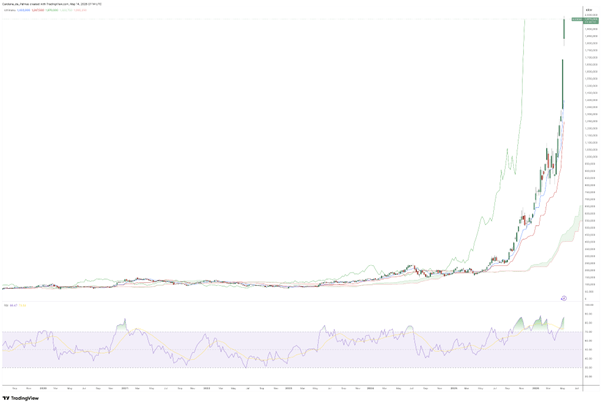
Weeky SK Hynix Chart – Source: TradingView
Meanwhile, SK Hynix has emerged as perhaps the purest AI play within the Korean equity market. The company is now approaching the $1 trillion market capitalization threshold after an extraordinary rally fueled by booming demand for high-bandwidth memory (HBM) chips, a critical component used in AI accelerators and advanced AI servers.
SK Hynix shares have climbed more than 200% this year, following an already remarkable 274% gain in 2025. The company has become one of the largest suppliers of HBM chips to AI-focused semiconductor firms, placing it at the center of the global generative AI investment wave. Beyond HBM, demand for conventional memory chips has also improved significantly as the broader semiconductor cycle recovers.
The rise of SK Hynix is particularly significant for South Korea’s financial markets. Should it join Samsung Electronics in the trillion-dollar club, South Korea would distinguish itself as the first nation outside the United States to boast multiple corporations with a valuation of $1 trillion or more. SK Hynix is already closing in on the market valuations of major American giants such as Walmart and Berkshire Hathaway, illustrating the scale of investor confidence in the long-term growth potential of AI-related semiconductor demand.
Can the KOSPI’s AI-Fueled Rally Go Even Further?
The record-breaking performances of Samsung Electronics, SK Hynix and other semiconductor leaders have firmly established South Korea as one of the biggest beneficiaries of the global AI boom. Their explosive earnings growth and dominant role in the artificial intelligence supply chain have transformed the KOSPI index into the best-performing major equity index in the world since the start of 2025.
Foreign capital has poured aggressively into Korean equities, particularly semiconductor names, driving the KOSPI into a near-vertical ascent toward successive record highs. The rally has become so powerful that major Wall Street institutions continue to revise their forecasts upward.
JPMorgan Chase & Co. has just hiked its KOSPI targets for the second time in a mere month thanks to surging semiconductor fundamentals, robust governance reforms, and a quickening pace in industrial growth (see our previous article for more). The bank now sees a base-case scenario of 9,000 points and a bullish scenario of 10,000 points. Goldman Sachs Group Inc. has also upgraded its outlook last week, pointing to what is described as the strongest earnings momentum in Asia.
For now, the bullish scenario seems to remain intact. Memory-chip demand continues to surge, AI infrastructure spending is still accelerating globally, and investors remain convinced that Korean semiconductor companies sit at the center of the next technological revolution. Strategists seem to increasingly argue that the market’s fundamentals still support further upside rather than signaling the end of the cycle. Yet, signs of nervousness are also starting to emerge.
The rally has become increasingly narrow and concentrated around a small group of AI-linked megacaps, making the broader market far more vulnerable to any slowdown in semiconductor momentum. The KOSPI has spent much of the month in overbought territory based on the daily RSI indicator, while positioning in Korean chipmakers has become one of the most crowded trades in global markets according to Steve Brice, Standard Chartered’s global chief investment officer.
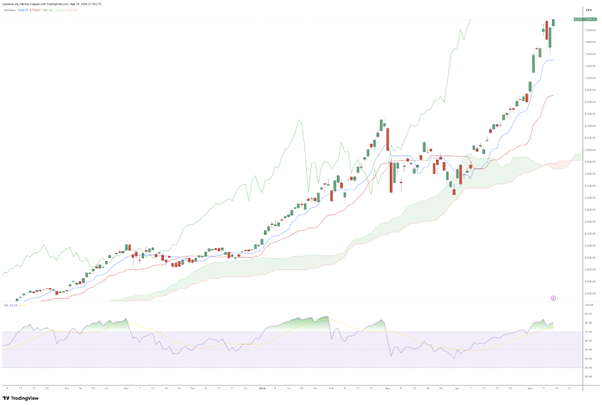
Daily KOSPI Chart – Source: TradingView
That concentration risk is being amplified by a growing sense of FOMO surrounding AI equities. Investors who missed earlier gains are likley continuing to chase momentum higher, reinforcing a self-sustaining cycle of inflows into the same handful of semiconductor names. The result is a market structure that appears extremely strong on the surface but increasingly fragile underneath, with global equities becoming dangerously dependent on a very small cluster of AI leaders to sustain broader market optimism.
At the same time, a new risk is beginning to emerge within the AI supercycle itself: governments are increasingly viewing artificial intelligence not simply as a source of innovation and productivity, but as a strategic and political resource tied to national power, industrial policy and economic influence. That shift could eventually lead to tighter regulations, export controls, taxation pressures or geopolitical competition over AI-related profits and supply chains.
Some strategists are already warning that the pace of the rally may be difficult to sustain in the short term. Standard Chartered recently downgraded semiconductors to neutral from overweight. Brice warned that a short-term correction would not be surprising given the scale and speed of recent gains.
For now, however, the AI trade continues to dominate global markets, and South Korea remains one of its clearest expressions. As long as demand for AI infrastructure keeps expanding, the KOSPI could continue pushing higher. But the more concentrated the rally becomes, the more sensitive the market may ultimately prove to shifts in sentiment, policy or the semiconductor cycle itself.
Sources: Yahoo Finance, Reuters, Bloomberg, Investing
The information provided does not constitute investment research. The material has not been prepared in accordance with the legal requirements designed to promote the independence of investment research and as such is to be considered to be a marketing communication.
All information has been prepared by ActivTrades (“AT”). The information does not contain a record of AT’s prices, or an offer of or solicitation for a transaction in any financial instrument. No representation or warranty is given as to the accuracy or completeness of this information.
Any material provided does not have regard to the specific investment objective and financial situation of any person who may receive it. Past performance is not a reliable indicator of future performance. AT provides an execution-only service. Consequently, any person acting on the information provided does so at their own risk. Forecasts are not guarantees. Rates may change. Political risk is unpredictable. Central bank actions may vary. Platforms’ tools do not guarantee success.