

Bitcoin ETF Inflows, Regulatory Clarity, and Price Structure: Where Are Traders Standing Now?

The following is a guest editorial courtesy of Carolane de Palmas, Markets Analyst at Retail FX and CFDs broker ActivTrades.
Over the past two months, U.S.-listed spot Bitcoin ETFs have recorded approximately $3.29 billion in net inflows according to SoSoValue, reversing a rather negative trend that dominated since late 2025. While this rebound appears encouraging, traders and investors might be wondering if the broader institutional context will be enough to support Bitcoin. What other factors are influencing the cryptocurrency? What’s next for Bitcoin? Let’s take a closer look:
Understanding ETF Flows as a Trading Signal
For traders, ETF inflows serve as more than a passive metric of market sentiment—they represent a direct proxy for institutional capital movement and liquidity conditions. Unlike retail-driven flows that react impulsively to price action, institutional ETF allocations tend to be larger, more strategic, and driven by longer-term conviction. This distinction matters significantly when assessing trend sustainability and identifying periods of genuine strength versus fleeting rallies.
Since their launch in January 2024, U.S. Bitcoin ETFs have accumulated $58.72 billion in cumulative inflows. This figure sits just below the $61.19 billion peak recorded in October when Bitcoin itself traded above $126,000. That proximity to prior highs might suggest a strong recovery is underway, but between November 2025 and February 2026, the market experienced a severe depletion, with Bitcoin ETFs recording $6.38 billion in net outflows.
This period coincided directly with Bitcoin’s sharp correction from above $100,000 to nearly $60,000—a gut-wrenching decline that shook institutional confidence. The recent recovery in ETF demand, while welcome, has not yet fully offset those prior withdrawals. For traders, this means the current uptrend is supportive but not yet at euphoric levels. The market is improving, but institutional conviction remains cautious.
Why Does ETF Flows Matter to Bitcoin Price Action?
When ETFs register sustained inflows, the downstream effects ripple through trading mechanics.
Increased spot demand tightens available supply in the market, forcing buyers to accept higher prices. Market depth improves, meaning that individual trades have a smaller impact on price, reducing the kind of violent downside swings that characterized the late-2025 selloff. Most critically, consistent institutional positioning tends to exhibit persistence—large allocators rarely reverse course on a weekly basis, and their presence anchors trends.
Conversely, sustained outflows accelerate declines because they signal institutional retreat. When major allocators begin unwinding positions, the reduction in underlying demand collides with forced selling pressure, creating a feedback loop that can rapidly wipe out smaller traders caught on the wrong side. The late-2025 experience demonstrated this, as ETF outflows compressed Bitcoin from $100,000 to $60,000.
Beyond the mechanics of ETF flows, regulatory developments are increasingly shaping the trajectory of crypto markets.
Regulatory Clarity as a Structural Catalyst
The proposed CLARITY Act in the United States represents one of the most important steps toward establishing a coherent legal framework for digital assets. A recent amendment restricts crypto companies from offering interest-like returns on passive stablecoin deposits—a seemingly restrictive measure that has nonetheless been interpreted positively by markets and major financial institutions alike.
On first reading, this limitation appears to constrain the crypto ecosystem. Stablecoin yields have historically been an attractive feature for users seeking returns beyond traditional banking products. However, market participants and institutional observers, including Bank of America, have framed the regulatory move as positive.
The core reasoning stems from the distinction between ambiguity and clarity. One of the most significant barriers to institutional participation has been regulatory uncertainty: crypto companies operating in murky legal territory represent unacceptable counterparty risk for large allocators.
By explicitly defining which yield products are permissible and which are not, the CLARITY Act eliminates a major source of regulatory fog. Crypto companies can now structure their offerings with confidence in what regulators will accept. Additionally, the restriction aligns the crypto ecosystem more closely with traditional financial standards.
High-yield savings products that collapse without warning have created major regulatory problems in the past; by moving away from this model, the legislation strengthens the credibility of the entire sector.
For traders, if the CLARITY Act passes, it would likely function as a catalyst for broader institutional adoption. Custodians could expand services with greater confidence. Banks could more easily integrate blockchain infrastructure. Asset managers could allocate capital to digital assets without navigating legal uncertainty. This translates practically into increased liquidity, lower systemic risk, and more stable capital flows into Bitcoin.
Regulatory clarity tends to reinforce Bitcoin’s positioning as a macro asset rather than a speculative instrument, which is a critical shift for sustaining long-term upside.
Weekly Bitcoin Technical Picture
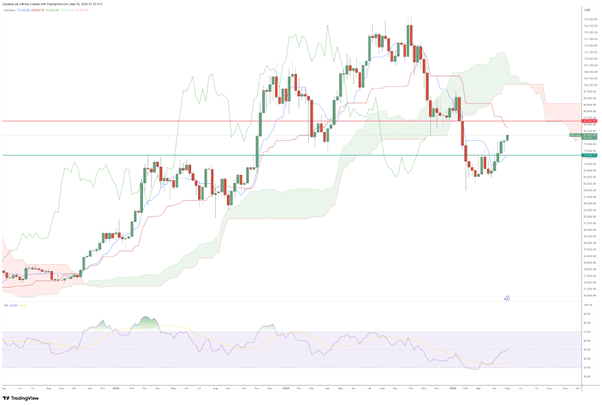
Weekly BTC/USD Chart – Source: TradingView
Price action currently trades near $81,000, a level that represents Bitcoin’s highest point since January. The weekly chart reveals a cryptocurrency that has rallied for six consecutive weeks, suggesting that some underlying demand is present.
The Ichimoku Cloud analysis shows price action currently positioned below the cloud structure, a configuration that typically indicates an underlying bearish trend. But prices could be reversing if the recent upward movement strengthens. Still, Bitcoin faces a significant resistance cluster around $86,369, but the cloud is thin, which means that it could be “easy” for the cryptocurrency to break through for the uptrend to gain credibility.
The psychological level of $90,000 sits above this resistance zone and would represent the next major objective if buyers can go through $86,369. Failure to break this resistance could send Bitcoin toward the $73,380 support level, with an even more critical floor at $70,000.
The weekly Relative Strength Index (RSI) currently sits near 50, having recovered from oversold conditions earlier in the year. This neutral positioning is significant—it suggests that momentum is neither exhausted nor overextended. If buyers take control, the RSI has room to move higher without warning of immediate reversal. Conversely, if sellers regain control, the RSI could slide back toward oversold territory, potentially accelerating Bitcoin’s decline.
Bottom Line
Bitcoin’s future depends on whether these three critical factors can reinforce each other.
First, ETF flows need to sustain their current positive trajectory and potentially accelerate, signaling that institutional conviction is not merely stabilizing but genuinely expanding. Current flows remain below prior peaks, suggesting room for improvement but also revealing that complacency has not yet set in.
Second, regulatory developments must continue to progress toward final approval and implementation. The CLARITY Act remains pending, and its passage would remove a critical structural impediment to institutional participation. Markets typically begin discounting policy developments well before final passage: if legislators signal strong support, the market could react positively even before a formal vote.
Third, Bitcoin must achieve a technical breakout above the $86,369 resistance level with a sustained weekly close, launching an assault on the psychological $90,000 barrier. Technical breakouts carry psychological weight, as they often trigger algorithmic buying, leverage liquidations of short positions, and renewed momentum.
A technical breakout without supportive flows or positive regulatory developments would feel hollow. Conversely, strong flows and regulatory progress without technical confirmation would suggest that the market is building infrastructure for a later move rather than executing one immediately.
Sources: CoinDesk, Yahoo Finance, CNBC
The information provided does not constitute investment research. The material has not been prepared in accordance with the legal requirements designed to promote the independence of investment research and as such is to be considered to be a marketing communication.
All information has been prepared by ActivTrades (“AT”). The information does not contain a record of AT’s prices, or an offer of or solicitation for a transaction in any financial instrument. No representation or warranty is given as to the accuracy or completeness of this information.
Any material provided does not have regard to the specific investment objective and financial situation of any person who may receive it. Past performance is not a reliable indicator of future performance. AT provides an execution-only service. Consequently, any person acting on the information provided does so at their own risk. Forecasts are not guarantees. Rates may change. Political risk is unpredictable. Central bank actions may vary. Platforms’ tools do not guarantee success.