
Robinhood shares drop 7% after revenues fall 17% to $1.07B in slow Q1 2026

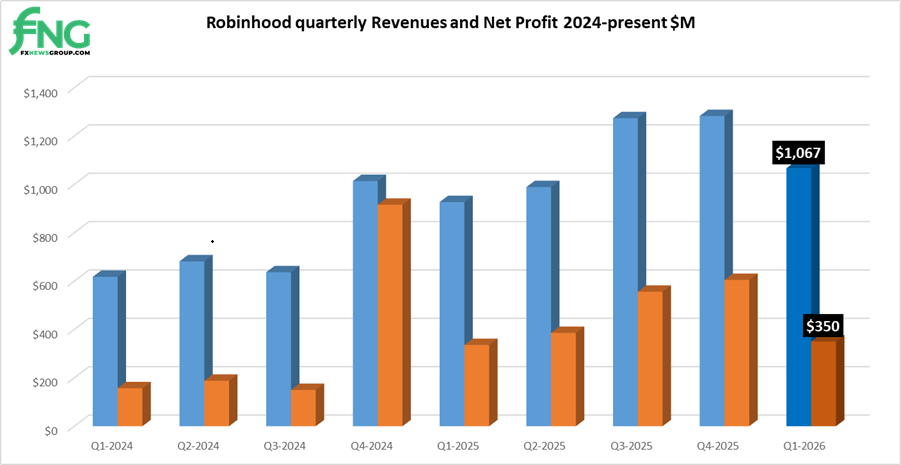
Following three consecutive quarters of growth, US neobroker Robinhood Markets Inc (NASDAQ:HOOD) took a step backward in Q1 2026, with both revenues and profits dropping significantly from Q4 2025 levels.
Revenues at Robinhood came in at $1.067 billion in Q1 2026, down by 17% from $1.28 billion in what was a record Q4 2025. Net profit of $350 million slid by 42% from the previous quarter’s $605 million.
HOOD stock took a tumble in aftermarket trading on Tuesday afternoon following release of the results, trading at about $77, down about 7% from Tuesday’s $82.07 closing price (and later falling further, down more than 9% to $74.41). Robinhood shares are now sitting at below half of their 52 week (and all time) high of $153.86, set in early October 2025.
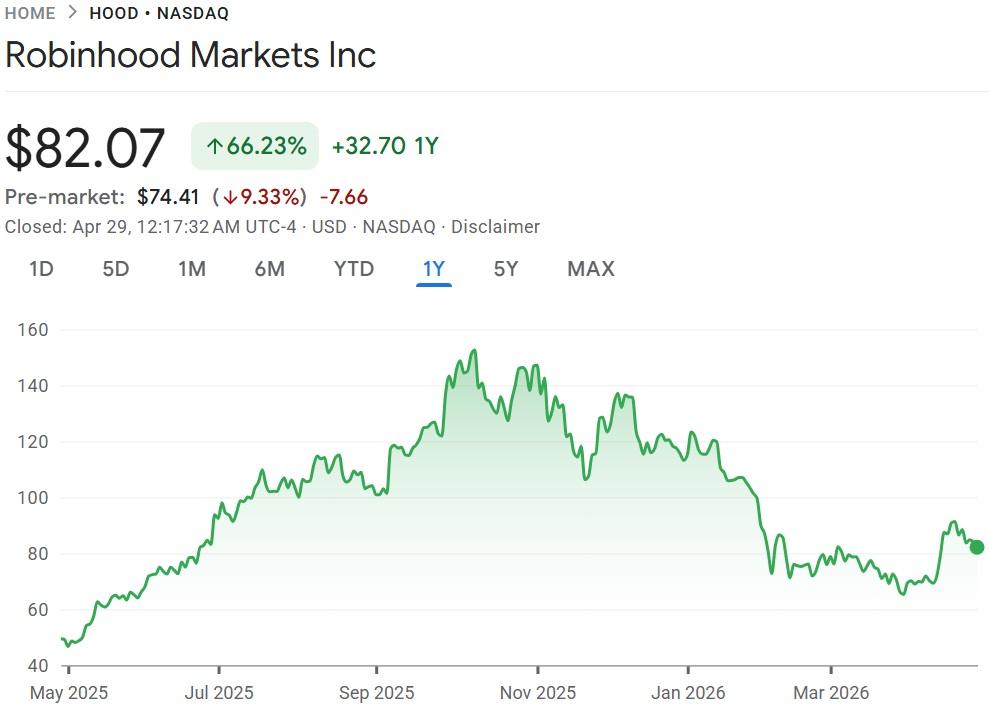
HOOD shares 1 year share price graph. Source: Google Finance.
First Quarter Results
- Total net revenues increased 15% year-over-year to $1.07 billion.
- Transaction-based revenues increased 7% year-over-year to $623 million (although lower that Q4 2025’s $776 million), primarily driven by other transaction revenue of $147 million, up 320%, which primarily consists of event contracts revenue, options revenue of $260 million, up 8%, and equities revenue of $82 million, up 46%, partially offset by cryptocurrencies revenue of $134 million (down by 39% from $221 million the previous quarter), down 47% YoY.
- Net interest revenues increased 24% year-over-year to $359 million, primarily driven by growth in interest-earning assets, partially offset by lower short-term interest rates and securities lending activity.
- Other revenues increased 57% year-over-year to $85 million, primarily driven by Robinhood Gold subscription revenue of $50 million up 32%.
- Net income increased 3% year-over-year to $346 million, compared to Q1 2025.
- Diluted earnings per share (“EPS”) increased 3% to $0.38, compared to Q1 2025.
- Total operating expenses increased 18% year-over-year to $656 million. The year-over-year increase was primarily driven by marketing and growth investments, and acquisition-related expenses.
- Adjusted Operating Expenses and Share-Based Compensation (“SBC”) (non-GAAP) increased 14% year-over-year to $607 million, which includes $14 million of costs related to Rothera and Trump Accounts.
- Adjusted EBITDA (non-GAAP) increased 14% year-over-year to $534 million.
- Funded Customers increased by 1.7 million, or 6%, year-over-year to 27.4 million.
- Investment Accounts increased by 2.1 million, or 8%, year-over-year to 29.1 million.
- Total Platform Assets increased 39% year-over-year to $307 billion, driven by continued Net Deposits, higher equity valuations, and acquired assets.
- Net Deposits were $17.7 billion, an annualized growth rate of 22% relative to Total Platform Assets at the end of Q4 2025. Over the past twelve months, Net Deposits were $67.8 billion, a growth rate of 31% relative to Total Platform Assets at the end of Q1 2025. See Key Performance Metrics for more information.
- Robinhood Gold Subscribers increased by 1.2 million, or 36%, year-over-year to 4.3 million.
- Average Revenue Per User (“ARPU”) increased 8% year-over-year to $157.
- Cash and cash equivalents totaled $5.0 billion, compared with $4.4 billion the end of Q1 2025.
- Share repurchases were $250 million, representing 3.1 million shares of our Class A common stock at an average price per share of approximately $81. Since starting our initial share repurchase program in Q3 2024, total share repurchases were $1.2 billion as of the end of Q1 2026, representing 25 million shares of our Class A common stock at an average price per share of approximately $46.
- In March 2026, the Company’s Board of Directors refreshed our share repurchase authorization to $1.5 billion, which is expected to be completed over the next approximately three years.
Q1 Highlights
Product Velocity Accelerates as Robinhood Builds a Global Financial Super App
#1 Platform for Active Traders
- Active trader engagement remained strong in Q1, resulting in double-digit year-over-year growth in equity and options volumes, and record volumes for Prediction Markets, Futures, Index Options, Shorting and Margin.
- Robinhood continued to deliver innovative products and services, including Cortex Digests – used by nearly 1 million customers to date – and the next generation of Robinhood Cortex, Cortex Assistant, which is rolling out across the app to deliver real-time, AI-powered insights.
- Robinhood Social beta also launched to 10,000 customers with strong early engagement, introducing a trading community within the Robinhood app that offers live, verified trades and authentic profiles that we plan to expand to more customers soon.
#1 in Wallet Share for the Next Generation
- To date, Robinhood Banking has crossed over $2 billion in deposits from over 125,000 Funded Customers and approximately 40 percent of customers signed up for direct deposit.
- Robinhood Strategies grew to over 285,000 Funded Customers with over $1.6 billion in assets under management to date.
- During the quarter, Robinhood introduced trust and custodial accounts as part of a new family investing experience, and unveiled the next evolution of its credit card, the Robinhood Platinum Card, which has seen strong early demand. In addition, the Robinhood Gold Card has now crossed 800,000 Funded Customers.
- The company also launched its IPO of Robinhood Ventures Fund I (“RVI”), a NYSE-listed closed-end investment fund that expands access to private markets by offering retail investors exposure to a portfolio of private companies operating at the frontiers of their industries.
- In April, the U.S. Department of the Treasury announced Robinhood will be the broker and sole initial trustee for Trump Accounts — a historic milestone in the Company’s mission to democratize finance for all. Working with BNY, Robinhood will build and run the standalone Trump Account app, host dedicated customer support, provide educational content, and custody the account assets.
#1 Global Financial Ecosystem
- International traction is picking up as Robinhood expands its global footprint, most recently securing in-principle approval from the Monetary Authority of Singapore to offer a comprehensive suite of brokerage services.
- To continue leading the global shift toward tokenization, the Company also launched the public testnet for Robinhood Chain, a financial-grade Ethereum Layer 2 designed to support tokenized real-world assets, which has already processed over 100 million transactions.
Additional Q1 2026 Operating Data
- Robinhood Retirement AUC increased 90% year-over-year to a record $27.4 billion.
- Margin Book increased 93% year-over-year to a record $17.0 billion.
- Cash and Deposits increased 71% year-over-year to $16.7 billion.
- Cash Sweep decreased 8% year-over-year to $26.0 billion.
- In February 2026, we updated our brokerage High-Yield Cash program to fund growth in margin lending, resulting in over $6 billion of Cash Sweep balances moving to Cash and Deposits in the form of customer free credit balances.
- Equity Notional Trading Volumes increased 54% year-over-year to $638 billion.
- Options Contracts Traded increased 17% year-over-year to 586 million.
- Crypto Notional Trading Volumes were $66 billion, including Robinhood App Notional Volumes which decreased 48% year-over-year to $24 billion, and Bitstamp Notional Volumes which were $42 billion.
- Event Contracts Traded were a record 8.8 billion.
Financial Outlook
Robinhood said that it is not providing a 2026 outlook for total operating expenses, and has not reconciled its 2026 outlook for Adjusted Operating Expenses and SBC to the most directly comparable GAAP financial measure, total operating expenses, because it is unable to predict with reasonable certainty the impact of certain items without unreasonable effort. These items include, but are not limited to, provision for credit losses and significant regulatory expenses which may be material and could have a significant impact on total operating expenses for 2026.
As previously disclosed, Robinhood’s 2026 expense plan is designed to accelerate product velocity, drive Net Deposit growth, and grow revenues. Its prior outlook for 2026 Adjusted Operating Expenses and SBC provided at Q4 2025 Earnings (February 10, 2026) was $2.6 billion to $2.725 billion. Robinhood now anticipates investing an additional $100 million to build and support the user interface for Trump Accounts, which was not included in its prior outlook. The work for Trump Accounts is contracted on a cost plus basis with a small margin, so Robinhood expects revenues to exceed costs. As a result, the updated outlook for 2026 Adjusted Operating Expenses and SBC is $2.7 billion to $2.825 billion.
This expense outlook does not include provision for credit losses, costs related to pending acquisitions, costs related to the Rothera joint venture, costs from modifications of executive awards in connection with a CFO transition, potential significant regulatory matters, or other significant expenses (such as impairments, restructuring charges, and other business acquisition- or disposition-related expenses) that may arise or accruals which may be determined in the future are required, as the company is unable to accurately predict the size or timing of such matters, expenses or accruals at this time.

Vlad Tenev, Chairman and CEO of Robinhood said,
“Driven by our relentless product velocity and innovation, Robinhood is increasingly positioned at the center of our customers’ financial lives, just as we enter the early innings of the Great Wealth Transfer.”
 Shiv Verma, Chief Financial Officer of Robinhood added,
“In Q1, customers remained engaged and rapidly adopted new products, leading to a 20 percent-plus annualized net deposit growth rate, double digit growth across equities and options, and record volumes for prediction markets, futures, and index options. And Q2 is off to a good start in April, as equity and option trading volumes are on track to be the highest month of the year, and even with tax season, net deposits are approximately $5 billion month-to-date. We believe there are massive opportunities ahead as we invest for the long term, ship products faster than ever to customers, and deliver value for shareholders.”
Robinhood’s full Q1 2026 results release can be seen here.