

Commodities ownership rises to 32% among retail investors, eToro survey reveals

After a sustained period of AI-driven optimism, retail investors are becoming more measured in their expectations for AI stocks and the so-called ‘Magnificent 7’, according to the latest Retail Investor Beat from trading and investing platform eToro.
The quarterly study, which surveyed 11,000 retail investors across 13 countries, found that 43% expect AI-related stock prices to increase in 2026, down from 52% the previous quarter. This marks the lowest reading since the question was first asked in Q4 2024.
Similarly, 40% believe the ‘Magnificent 7’ will outperform the broader market in 2026, compared to 47% last quarter, also the lowest reading since Q4 2024.
The survey was conducted between 12–27 February 2026, prior to the recent escalation in the Middle East. The findings therefore reflect investor sentiment before the outbreak of the Iran conflict.
Commenting on the data, eToro’s Global Market Strategist Lale Akoner said:
“The shift in expectations suggests retail investors are becoming more measured about mega-cap tech rather than turning away from the AI theme altogether. Recent earnings volatility and increasing scrutiny around capital expenditure appear to be encouraging a more selective approach.
“It’s important to note that this data captures sentiment before the latest geopolitical escalation. While conflict can influence short-term positioning, the broader trends we’re seeing such as greater awareness of concentration risk and increased interest in diversification, appear structural rather than event-driven.
“After a prolonged period where a small group of companies accounted for a significant share of market gains, investors are becoming more conscious of concentration risk. The data suggests that some retail investors may be looking to rebalance portfolios by broadening exposure beyond AI leaders, including looking to cyclical stocks and other asset classes, such as commodities.”
Commodities are gaining further ground within retail portfolios. Ownership rose to 32%, up from 30% last quarter and the highest level recorded since this question was introduced in Q3 2023.
Among commodity investors, gold is the most widely held asset, with 69% having exposure. Silver follows at 35%, oil at 29%, natural gas at 20% and copper at 18%.
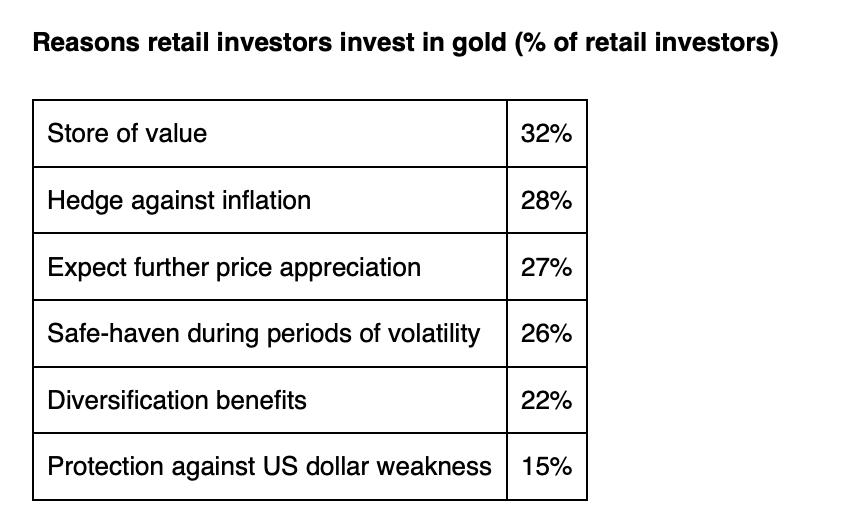
In light of gold’s strong gains over the past year, expectations for the next six months remain measured. Retail investors forecast an average rise of 3.1%, with millennials and boomers the most bullish (3.4%), while Gen Z is more cautious at 2%. The most common view is that prices will increase by 5-10% (18%), followed by 1-5% (17%) and that prices will remain broadly unchanged (14%).
Lale Akoner added:
“Even before the latest geopolitical developments, retail investors were increasing their exposure to tangible assets. Gold in particular appears to be viewed less as a short-term trade and more as a strategic hedge and diversifier, especially as the momentum-driven rally begins to moderate.
“While conflict may affect near-term market dynamics, we see a broader longer-term shift toward real assets and exposure to the ‘old economy’ as retail portfolios become more balanced across sectors and asset classes.”
The latest Retail Investor Beat reveals that 22% of retail investors now view international conflict as the biggest threat to their investments – compared to 17% the previous quarter – the same percentage of people who point at the state of the global economy and a potential recession. This marks a reordering of investor fears compared to a year ago, when the state of the global economy was first at 23%, followed by inflation at 21% and international conflict at 18%.
“Geopolitical risk had already been climbing investors’ list of concerns even before the latest escalation in the Middle East. In recent years, markets have had to navigate a series of global flashpoints, making investors far more attuned to the potential impact of geopolitical events. The fact that international conflict now ranks alongside recession fears as the biggest perceived threat highlights how closely retail investors are watching global developments and recognising their potential implications for markets and portfolios,” explained Lale Akoner.