
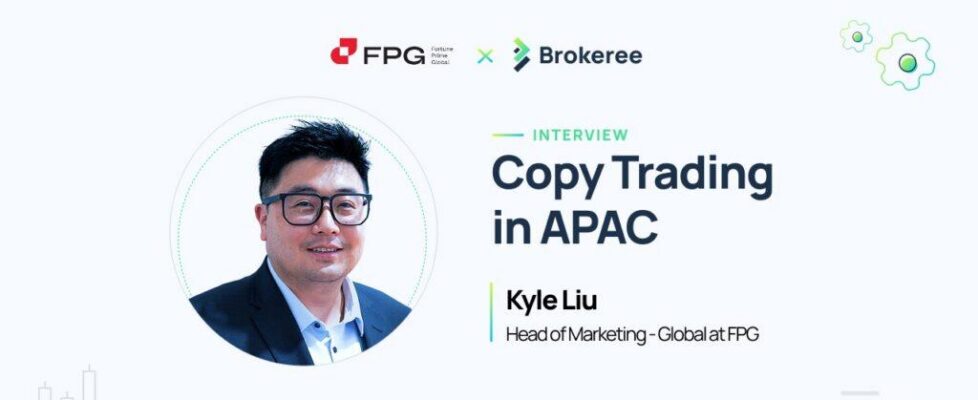
“A Short List of Credible Strategies Beats a Long List of Noise”: FPG on Copy Trading in APAC

FNG Interview… Copy trading has become a standard offering for many brokers serving retail traders across APAC. A young, mobile-first generation of traders has entered the markets in large numbers over the past few years, and many of them prefer to start by following experienced traders rather than building strategies from scratch. Brokers across the region have responded by investing heavily in social and copy trading infrastructure. The conversation has shifted from whether to offer it to how to run it well.
Few firms are better placed to speak about that shift than Fortune Prime Global (FPG), a multi-asset brokerage with deep roots across APAC and the Middle East, and a client of Brokeree Solutions. Tatiana Pilipenko, Regional Head of Business Development (APAC, UK & Americas) at Brokeree, interviewed Kyle Liu, Head of Marketing – Global at FPG, about what is driving copy trading adoption across APAC, the trends shaping the market, the mistakes brokers should avoid when launching, and how AI is set to change the space. The conversation also covers practical questions, including how FPG solved the “empty leaderboard” problem on its own platform.
“Brokers in APAC come to us at very different stages. Some are still deciding whether to launch copy trading; others ask about the operational side of offering this service, including finding strategy providers, screening them, and managing the risk. FPG has been offering copy trading for a while now, and I wanted to ask those questions to someone who has worked through them. Their perspective is so valuable,” says Tatiana.
Tatiana: Hi Kyle. From your perspective, what are the main factors driving the adoption of copy trading across the APAC region?
Kyle: APAC has a huge, young, mobile-first retail base that came into trading fast, often without years of experience behind them. Copy trading lets them participate without having to master technical analysis on day one. On top of that, this region is deeply social. People here trust the community, KOLs, and “someone who’s already doing it well” far more than a textbook. Smartphone penetration and super-app habits make the whole thing frictionless. And realistically, a lot of newer traders got burned trading solo, so following a proven track record just feels safer.
At FPG, with close to thirty years across Greater China, Southeast Asia and the Middle East, we see the same pattern everywhere: the appetite to participate is high, but formal financial education is still catching up, and copy trading fills that gap neatly.
Tatiana: What trends are you currently seeing in the APAC copy trading market?
Kyle: A few stand out. First, curation over volume. Clients don’t want a wall of 500 anonymous strategies anymore; they want a shortlist they can trust, which is exactly how we’ve built FPG’s offering.
Second, the best signal providers are becoming genuine influencers; the line between “trader” and “KOL” is blurring, and they bring their own communities. Third, transparency is now table stakes: verified track records and real drawdown history, not cherry-picked screenshots. We’re also seeing copy trading spread beyond FX into indices, commodities and crypto, plus the early edges of AI-assisted strategy matching. And regulators across the region are watching more closely, which is healthy for the space long term.
Tatiana: If a broker is considering launching copy trading today, what are the three biggest mistakes they should avoid?
Kyle: Launching with an empty or low-quality leaderboard. Nothing kills trust faster than a new client opening the app and finding nothing credible to copy.
Not vetting providers properly. One blow-up strategy that wipes out its followers does more reputational damage than ten good ones do good. At FPG, curation and risk screening aren’t optional; they’re the foundation.
Marketing it like a get-rich-quick product. Overselling returns creates compliance exposure, and guarantees churn the moment clients hit their first drawdown. Set expectations honestly from the start.
Tatiana: In the age of AI, how do you see copy trading evolving over the next few years?
Kyle: I think AI shifts it from “pick a trader off a list” to “get matched to the right strategy for your risk profile.” That’s the near-term change — smarter matching, better drawdown and risk analytics, more personalised allocation. We’ll also see more algorithmic and AI-built strategies sitting alongside human providers. But I don’t think AI replaces the human trust element; people still want to follow someone whose story they understand.
At FPG, our view is that AI should make copy trading safer and more personalised, not turn it into a black box. Explainability and transparency will matter more, not less, as regulators pay closer attention.
Tatiana: How do you balance making copy trading accessible for beginners while encouraging responsible trading behaviour?
Kyle: The trick is making entry simple without making the risk invisible. Onboarding should be a few taps, but the guardrails have to be built in by default — sensible position sizing, clear risk labels on each strategy, drawdown alerts, easy stop-copy. At FPG, we lean toward weaving education in, rather than bolting it on.
A beginner should understand what they’re copying, and why it can lose money, before committing real funds. Accessible doesn’t mean frictionless to the point of recklessness. The goal is a client who’s still trading responsibly in two years, not one who blows up in two weeks.
Tatiana: What risk management safeguards do you believe are essential for both brokers and traders?
Kyle: On the broker side: proper vetting and verified track records for providers, exposure caps, active monitoring for reckless “pump” strategies, and negative balance protection — all things we treat as standard at FPG. On the trader side: max allocation limits per provider, copy-stop-loss settings, diversification nudges so nobody puts everything behind one name, and clear drawdown alerts.
The principle is the same for both.
No single strategy or client should be able to cause damage the system didn’t see coming. Good safeguards are quiet; they prevent the disasters that would otherwise define your reputation.
Tatiana: Many brokers struggle with the “empty leaderboard” challenge when launching copy trading. How did you address this issue, and what practical advice would you offer firms that are just getting started?
Kyle: It’s a genuine chicken-and-egg problem: followers won’t come without good providers, and providers won’t come without followers. What worked for FPG was seeding the platform deliberately instead of waiting. We identified our own consistently strong clients and brought them on as strategy providers, leaned on our IB and KOL network across the region, and made sure the first cohort on the leaderboard was actually worth copying, not filler.
My practical advice to firms starting out: quality over quantity from day one, incentivise your early providers, and be transparent about track records even when the sample size is small. A short list of credible strategies beats a long list of noise every time.
Tatiana: What factors do you think have contributed most to the growth and success of your copy trading service?
Kyle: A big part is that FPG genuinely understands the APAC client — multilingual support, local payment rails, and an IB/KOL network that reaches these markets rather than treating the region as an afterthought. Curation matters too; we’ve been deliberate about who gets featured. And we treat copy trading as part of a broader FPG ecosystem — education, community, and support — not a standalone gimmick. When the whole experience is coherent, and the strategies are trustworthy, clients stay.
Tatiana: What has been the single biggest impact of copy trading on your brokerage’s growth and client engagement?
Kyle: Stickiness. Copy trading turns a fairly transactional relationship into an ongoing one — clients check in more often, stay engaged through the community, and tend to have longer lifecycles because they’re not trading in isolation. For FPG, it’s also become a real acquisition channel, since strong providers bring their own followings with them. If I had to name one thing, it’s that copy trading deepened our relationship with clients rather than just adding another product line to the menu.
Conclusion
Kyle’s answers point to a copy trading market in APAC where trust and curation carry as much weight as the technology behind the service. From attracting strategy providers to managing risk and setting realistic expectations, the discussion highlights the practical decisions that shape a successful copy trading offering. We thank Kyle for sharing FPG’s experience and perspective.
About Brokeree Solutions
Brokeree Solutions is an international provider of technological solutions for multi-asset brokers worldwide. With 12 years of industry expertise, the company specializes in turnkey solutions development, trading platform servicing, and consultation for retail brokers using MetaTrader 4 & 5 and other trading platforms. Brokeree Solutions’ extensive product portfolio includes flagship systems like Social Trading, PAMM, Prop Pulse, and Liquidity Bridge, offering comprehensive technologies that address almost any broker’s needs.