

The $200 Question: Is the 2026 Iran War Preparing the World for a New Era of Triple-Digit Oil?

The following is a guest editorial courtesy of Carolane de Palmas, Markets Analyst at Retail FX and CFDs broker ActivTrades.
Oil prices climbed again on Thursday, rising despite the International Energy Agency’s announcement the previous day that it would release a record 400 million barrels from emergency reserves in an effort to cushion the economic blow of the war with Iran. West Texas Intermediate crude was up almost 3% at around $98.40 at the time of writing, while Brent had risen more than 5% to around $91.70. The fact that prices are moving higher even after the largest coordinated reserve release in history speaks to the depth of anxiety gripping energy markets right now.
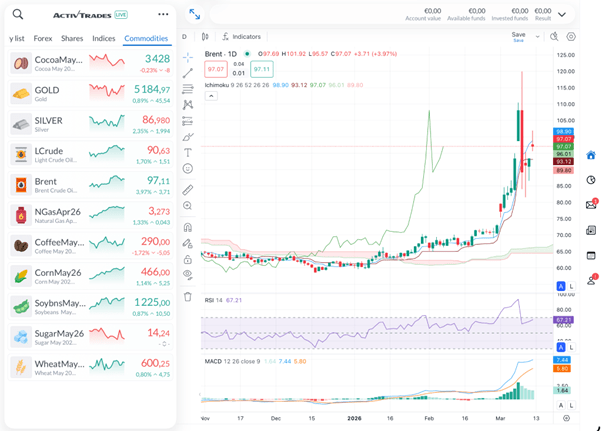
Daily Brent Chart – Source: ActivTrader
This analysis is divided into two parts. The first examines why oil prices have continued to climb in spite of the IEA’s intervention, what that decision actually involves and why it has so far failed to reassure markets, and what Iran’s explicit warning — that the world should prepare for oil at $200 a barrel — tells us about the trajectory of the conflict and the vulnerability of global supply. The second part turns to the broader consequences: how high prices could realistically go from here, and what a sustained energy shock of this magnitude could mean for the global economy and for investors.
Oil Prices Keep Climbing Despite The IEA’s Emergency Reserve Release
Crude oil markets have remained deeply unsettled since the United States and Israel launched coordinated airstrikes against Iran on February 28, sending shockwaves through global energy supply chains and driving fuel costs sharply higher across the world. Prices surged to above $119 per barrel earlier this week — a peak not seen in nearly four years — before pulling back to around $90. Even at that lower level, the market remains dramatically elevated compared to where it stood before the conflict began, a sign that traders are far from convinced the crisis is nearing resolution.
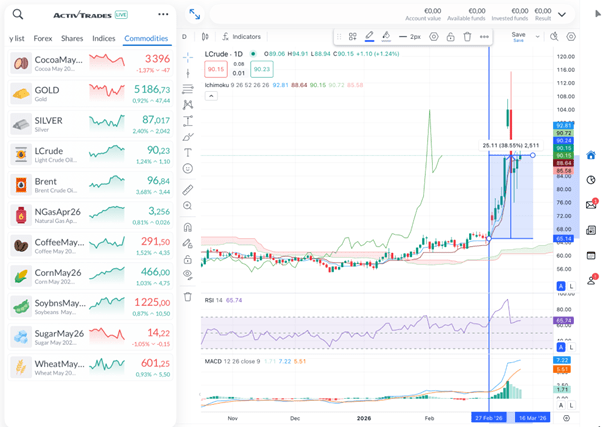
Daily Light Crude Chart – Source: ActivTrader
All 32 member countries of the International Energy Agency — among them the United Kingdom, the United States, and most of the world’s wealthiest economies — agreed on Wednesday to collectively release 400 million barrels from their strategic petroleum reserves. This coordinated intervention represents the largest emergency release in the IEA’s history. At 400 million barrels, the volume is more than double the previous record of 182.7 million barrels set in 2022 following the Russian invasion of Ukraine.
Member nations, which together account for roughly two thirds of global energy production and around 80% of global consumption, are required under IEA rules to maintain reserves equivalent to at least 90 days of their domestic oil needs. Combined, those governments currently hold over 1.2 billion barrels in emergency stockpiles, with an additional 600 million barrels held by industry under government obligation. Releasing 400 million barrels therefore represents a significant drawdown of roughly a third of government-held stocks — a commitment the IEA cannot make again in the near term.
According to CNBC, while the IEA has authorized the release, it has left the logistics to its member states, allowing each country to bring its portion of the emergency reserves to market based on local conditions rather than a centralized timeline. And when that oil does begin flowing, it will not arrive as a sudden surge. Rather, producers will make additional volumes available for refineries to order — a process that energy analysts warn is already constrained by a global shortage of refining capacity.
In practical terms, the 400 million barrels would amount to only around three or four days of worldwide supply, or approximately two weeks’ worth of the volumes that would ordinarily transit the Strait of Hormuz under normal conditions. Historically significant as the move may be, analysts have been quick to characterise it as a temporary buffer rather than a lasting fix.
That assessment appears to be shared by oil traders. Despite the announcement, prices have not fallen as sharply as many anticipated, suggesting markets had already priced in some form of coordinated reserve release and remain focused on the deeper uncertainty surrounding Iranian supply. Oil prices will stay elevated as long as the risk to supply persists, and the latest price trajectory indicates that investors are still bracing for a prolonged disruption rather than a swift end to the conflict. The other structural constraint is that the IEA has now deployed one of its most powerful emergency tools — and deploying it again in quick succession is not a realistic option.
Political statements from Washington have done little to shift market sentiment. President Trump argued the IEA decision would substantially reduce oil prices as the threat to America and the world is addressed, while White House Press Secretary Karoline Leavitt told reporters that Americans would see oil and gas prices fall rapidly once the war with Iran ends. Iranian officials, however, have continued to signal that the country has no intention of yielding to the demands repeatedly made by President Trump, leaving the fundamental question of supply disruption unresolved — and oil prices stubbornly high.
Iran Warns Of $200 Oil As The Strait Of Hormuz Remains Paralysed
Iran has not simply been a passive subject of Western military pressure. Its officials have issued stark warnings about where oil prices could go next, and events in the region suggest those warnings are not idle rhetoric.
Ebrahim Zolfaqari, a senior Iranian official, declared that no litre of oil would be permitted to reach the United States, Israel, or their partners, stating explicitly that any vessel or tanker bound for those destinations would be treated as a legitimate military target. He then issued a direct warning to global markets, telling the world to prepare for oil at $200 a barrel, arguing that the price of oil is ultimately a function of regional security — security that, in his framing, Western powers had themselves destroyed. The remarks reflect a deliberate strategy of using the threat of energy disruption as leverage, and markets appear to be taking that threat seriously.
Those words have been accompanied by action. Three additional foreign vessels were struck overnight off the coasts of Iraq and the United Arab Emirates, according to authorities, in incidents that mark a continued escalation in attacks on commercial shipping. The latest strikes follow a near-complete halt in traffic through the Strait of Hormuz since the United States and Israel launched their airstrikes on Iran late February, and they underscore why the IEA’s reserve release has done so little to calm prices.
The Strait of Hormuz is one of the most consequential chokepoints in the global economy. The narrow waterway separating Iran from the Arabian Peninsula is the sole maritime passage connecting the Persian Gulf to the open ocean, and under normal circumstances it carries roughly a fifth of the world’s total energy supplies (by some measures as much as a quarter of all oil transported by sea). Oil analysts have long identified it as the single geographic vulnerability most capable of triggering extreme price spikes if disrupted, precisely because there is no viable alternative route for the volumes involved. There is no pipeline network or overland corridor that can absorb that kind of displacement at short notice.
What is now unfolding is no longer a theoretical scenario. Shipping traffic through the strait has effectively ground to a halt since the conflict began, and the consequences for regional production are already severe. According to Bloomberg, Middle Eastern countries have cut approximately two thirds of their oil output as a result of the closure, a reduction that dwarfs anything the IEA’s reserve release could compensate for over any sustained period. The strategic petroleum reserve was designed to bridge short-term disruptions, not to substitute indefinitely for one of the world’s primary arteries of energy supply. As long as the strait remains closed and Iranian officials continue to frame commercial vessels as military targets, the structural case for higher oil prices remains firmly in place, regardless of what emergency reserves any government chooses to release.
The previous section established why the Strait of Hormuz closure has rendered the IEA’s emergency release largely ineffective, but the more pressing question for markets, governments, and ordinary consumers is how much further prices could realistically climb from here. That’s what we cover in the following analysis.
Sources: Reuters, CNBC, BBC, The Wall Street Journal, Forbes, The Guardian
The information provided does not constitute investment research. The material has not been prepared in accordance with the legal requirements designed to promote the independence of investment research and as such is to be considered to be a marketing communication.
All information has been prepared by ActivTrades (“AT”). The information does not contain a record of AT’s prices, or an offer of or solicitation for a transaction in any financial instrument. No representation or warranty is given as to the accuracy or completeness of this information.
Any material provided does not have regard to the specific investment objective and financial situation of any person who may receive it. Past performance is not a reliable indicator of future performance. AT provides an execution-only service. Consequently, any person acting on the information provided does so at their own risk. Forecasts are not guarantees. Rates may change. Political risk is unpredictable. Central bank actions may vary. Platforms’ tools do not guarantee success.