

Most Traded US Stocks on ActivTrades in July 2026: Microsoft Soars, Micron and Tesla Tumble

The following is a guest editorial courtesy of Carolane de Palmas, Markets Analyst at Retail FX and CFDs broker ActivTrades.
July delivered a striking reminder that a relatively stable market can hide major opportunities—and risks—beneath the surface. While the broader S&P500 moved only modestly, some of the stocks most actively traded by ActivTrades clients experienced impressive swings, with monthly performances ranging from a 24.76% surge to a 28.44% collapse. Microsoft emerged as the standout performer, while Micron and Tesla suffered sharp reversals.
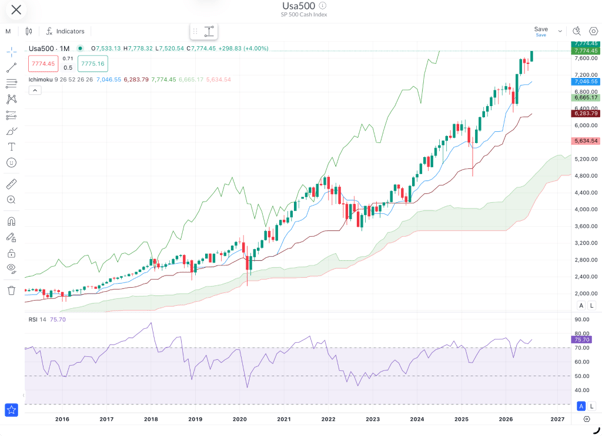
S&P500 Monthly Chart – Source: ActivTrader
Among the five most traded U.S. instruments on ActivTrader—Microsoft, Nvidia, Micron, Tesla and the SPY ETF—the contrast highlights just how differently individual stocks can perform even when the wider market remains relatively calm. For active traders, this dispersion can create significant opportunities around stock-specific volatility, earnings and market catalysts.
Microsoft: the AI trade finally pays off
Microsoft (MSFT.US) was the standout story of the month, gaining 24.76% and posting one of the largest single-day market-value increases in stock market history. The catalyst was clear: fiscal fourth-quarter 2026 results released on July 29 showed revenue of $90 billion, up 18% year-on-year and comfortably ahead of what Wall Street had priced in. Azure, Microsoft’s cloud division, crossed $100 billion in annual revenue for the first time and grew more than 40% over the quarter, addressing the market’s biggest lingering doubt: whether hundreds of billions of dollars in AI infrastructure spending would actually translate into revenue growth.
The rally is best understood in context. Microsoft shares had been down close to 19% for the year heading into the earning report, as investors fretted over the size of the company’s AI capital expenditure and uncertain near-term returns. CFO Amy Hood’s guidance for double-digit revenue and operating income growth through fiscal 2027, alongside a pledge to remain free-cash-flow positive, gave the bulls the reassurance they had been waiting for. The stock jumped over 15% the day after the release and extended gains further into month-end, a scale of single-day repricing rarely seen in a company of Microsoft’s size.
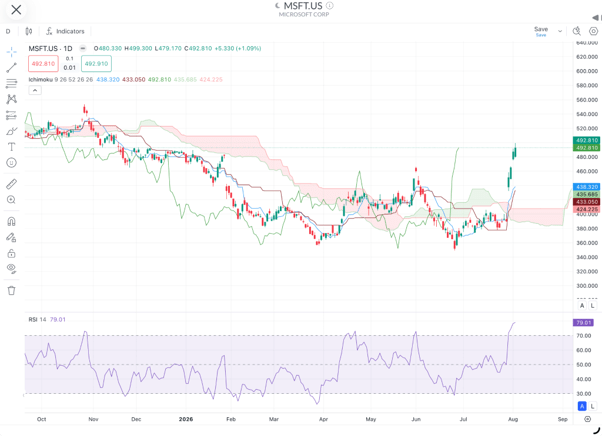
Microsoft Daily Chart – Source: ActivTrader
Nvidia: a quiet month in a volatile year
By comparison, Nvidia (NVDA.US) had a subdued July, edging up just 0.64%. That modest gain follows a choppy first half of 2026 in which the chipmaker corrected in June before stabilizing. Nvidia’s year-to-date performance has lagged its own recent history — a single-digit percentage gain in 2026 stands in stark contrast to the triple-digit annual returns the stock delivered between 2023 and 2025.
The underlying growth drivers, though, remain intact. Hyperscaler capital expenditure on AI infrastructure has continued to expand, and Nvidia’s product roadmap — from its current Blackwell architecture through to the upcoming Rubin generation — keeps it positioned at the center of the AI buildout. The near-flat July price action suggests the market is digesting rather than rejecting the AI capex story, with investors now demanding tangible evidence of monetization rather than rewarding capacity expansion alone. That makes Nvidia a stock to watch closely into its next earnings date (August 26), where any signal on demand visibility could reignite volatility.
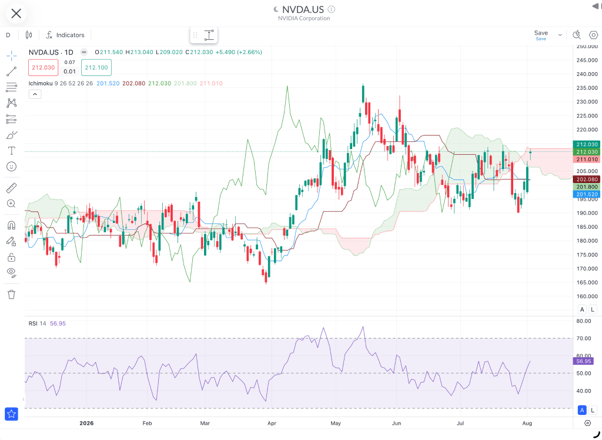
Nvidia Daily Chart – Source: ActivTrader
Micron: a spectacular reversal
Micron (MU.US) delivered the sharpest reversal of the month, plunging 28.44% after a run that had seen the stock more than triple over the prior year on the back of a global memory-chip shortage. The pullback was not driven by weak fundamentals — Micron’s fiscal third-quarter results, released in late June, had crushed expectations, with record revenue and guidance pointing to further strength. Instead, the sell-off reflects a classic case of a crowded, momentum-driven trade unwinding.
Several catalysts compounded the move through July. News that Chinese memory maker ChangXin Memory Technologies had completed a Shanghai listing implying an $85.5 billion valuation reignited fears of future Chinese competition undercutting pricing power in the memory sector. South Korean regulatory moves to curb leveraged single-stock ETFs tied to rivals SK Hynix and Samsung added further pressure across the group. Layered on top was a broader loss of investor confidence in near-term AI infrastructure spending, as several large technology buyers signaled a more cautious approach to compute budgets.
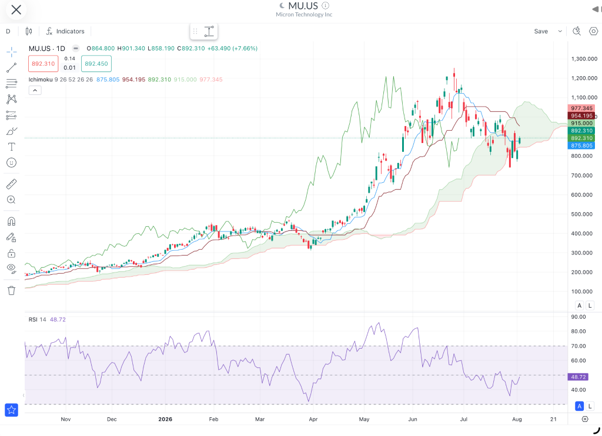
Micron Daily Chart – Source: ActivTrader
Tesla: capex concerns overshadow record deliveries
Tesla (TSLA.US) fell 26.01% in July, despite reporting record second-quarter deliveries of roughly 480,000 vehicles and revenue growth of around 26% year-on-year, its fastest pace in three years. The market’s focus, however, was on profitability rather than volume. Adjusted earnings per share of $0.33 came in well below the roughly $0.51-$0.54 analysts had expected, as regulatory credit revenue collapsed and average selling prices declined under competitive pressure. Free cash flow turned negative, and the company’s planned capital expenditure — some $25 billion earmarked largely for AI, robotics and autonomous-driving initiatives — spooked investors already wary of rising spend across the technology sector.
Tesla’s stock fell sharply in the days immediately following the July 22 earnings release and continued to bleed through the month as analysts trimmed price targets, citing margin compression and skepticism toward the pace of the company’s autonomous-driving ambitions. The divergence between Tesla’s operational headline numbers — records on revenue and deliveries — and its share-price reaction underlines how sensitive the market has become to capital spending across the entire AI-adjacent complex, Tesla included.
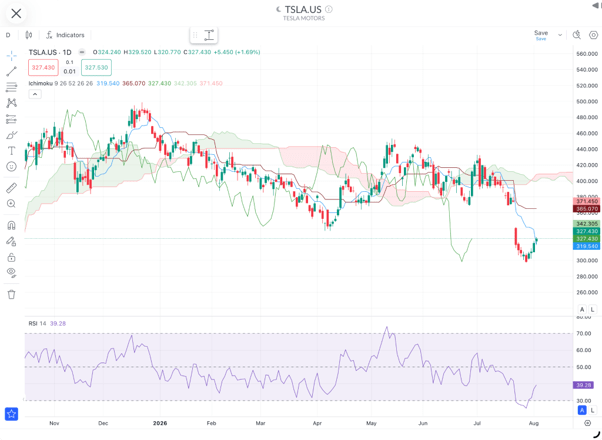
Tesla Daily Chart – Source: ActivTrader
Trading these movements with ActivTrades
Months like this one illustrate why some active traders turn to CFDs to gain exposure to short-term price swings on both sides of the market. ActivTrades offers CFDs on Microsoft, Nvidia, Micron, Tesla, the SPY ETF and a wide range of other US equities and indices, giving traders the ability to take a position whether a stock is rallying on an earnings beat, as Microsoft did in July, or reversing sharply lower on shifting sentiment, as was the case with Micron and Tesla.
CFDs let traders go long or short without owning the underlying shares, and they typically offer leverage and quick execution around earnings releases and other market-moving event. Access to tight spreads, a broad range of US equity CFDs and dedicated trading platforms are among the advantages ActivTrades provides for trading these kind of market conditions.
Of course, these same features carry real risks. Leverage magnifies losses as well as gains, and a fast-moving stock can move against a position just as quickly as it moves in its favo. CFDs are complex instruments and are not suited to every investor’s risk tolerance or trading horizon; a clear risk-management plan, appropriate position sizing and an understanding of how leverage affects both potential returns and potential losses are key before trading these products.
Sources: CNBC, Reuters, Wall Street Journal, Yahoo Finance, Forbes, Earnings Reports
The information provided does not constitute investment research. The material has not been prepared in accordance with the legal requirements designed to promote the independence of investment research and as such is to be considered to be a marketing communication.
All information has been prepared by ActivTrades (“AT”). The information does not contain a record of AT’s prices, or an offer of or solicitation for a transaction in any financial instrument. No representation or warranty is given as to the accuracy or completeness of this information.
Any material provided does not have regard to the specific investment objective and financial situation of any person who may receive it. Past performance is not a reliable indicator of future performance. AT provides an execution-only service. Consequently, any person acting on the information provided does so at their own risk. Forecasts are not guarantees. Rates may change. Political risk is unpredictable. Central bank actions may vary. Platforms’ tools do not guarantee success.