

UBS Group registers rise in profit in Q3 2026

UBS Group AG reported today its third-quarter 2026 results on a consolidated basis.
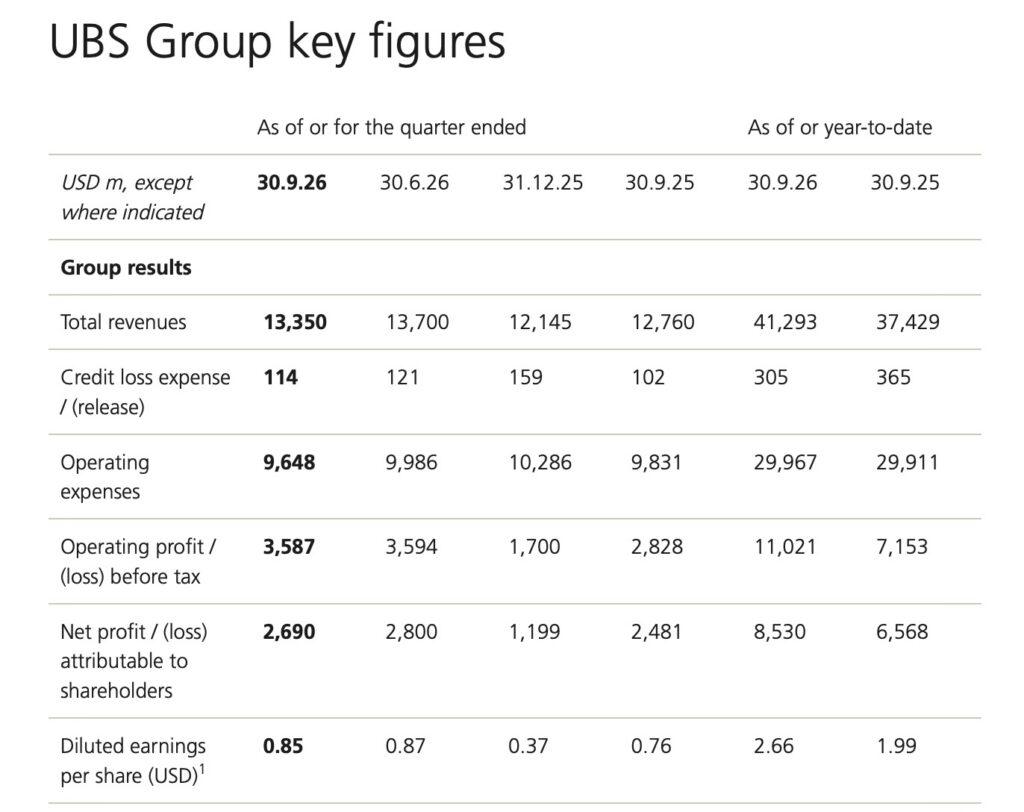
In 3Q26, UBS reported a profit before tax (PBT) of USD 3,587m and USD 4,077m on an underlying basis, up 27% year on year and 14% year on year, respectively, driven by higher underlying PBT across each of UBS’s core business divisions.
Reported revenues were USD 13,350m, up 5% Y/Y. On an underlying basis, revenues increased by 10% to USD 13,387m, with a 3% Y/Y increase in revenues in its core businesses.
GWM underlying revenues increased 8% from the year-ago quarter to USD 6,898m, mainly driven by a 9% increase in recurring net fee income and 8% rise in net interest income. The Investment Bank delivered a record third quarter of underlying revenues, propelled by a 17% increase in Global Markets to USD 2,548m, led by a 22% increase in Equities, supported by higher client balances, market share gains and strong activity in Corporate Derivatives and Structured Products.
Group invested assets were USD 7.3trn. GWM net new assets for the quarter totaled USD 55.1bn, representing a 4.5% annualized growth rate, with positive contributions across all regions and led by APAC and the Americas. In the Americas, UBS continued to execute its strategy with discipline, driving growth and delivering further improvements in profitability. PBT increased by 28% Y/Y, and the PBT margin improved by over 2 percentage points from the year-ago quarter to 16%.
UBS continues to execute on the final stages of the integration with Credit Suisse. With USD 13.2bn of gross cost reductions already delivered, including USD 0.6bn in the third quarter, UBS expects to deliver a total of USD 13.7bn in cumulative gross cost savings, above its previous ambition of approximately USD 13.5bn.
As of 30 September 2026, nearly all of the legacy Credit Suisse IT applications in scope for decommissioning were no longer in use and around 90% of such applications had already been fully decommissioned.
UBS’s strong capital generation in the quarter further fortified its capital position with a CET1 capital ratio of 14.7% and a CET1 leverage ratio of 4.6%, both above its guidance of ~14% and >4.0%, respectively. UBS expects to end 2026 with a CET1 capital ratio at or very close to its target of around 14%, including a potential accrual for the initial portion of intended 2027 share buybacks.
In the quarter UBS continued to accrue for mid-teens percentage growth in its dividend, and repurchased USD 1.8bn of shares. UBS plans to complete the USD 3bn program by the time it reports its fourth quarter results. The amount and pace of share repurchases will remain subject to its short-term financial performance and outlook, maintaining a CET1 capital ratio of around 14% and further visibility on the deliberations by the Swiss Parliament on the capitalization of foreign subsidiaries.
For the fourth quarter, UBS expects a more typical sequential seasonal moderation in transaction volumes across its businesses. In Global Markets, the strong prior-year performance, which included a gain on disposal, may weigh on the year-on-year comparison. In Global Banking, UBS expects revenues to increase sequentially, based on the current pipeline and assuming constructive markets. Net interest income is expected to increase by a low-single-digit percentage sequentially in Global Wealth Management and increase slightly in Personal & Corporate Banking in Swiss franc terms.
UBS expects to end 2026 with a CET1 capital ratio at or very close to its target of around 14%, including a potential accrual for the initial portion of intended 2027 share buybacks.
UBS remains strategically committed to its diversified business model and its global and regional footprint. As the political process on future regulatory requirements in Switzerland progresses, UBS will continue to engage constructively in the hope that Parliament will reach a solution that supports the country’s financial stability without imposing undue costs on UBS’s shareholders, clients and employees and without impacting its long-term competitive position.