

How Can Traders Exploit Oil Price Correlations?

The following is a guest editorial courtesy of Carolane de Palmas, Markets Analyst at Retail FX and CFDs broker ActivTrades.
The relationship between crude oil and financial markets has become increasingly important this year as geopolitical tensions in the Middle East continue to reshape expectations for energy prices, inflation, global monetary policy, and corporate profitability. While crude oil futures retreated from their recent four-month highs, oil prices remain around elevated levels as traders assess the risk of prolonged supply disruptions.
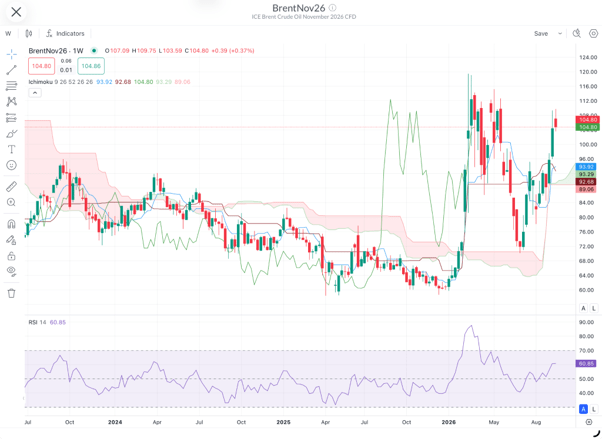
Brent Futures Weekly Chart – Source: ActivTrades.
The latest market reaction illustrates why oil can be more than a standalone trading opportunity. Changes in crude prices can transmit rapidly into airlines, energy producers, transportation companies, inflation-sensitive assets and broader equity markets. For short-term traders, understanding these relationships can provide another way to identify potential short-term opportunities or hedge existing exposure. However, correlations are not fixed rules: they can strengthen, weaken or even reverse depending on the economic and geopolitical environment.
What is correlation and why does it matter to traders?
In financial markets, correlation measures the degree to which two assets tend to move in relation to each other. A positive correlation means that two assets have historically tended to move in the same direction. A negative correlation means that they have tended to move in opposite directions. A correlation close to zero indicates little consistent relationship over the period being analysed.
Let’s take a look at the relationship between crude oil and airline stocks.
Jet fuel represents a significant operating cost for airlines. When crude oil rises sharply and airlines cannot immediately pass those higher costs on to customers, margins can come under pressure. The opposite can occur when oil prices decline, potentially providing relief to fuel expenses.
That relationship has become particularly visible during the current energy shock, as U.S. airfares increased 23.4% year over year in August, according to data reported by TravelPulse. At the same time, airlines are increasingly adjusting capacity rather than simply competing for market share.
United Airlines CFO Mike Leskinen said on Wednesday that the company would remove some flights from its December schedule and could make additional reductions in 2027 if fuel prices remain elevated. The strategy, he explained, is focused on profitability and free cash flow rather than maximising passenger volumes.
This creates an important transmission mechanism for traders: oil prices can influence airline costs, airline pricing decisions, capacity and ultimately equity valuations.
From crude oil to airlines and energy stocks
The relationship becomes even more interesting when looking at different parts of the energy ecosystem, as an oil price increase can have very different implications depending on the company involved.
For an airline, higher fuel prices generally represent a cost increase. For an oil producer, however, higher realised crude prices can increase revenue and potentially improve cash generation, assuming production volumes and costs remain relatively stable. This creates the possibility of observing opposite market reactions across sectors.
Oil exploration and production companies, for example, can benefit from a sustained increase in crude prices because the value of their output rises. Oilfield-services companies can also potentially benefit from increased investment in drilling and production if high prices encourage producers to expand activity.
The relationship is nevertheless more complicated than simply buying energy stocks whenever crude rises. Companies have different production costs, hedging policies, debt levels and exposure to specific commodities. A producer may also underperform crude if investors are concerned about its balance sheet or operational execution.
The same principle applies to airlines. Higher oil prices do not necessarily mean airline shares must decline. If carriers have sufficient pricing power, they may pass part of the additional fuel expense to passengers. The current environment demonstrates precisely this tension. Airlines have been raising fares while simultaneously reducing less-profitable capacity, suggesting that pricing power can partly offset the increase in fuel expenses.
How traders can use correlations for short-term strategies with ActivTrades
One potential application is portfolio hedging.
Imagine a trader holds a portfolio with significant exposure to airlines. If crude oil suddenly breaks higher because of a new geopolitical development, the trader may anticipate that higher fuel costs could weigh on airline profitability. Rather than immediately selling the entire equity position, a trader could consider taking a short-term position in an oil-related instrument to create an offsetting exposure.
If oil rises and airline shares subsequently weaken, gains on the oil position could potentially compensate for part of the decline in the airline exposure. The reverse can also apply. A trader heavily exposed to energy stocks may consider whether a short-term decline in crude could create downside risk and look for an instrument with an opposing relationship.
This is correlation-based hedging, rather than a prediction that two assets will move in precisely opposite directions. But traders also need to consider historical volatility, position size and the sensitivity of the individual asset to oil prices.
Correlation can also be used to identify relative-value opportunities.
For example, suppose crude oil rises sharply while an airline stock initially remains relatively stable. A trader may investigate whether the relationship between the two assets has temporarily diverged. That does not automatically mean the airline stock must fall. Other factors could explain its resilience, including strong bookings, pricing power, cost controls or company-specific news. Similarly, if crude rises while an oil producer fails to participate in the move, traders may investigate whether company-specific factors are limiting the stock’s sensitivity to the commodity.
The objective is therefore not to trade a correlation blindly, but to use it as a screening tool for potential market dislocations.
How ActivTrades can fit into correlation-based trading
 As Nedko Geshev, Chief Communications Officer at ActivTrades, explained,
“Correlation analysis can help traders identify how moves in one market may affect another and explore short-term opportunities across different instruments. Oil can be a particularly useful cross-market signal during geopolitical shocks, but correlations can change quickly. Traders should therefore combine them with sound risk management and an understanding of the underlying market drivers, especially when trading CFDs.”
The ability to access several related markets in one powerful platform is key when traders want to express a short-term view across asset classes. ActivTrades offers CFDs on crude oil and Brent, alongside a broader selection of commodity markets, allowing traders to take long or short positions without taking physical ownership of the underlying asset. In total, traders can access more than 1,000 financial assets with ActivTrades, including major oil and airline companies.
Bottom Line
The connection between oil and other assets is particularly relevant during periods of geopolitical uncertainty. A trader does not necessarily need to have a directional view on crude alone. Instead, oil can become a reference point for analysing potential changes in airlines, energy companies, currencies, inflation expectations and broader equity-market risk.
For example, a sudden oil-price breakout could prompt traders to examine whether airline stocks are underperforming, whether energy shares are confirming the move and whether broader equity markets are beginning to price higher inflation. That creates a framework rather than a single trade signal. But the biggest risk in correlation trading is assuming that yesterday’s relationship will necessarily remain valid tomorrow.
For short-term traders, this means correlation should be monitored alongside the catalyst behind the move.
Sources: Reuters; The Wall Street Journal; TravelPulse; NerdWallet; ActivTrades; various Airlines’ Investor Relations; MarketWatch
The information provided does not constitute investment research. The material has not been prepared in accordance with the legal requirements designed to promote the independence of investment research and as such is to be considered to be a marketing communication.
All information has been prepared by ActivTrades (“AT”). The information does not contain a record of AT’s prices, or an offer of or solicitation for a transaction in any financial instrument. No representation or warranty is given as to the accuracy or completeness of this information.
Any material provided does not have regard to the specific investment objective and financial situation of any person who may receive it. Past performance is not a reliable indicator of future performance. AT provides an execution-only service. Consequently, any person acting on the information provided does so at their own risk. Forecasts are not guarantees. Rates may change. Political risk is unpredictable. Central bank actions may vary. Platforms’ tools do not guarantee success.