
Trading 212 UK revenues soar 72% in 2025 to £277M, profit tops £92M

It looks like UK and Bulgaria based online broker Trading 212 had another very good year in 2025. The company’s UK, FCA regulated arm, Trading 212 UK Limited, has released its 2025 financial results indicating significant continued growth, as profits more than doubled in the year.
Before getting to the results, we’d point out that Trading 212 UK is one of five principal subsidiaries of parent Trading 212 Group Limited – the others include a Bulgaria licensed sub, one in Cyprus licensed by CySEC, ASIC licensed Trading 212 AU Pty in Australia, and FXFlat Bank GmbH in Germany. But in 2024 Trading 212 UK accounted for about 83% of Group revenues, and 92% of Group profits, such that Trading 212 UK serves as a very good proxy for overall Group results.
Trading 212 is controlled by Bulgarian entrepreneurs Borislav Nedialkov and Ivan Ashminov. The company is run day-to-day by London based CEO Mukid Chowdhury.
2025 results
Revenue at Trading 212 UK came in at £277.6 million (USD $375 million) in 2025, up by 72% from £161.7 million in 2024. Even though admin expenses climbed from £113 million in 2024 to £163 million last year, net profit at Trading 212 UK more than doubled to £92.2 million in 2025, from £39.7 million the previous year.
A good portion of the increase in both revenues and profits came from Net Client Interest Income – the difference between what Trading 212 earns on client balances held at the company, and interest it pays to those clients. Interest income at Trading 212 rose to £20.6 million in 2025, versus £11.6 million in 2024.
Business overview
The Company’s activities during the year consisted of:
- The provision of an internet/app-based stockbroking and cash savings platform.
- The provision of a Contract for Difference (“CFD”) trading platform where two parties agree to exchange the market performance of an underlying security, currency, or other financial asset through a derivative contract.
All products are operated through T212’s trading platform to clients predominantly resident in the UK.
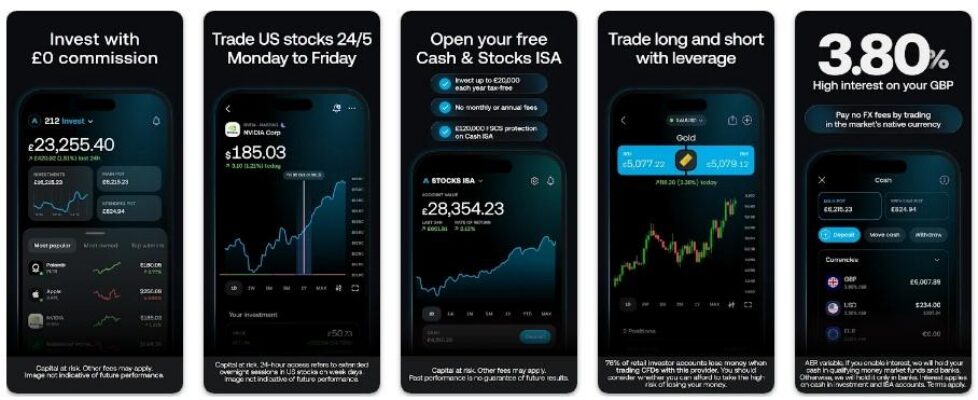
For the stockbroking business, the Company operates a zero-commission model where clients do not pay commission for trading nor suffer custody fees for the assets held. T212 earns fees from, clients when they trade in a currency different to that in which their cash was deposited. T212 also keeps a portion of the interest earned on uninvested client money and earns fees through a fully collateralised stock lending programme.
The cash savings offering is completely fee-free. T212 generates income from the net interest margin on its cash savings product, representing the difference between interest earned on client deposits and interest paid out to clients. T212 manages its own risk in accordance with its liquidity risk management framework.
For the CFD product, T212 manages market risk in line with its trading risk management policy and limits. These are based on defined risk parameters for each asset class, with exposures outside of these limits hedged with reputable third parties. Income is primarily generated through the bid-offer spread and overnight financing; for positions held overnight, the Company applies a charge or credit based upon the national value of the positions and the direction of the trade (long or short), prevailing market interest rates, and a mark-up. Additionally, an FX fee is applied to the realised profit or loss when a position is closed in a currency different from the client’s account base currency.
Trading 212 Strategy
T212 UK is an online only investment broking and wealth management platform for retail clients predominantly based in the UK. Its mission is to democratise access to financial markets and empower its users to build healthy saving and investment habits.
While operating an integrated savings, investment, and trading platform—offering CFDs alongside tax-efficient ISAs and General Investment Accounts, T212’s growth strategy remains focused on the stockbroking and cash savings part of the business, and growing the value of client Money and client asset balances under administration.
While this growth continues to be driven in part by broader market trends and activity, crucially it is driven by the increasing popularity of T212’s platform and its product offering which includes, for example, T212’s zero commission pricing structure, the ability to trade in fractional amounts of shares, the functionality within the platform to build portfolios and market leading interest on cash. In addition, the ability to trade via T212’s mobile app has proved to be extremely popular with the tech savvy demographic.
These features have helped open up online share trading and wealth management to a significantly wider and diverse client base who may not historically have had access to the financial markets or been considered as potential customers. T212’s products, services and technology has facilitated and enabled a wider audience to participate in managing their own financial affairs and investment decisions that they were previously unable to do.
During the year, the Company launched and further developed several initiatives to enhance its client offering. Some highlights include:
- The interest-sharing programme has been further strengthened, so that for the vast majority of 2025, clients have enjoyed market leading interest rates and flexibility on their uninvested cash.
- The continued expansion of the Trading 212 debit card offering which allows clients with a general investment account to have more convenient access to their funds and benefit from market-leading cashback on spending.
- The trading infrastructure has been enhanced to allow over 100,000 orders per second.
- Transitioning its Public API to live execution, enabling users to automate trades and build bespoke financial tools.
Performance
In 2025, T212 made revenues of £277.6M (2024: £161.7M) and profit before tax of £123.1M (2024: £52.9M).
The 72% growth in revenues follows a 55% increase the previous year and continues to demonstrate the increasing popularity of technology based trading and wealth-building apps that allow the “new” generation to manage their financial portfolios using tech that is both familiar to them whilst removing significant costs of both entry and ongoing transaction-based costs.
The Company’s total administrative expenses rose 44% to £163.0M (2024: £113.3M) reflecting a larger headcount, increased marketing activities and greater transactional costs.
Net assets have increased from £156.2M to £194.3M year-on-year, a result of continued profitability less £54.1M in dividends.
Customer acquisition
Non-financial indicators have historically been focused on customer acquisition and customer activity. As there is no cost for a client to open an account, the number of accounts holding either cash or assets is the more useful gauge of business growth and potential.
During 2025 some of the key metrics we analyse have moved as follows:
- number of funded accounts up 69%.
- average number of monthly active users up 84%.
- total value of client money & assets combined up 140%.
- system uptime increased from 99.98% to 99.99%.
- Apple store rating increased from 4.6 to 4.7.
- client satisfaction from chat/emails, rose from 77 to 85.
Other positive indicators of performance during the year include the significant improvements made across the business, including:
- improvements made to the Company’s operational resilience framework and operations;
- the maturity of the risk management framework and risk reporting capabilities;
- and further embedding the changes from the Company’s Target Operating Model throughout the business.
Future developments
The Company said it will continue its objective of democratising access to financial markets through increasing the breadth and value of services offered to its client base through the T212 app. Trading 212 hopes to achieve this through new products, as well as further enhancements to the existing offering.
The Company gained permission from the FCA on 26 February 2026 to launch a Self-Invested Personal Pension (SIPP) product. The new SIPP offering has been developed to complement and enhance the Company’s current range of products, enabling customers to consolidate their long-term financial planning needs within a single platform. The directors believe that the addition of a SIPP product will deepen the Company’s relationship with its existing customer base whilst also broadening its appeal to prospective customers seeking a comprehensive, tax-efficient retirement savings solution.
Furthermore, the Company is currently enhancing its risk management and trade execution framework by centralising certain activities within a newly established Group subsidiary based in Ireland. In the upcoming financial-year, the Company’s CFD hedging activities and the Systematic Internaliser (SI) functions for the share dealing business will transition to this specialist entity. This restructuring is intended to provide the Company with greater execution efficiency and more robust market risk mitigation by leveraging Group-wide expertise and scale.