
TradingView introduces enhanced Paper Trading capabilities for futures contracts

TradingView has announced a powerful update for futures traders: enhanced Paper Trading capabilities for futures contracts.
Up until now, Paper Trading supported only essential actions like opening and closing futures trades, which limited the ability to design and test long-term strategies. With this update, TradingView users can now simulate the entire lifecycle of a futures contract, from execution and expiration to fees and balance changes. This makes testing much more accurate, realistic, and insightful.
All expiring futures are now settled at the final settlement price. This provides a much clearer picture of your realized profits and losses, helping you evaluate the true effectiveness of your strategy under close-to-real market conditions.
Expired positions now close automatically, and all active orders linked to expired contracts are cancelled. This means fewer manual cleanups: your account now reflects only active positions, preventing mistakes and keeping your strategy simulation smooth and accurate.
All executions are now fully reflected in your Account History and Trading Journal. This gives you complete transparency into your trading performance and lets you analyze every trade detail, so you can identify patterns, improve discipline, and refine your strategy.
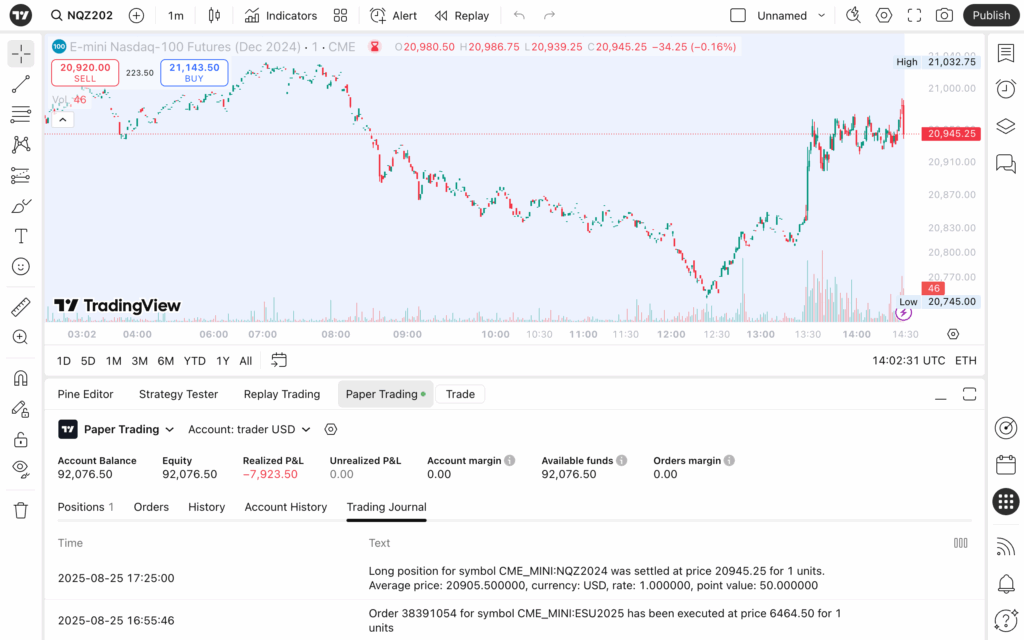
A new Expiration date column has been added to the trading panel for both positions and orders. Having clear visibility into contract expirations helps you manage risk better and avoid surprises when a contract reaches maturity.
All futures are treated as cash-settled, regardless of their actual type, meaning they are closed by paying/receiving the difference between the entry price and the settlement price in cash.
This allows you to test strategies without restrictions, giving you a more flexible and versatile testing environment.
All these features are enabled by default for both new and existing Paper Trading accounts and apply to all expiring futures contracts.
This update does not apply to perpetual or continuous futures.