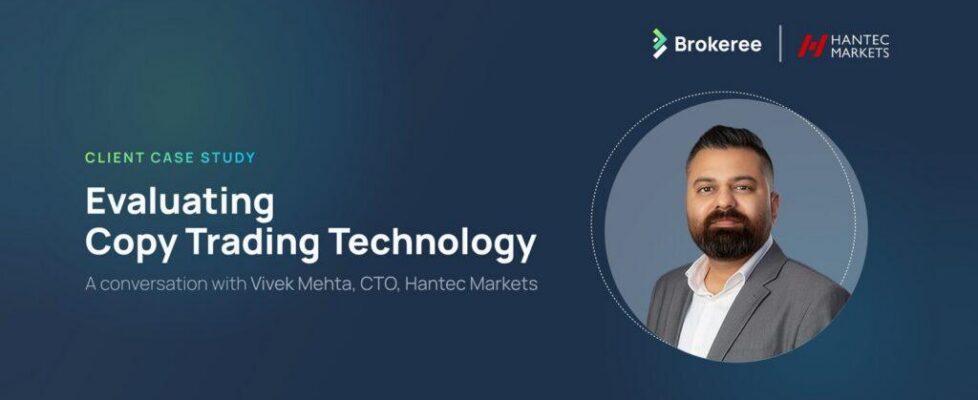
Evaluating Copy Trading Technology: A Conversation with Hantec Markets

The global copy trading platform market is projected to grow at a compound annual growth rate of 17.8% through 2033, driven by the increasing adoption of automated trading technologies and social trading trends.
As more brokers introduce copy trading, selecting the right technology partner has become one of the most consequential parts of the launch. While many providers appear similar on paper, meaningful differences often emerge when brokers evaluate them against their own operational requirements or after they’ve gained experience with an existing tech provider.
Earlier this year, Hantec Markets, a global multi-asset broker with more than three decades of industry experience, transitioned from its previous copy trading solution to Brokeree’s Social Trading platform.
To understand what drove that decision and how the transition was managed, Brokeree’s Marketing Manager Arina Sharagina spoke with Vivek Mehta, Chief Technology Officer at Hantec Markets. In this conversation, Vivek shares how Hantec approached the evaluation process, the criteria that shaped the final decision, and what other brokers should weigh before selecting a long-term technology partner.
Q1. Social trading has been part of Hantec’s offering for some time. What changed in the business that made now the right time to reassess your technology partner? Was there a specific moment when it became clear a change was needed?
Vivek: Social trading has been part of our offering for a while, but as Hantec Markets grew across multiple markets it became a much more strategic part of our broader product mix rather than a peripheral feature. That shift raised the bar for the technology behind it: we needed a solution that could support future scale, give us greater operational control, and deliver a more consistent experience for both signal providers and followers.
There wasn’t a single dramatic moment that forced the decision. It came out of a more deliberate review — of the recurring operational limitations we were working around, the effort it took to manage the existing platform day to day, and where we wanted the service to go over the longer term. Once we put those together, it was clear that continuing to engineer around those limitations would hold back the pace at which we could develop the service. That is what made it the right time to reassess.
Q2. Once you decided to evaluate the market, what did the selection process look like? How did you compare different copy trading solutions?
Vivek: We started internally rather than with vendors. The first step was documenting the requirements of every stakeholder that touches the service — Product, Technology, Trading, Operations, Compliance and Client Support — so we were evaluating against our own operational reality, not a generic checklist.
From there we assessed providers across a consistent set of criteria: platform functionality, scalability, reliability, integration capability, reporting, administrative controls, security and technical support. But we were careful not to stop at demonstrations and feature lists. What mattered more was how each solution behaved in real trading conditions — volatile markets, high trading volumes and a range of account configurations.
We also weighed the things that sit around the technology: the quality of the provider’s implementation team, the documentation, and the standard of post-launch support. And we looked hard at long-term product direction, because we wanted a partner that would keep investing in the platform as client expectations evolved, not one whose roadmap ended at the sale.
Q3. What were the non-negotiable criteria on your list? And were there factors that turned out to matter more than you expected once you looked closely at how each solution worked?
Vivek: A few things were genuinely non-negotiable. The first was reliability and execution accuracy: in copy trading, traders have to be able to trust that the copying logic will behave consistently and transparently. The second was risk management — we needed strong, flexible controls, including different allocation methods, equity protection, and controls available to both followers and our administrators. Clean integration with our existing trading infrastructure and operational processes was another, without adding unnecessary complexity. And scalability, security, reporting, auditability and the regulatory considerations around all of that were central throughout.
What mattered more than we expected was administrative usability and operational visibility. A platform can have excellent client-facing features, but it also has to let our internal teams see and investigate activity so they can support clients quickly and effectively — that internal side turned out to be just as important as the trader experience. In the same vein, the responsiveness and technical capability of the provider’s own team weighed heavily, because with a technology partner the relationship really begins at implementation; it doesn’t end there.
Q4. Hantec was already running its PAMM service on Brokeree’s infrastructure. When it came to Social Trading, what stood out about the platform itself?
Vivek: We were already running our PAMM service on Brokeree’s infrastructure, and that experience counted for a lot. It had already given us confidence in their technical depth and, just as importantly, their understanding of how a brokerage operates.
When we looked at the Social Trading platform specifically, what stood out was the balance it struck between functionality for clients and control for us as the broker. Its configuration was flexible enough to let us structure the service around our own commercial, operational and risk-management requirements rather than forcing us to fit a fixed model. We were particularly interested in the copying controls, the performance visibility, and the tools for managing both signal providers and followers.
There was also a practical advantage in building on technology from a partner we already worked with: it let us simplify support, integration and vendor management across our investment services, rather than adding another separate relationship to maintain.
Q5. Was there anything during the migration that was more challenging than expected?
Vivek: The technology deployment itself was only one part of the migration — and not the hardest part. The more complex work was aligning account structures, trading conditions, symbols, permissions and business rules between the existing environment and the new one, and making sure the transition was carefully managed for existing users. We wanted the new platform’s behaviour validated across a wide range of trading scenarios before anyone relied on it.
That made coordination essential. Technology, Trading, Operations, Compliance, Marketing and Support all had to move together. We also treated client communication and internal training as first-order tasks, because even a positive platform change can create uncertainty if users and support teams aren’t properly prepared. A phased testing and validation process was what made the difference; it let us identify configuration differences early and take a lot of operational risk out of the launch.
Q6. How have your clients (both the signal providers and traders) responded since the transition?
Vivek: The overall response has been positive, particularly around the clarity of the platform and how much easier it is to understand and manage copy-trading relationships. Signal providers have benefited from improved visibility and from a platform that lets them present their strategies more effectively. Followers, for their part, have more control over how they participate, including selecting strategies that match their own preferences and risk appetite.
As with any transition, some clients needed a little guidance during the initial adjustment period, and our Support and Operations teams worked closely with them to make the change as smooth as possible. We treat feedback as an ongoing part of the process rather than a one-off, and we’re continuing to refine the experience based on how clients actually use the platform.
Q7. Now that Hantec Social is running on the new platform, what operational improvements have made the biggest difference for your team?
Vivek: The single biggest improvement has been administrative visibility. It is much easier now for our teams to monitor activity and investigate client queries, which flows directly into the quality and speed of support we can offer. The more flexible configuration has also let us manage different client segments and business requirements without leaning on the manual workarounds we used to rely on.
Beyond that, the platform simply surfaces clearer information for our Trading, Operations and Support teams, so issues get resolved more efficiently. Working with a technology partner that already understands our environment has simplified communication and cut the time it takes to diagnose a technical or operational question. Taken together, it gives us a stronger foundation to expand the service without adding disproportionate operational overhead.
Q8. For brokers currently weighing a copy trading provider, or considering a switch from their existing one, what advice would you give them based on your experience?
Vivek: Start with your own operating model and your clients’ needs, rather than choosing a platform on the strength of the longest feature list. Involve Technology, Trading, Operations, Compliance and Support from the very beginning, because each of those teams will surface different risks and requirements that you won’t see from any single vantage point.
Then test the full lifecycle, not just the headline features — onboarding, strategy discovery, allocation, execution, risk controls, fees, reporting, exception handling, right through to account closure. And evaluate how the solution behaves in volatile markets and under higher volumes, not only in the calm of a demonstration. I’d also urge brokers to review the administrative tools as carefully as the client-facing interface; internal visibility has a real effect on both support quality and operating costs, and it is easy to overlook.
Finally, remember what you’re doing: you are selecting a long-term technology partner, not simply purchasing software, so weigh the provider’s implementation capability, responsiveness and roadmap. And treat the migration itself as a business-change programme, with proper testing, training and client communication, rather than as a purely technical integration.
Q9. Looking ahead, how do you see client expectations around copy trading evolving over the next few years, and how is Hantec preparing for that?
Vivek: Client expectations are going to rise on several fronts at once. Clients will increasingly expect greater transparency — around strategy performance, drawdowns, risk, fees and historical behaviour. They’ll want more control and personalisation, too, rather than a binary choice to copy a provider or not. And mobile-first access, real-time information and a seamless experience across platforms will simply become the standard rather than a differentiator.
We also expect growing demand for more intelligent strategy discovery and risk-based recommendations to help clients navigate their choices. That is promising, but it has to be introduced responsibly — with appropriate transparency and proper client safeguards. Through all of it, trust will remain the critical factor: brokers will need strong monitoring, clear performance information and effective controls that protect both followers and strategy providers.
Our own preparation is focused on the foundations — strengthening the underlying technology, our data capabilities and our operational framework — so the service can evolve to meet those expectations while maintaining the reliability, security and regulatory alignment that clients depend on.
Conclusion
Vivek’s answers give us a closer look at how Hantec approached the move to a new Social Trading technology partner and what mattered during the selection and migration process. The discussion also touches on what brokers may want to consider when evaluating a copy trading provider for the longer term. We thank Vivek for sharing Hantec’s experience and perspective.
About Hantec Markets
Hantec Markets is a global trading platform that empowers traders with reliability, trust, and control across their trading experience. Backed by more than 36 years of group heritage, the company offers a range of trading products and services designed to suit different trading styles, including Hantec Mobile for real-time trading, charts, signals, and news on the go; Hantec WebTrader for fast browser-based trading with live market tools; Hantec Social for automatic copy trading from expert strategy providers; Hantec PAMM for managed trading opportunities; and MetaTrader® 4 and 5, the trusted platforms used by advanced traders worldwide. Hantec Markets is regulated across the United Kingdom, Australia, Hong Kong, and Mauritius and is the official trading partner of the Ultimate Fighting Championship (UFC) in APAC and Club Atlético de Madrid in Latin America.
About Brokeree Solutions
Brokeree Solutions is an international provider of technological solutions for multi-asset brokers worldwide. With 12 years of industry expertise, the company specializes in turnkey solutions development, trading platform servicing, and consultation for retail brokers using MetaTrader 4 & 5 and other trading platforms. Brokeree Solutions’ extensive product portfolio includes flagship systems like Social Trading, PAMM, Prop Pulse, and Liquidity Bridge, offering comprehensive technologies that address almost any broker’s needs.