
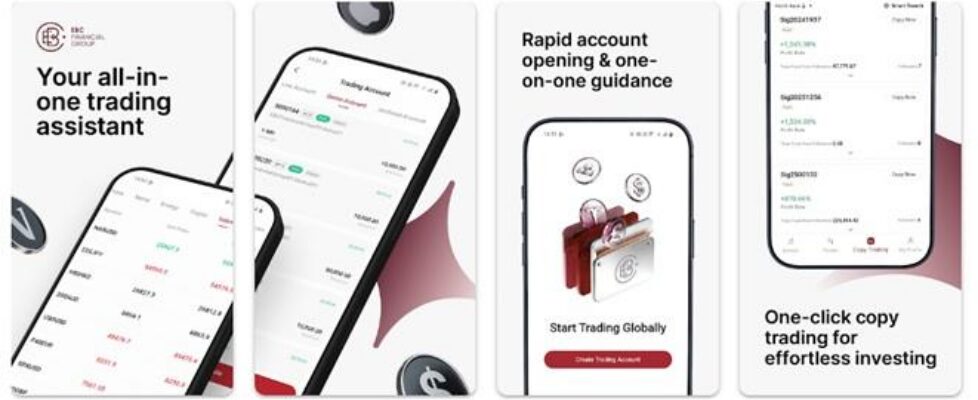
EBC expands live trading in the EBC App

Global Retail FX and CFDs broker EBC Financial has announced that it has expanded live trading in the EBC App, bringing account management, funding tools, and trade execution together on one mobile platform.
First introduced in stages on 14 September 2026, the trading feature has since been extended to additional markets, with a further rollout recorded on 21 October. Access remains subject to each client’s location, account eligibility, and the EBC entity providing the service.
 Andria Phiniefs, Marketing Director, EBC Financial Group said,
“Our mission is to help our clients trade better by making our platform accessible any time, any anywhere. The EBC App now allows them to monitor their accounts, follow the status of their orders, and manage their exposure without switching between several platforms. Bringing these functions together should make day-to-day account management more straightforward, while keeping trading risks and responsibilities clear.”
What Clients Can Do in the App
Clients can view real-time quotes and trade CFDs on over 300 forex pairs, commodities, indices, stocks, and ETFs. They can place orders at the current market price, or set pending orders that execute only when the price reaches a level they choose. They can also set take-profit and stop-loss levels, cancel orders, and close several positions at once with a single tap.
Take-profit and stop-loss orders help clients manage their exposure on a position based on their risk tolerance. In fast-moving markets, or when prices jump past a set level, a stop-loss may be filled at a worse price than the one set. As CFDs are complex instruments and come with a high risk of losing money rapidly due to leverage, and losses can exceed deposits, a solid and sound risk management strategy guided by informed decisions is essential.
One App from Account Opening to Trade
EBC announced the EBC App on 7 July 2026 as an account management platform. Clients could already open an account and complete identity verification in the app, make deposits and withdrawals, and reach 24/7 multilingual support. They could also switch between accounts, with funds, positions, and trading activity synchronised in real time. With live trading added, the same app now covers the final step of placing a trade.
What Happens After the Tap
Through the group’s Smart Order Routing Engine, more than 87.6% of EBC orders are filled at a better price than requested. In other words, those orders were filled at a price more favourable to the client than the one quoted when they were placed. EBC’s trading environment provides an average execution speed of 20ms, capacity to process 1,000 orders per second, and 98.75% system stability, supported by Tier 4 private leased-line servers across five global financial hubs and 30 data centres worldwide.
Pricing draws on more than 50 bank and non-bank liquidity providers, including J.P. Morgan, UBS, Barclays, and Goldman Sachs. EBC offers raw ECN spreads from 0.0 pips, where the spread is the gap between the buy and sell price, and five levels of market depth, which show the prices and volumes available beyond the best quote.
EBC App Availability
The EBC App, provided by EBC Financial Group (SVG) LLC, is available for iOS and Android. Trading functionality, instruments, and account services are subject to applicable local requirements and client eligibility.
About EBC Financial Group
EBC Financial Group, headquartered in London, is a comprehensive financial services group licensed and operating in multiple key jurisdictions worldwide. The group offers over 200 Contracts for Difference (CFDs) products, including foreign exchange, precious metals, energy, stock indices, US stocks, ETFs, and crypto. With branches in major global financial centres such as Tokyo, Sydney, Singapore, and Hong Kong, its service network covers over 100 countries and regions.
Regulation is the cornerstone of trust in the financial industry. EBC ‘s various operating entities hold financial regulatory licenses issued by the UK’s Financial Conduct Authority (FCA), Australia’s Securities and Investments Commission (ASIC), the Cayman Islands Monetary Authority (CIMA), and South Africa’s Financial Sector Conduct Authority (FSCA), strictly adhering to local regulatory rules in their operations.