

Why High-Risk-Reward Ratio Matters More Than Win Rate for New Traders

Most new traders start with a single obsession: winning. The fixation on win rate is natural — and it’s also one of the main reasons so many retail accounts bleed out quietly over months.
The CFTC has repeatedly flagged how futures markets expose uninformed traders to losses they didn’t anticipate. Knowing how to evaluate the risk-reward ratio trading won’t eliminate risk, but it puts a trader in control of how much they take on with each position.
If you’ve been trading for some time, you could have noticed that having a mentor who understands position sizing, entries, and probability gives you a real edge. That’s exactly the kind of structured guidance offered by WR Trading, where personal mentorship for traders is built around the core skill this post covers: mastering the risk-to-reward ratio before anything else.
What the Win-Rate Trap Actually Costs You
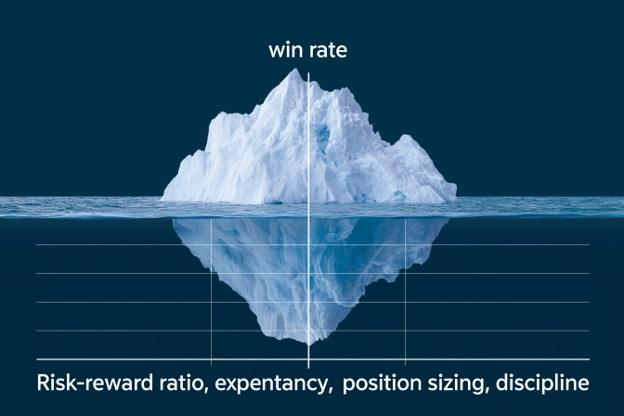
New traders conflate accuracy with profitability. The logic seems solid — win more trades, make more money. Over 100 trades, a 35% win rate at 1:3 outearns a 65% win rate at 1:1 by $1,000. The ratio does more work than accuracy.
That’s high-risk reward trading in its most basic form — the difference between accounts that compound over years and ones that hit zero before the trader learns anything
How to Calculate Risk-Reward Ratio in Trading
The formula itself is simple. To calculate the risk-reward ratio in trading, divide the distance from your entry to your take-profit target by the distance from your entry to your stop-loss:
RRR = (Take Profit – Entry) / (Entry – Stop Loss)
Entry at $100, stop at $95, target at $115 — risk $5, reward $15, risk-to-reward ratio of 1:3. The practical output of that calculation is your break-even win rate: the minimum accuracy needed to avoid losing money at that ratio.
| Risk-Reward Ratio | Break-Even Win Rate Needed |
| 1:1 | 50% |
| 1:2 | 33.3% |
| 1:3 | 25% |
| 1:4 | 20% |
| 1:5 | 16.7% |
That table makes something clear: a 1:3 risk-reward ratio lets you be wrong on three out of every four trades and still not lose money — as long as you take your stops without exception. A 1:1 ratio, by contrast, demands that you be right more than half the time just to break even, before accounting for commissions and slippage.

The choice of ratio isn’t cosmetic. It defines the entire structure of your trading system.
Expectancy: The Number That Unifies Both Metrics
The concept that ties win rate and risk-reward ratio together is called expectancy. It’s expressed as:
Expectancy = (Win Rate × Average Win) – (Loss Rate × Average Loss)
A positive expectancy gives your system a real edge. A negative expectancy means you’re mathematically guaranteed to lose over a large enough sample of trades, regardless of how good any individual week feels.
Here’s what it could look like with numbers. At 2.5:1, a 40% win rate produces positive expectancy; at 0.8:1, a 65% win rate produces a loss — accuracy and profitability simply don’t move together.
This is the clearest argument for building your strategy around a good risk-to-reward ratio from the start, not as an afterthought.
Why Most Retail Traders Never Learn This
The data on retail trading outcomes points in one direction. EU regulations require brokers to display the percentage of losing clients directly on their websites — and across the board, those numbers are uncomfortable reading. ESMA’s 2025 retail CFD account statistics, covering 20 EU brokers, put the loss rate at 74–89% of retail accounts — a number that has barely moved despite better platforms and more accessible education.
These traders weren’t necessarily making wrong predictions. Many were making the mistake of winning small and losing large — a pattern driven by emotion, not mathematics. Cutting winners short to lock in a “win” and holding losers hoping for a reversal is the behavioral signature of someone chasing win rate rather than managing risk-reward ratio trading.
The Psychology of Being “Right”
Winning feels good in a way that has nothing to do with profit. Research in behavioral finance shows that the emotional reward of a correct trade activates the same dopamine pathways as other forms of reinforcement — which is why traders chase that feeling even when the underlying math is working against them.
A trader who takes profits at 1:0.5 and lets losses run to 1:2 will feel like they’re winning constantly, right up until their account is gone. The fixation on accuracy over profitability is not a rookie mistake that you naturally outgrow — it’s a cognitive bias that requires deliberate correction, which is one reason structured trading mentorship proves valuable for accelerating that shift.
What a Good Risk-to-Reward Ratio Looks Like in Practice
The best risk-reward ratio isn’t universal — it depends on your style, market, and how often your setups produce entries. Different market call approaches require different standards:
- Scalping typically operates at 1:1 to 1:1.5, compensated by high accuracy (60–70%) and volume.
- Day trading often targets 1:2 to 1:3 with moderate win rates around 50–60%.
- Swing trading commonly uses 1:3 to 1:5, accepting lower win rates of 40–50% in exchange for letting trades run.
- Position trading may use 1:5 or higher, with win rates potentially dropping to 30–40% while remaining profitable.
Most professional traders aim for a minimum of 1:2 as their floor. A 1:3 ratio is widely regarded as the best risk-reward ratio benchmark for day and swing traders because it provides enough buffer to absorb losing streaks without destroying equity.
The math backs that up: at 1:2, you can lose every other trade but still break even. At 1:3, you can lose three out of four trades and remain flat. That cushion is not just mathematical comfort — it’s what allows a trader to stay in the game long enough for their edge to materialize across a statistically meaningful sample of trades.
Why Professionals Win Less Than You Think
The data on professional traders consistently contradicts the popular image of someone who wins most of the time. Most professional traders have win rates near 60% or below. Many highly successful traders operate with win rates between 30% and 40%, losing frequently in small amounts while occasionally holding large winners that anchor their overall performance.
That profile — frequent small losses, infrequent large wins — is only psychologically sustainable if the trader has genuinely internalized why the risk-reward ratio matters more than being right on any given trade. For new traders, reaching that mindset is often the single most difficult adjustment, and it rarely happens through reading alone.
How to Apply This to Your Trades
Before taking any position, a disciplined trader defines three things in order:
- Entry price — where you plan to get in, based on market structure, not impulse.
- Stop-loss placement — set below support for longs or above resistance for shorts, determined by the chart, not by the dollar amount you’re willing to lose.
- Take-profit target — a realistic level based on prior highs, supply and demand zones, or measured moves. This sets your potential reward.
Only after defining all three do you calculate your risk-to-reward ratio. If the result is below 1:2, the setup doesn’t meet the standard — regardless of how confident you feel about the direction. Skip this one and wait for the next.
One critical rule: never move your stop-loss to create a better-looking ratio. That’s not improving your trade; it’s falsifying the math while exposing yourself to a larger loss.
| Win Rate | Minimum RRR Needed to Be Profitable |
| 25% | 1:3 |
| 33% | 1:2 |
| 40% | 1:1.5 |
| 50% | 1:1 |
| 60% | Better than 1:0.67 |
The table makes it easy to check whether your historical win rate is compatible with the ratio you’re using. If your win rate and ratio combination falls below the break-even line, no amount of better setups will fix the problem — the system itself doesn’t have a positive expectancy.
Understanding this compatibility check is a foundational part of what structured trading mentorship should teach before anything else — entries, indicators, or market analysis.
The Sample Size Problem Nobody Talks About
Even a perfectly calibrated risk-reward ratio can look like it’s failing over short periods. The math of expectancy only becomes reliable across a sufficiently large sample. Preliminary readings require at least 30–50 trades. More sound conclusions call for a hundred or more.
This is why new traders often abandon systems that work. A 1:3 ratio with a 40% win rate will still produce runs of 4–6 consecutive losses — not because the system is broken, but because that’s normal variance at that win rate. Traders who don’t understand this quit exactly when they should be continuing.
Put It Together & Build a System That Lasts
The transition from thinking about accuracy to thinking about expectancy is the defining shift in a trader’s development. It requires accepting that you’ll be wrong often — sometimes for stretches that feel like they’ll never end — and trusting that the math will work out across a large enough sample.
That’s not a comfortable place to operate from without some foundation of understanding why it works. It also explains why many traders who study the mechanics still struggle until they get direct feedback on how they’re applying them in real trades. Practical trading mentorship — focused on position sizing, stop placement, and ratio discipline — closes the gap between knowing the concept and executing it under pressure.
Risk-reward ratio trading isn’t complicated. The formula takes about 30 seconds to run. The challenge is building the discipline to reject trades that don’t meet the standard, hold trades that do, and let the math work at scale. That discipline, more than any particular setup or indicator, is what makes the difference between traders who survive and those who do not.