

Beyond Dollar Dominance: Reserve Managers Prepare for a New Financial Era

The following is a guest editorial courtesy of Carolane de Palmas, Markets Analyst at Retail FX and CFDs broker ActivTrades.
The world’s central banks are gradually redefining how they manage reserves and prepare for a changing global financial system. According to the latest Global Public Investor report from the Official Monetary and Financial Institutions Forum (OMFIF), reserve managers are becoming less reliant on the US Dollar over the long term while increasing allocations to gold and accelerating investments in artificial intelligence.
Although the greenback remains the world’s dominant reserve currency, geopolitical uncertainty, shifting trade dynamics and rapid technological advances are encouraging policymakers to rethink both where they store value and how they manage increasingly complex financial systems. The survey, covering institutions responsible for roughly $10 trillion in assets, suggests reserve management is entering a new phase driven as much by resilience and technology as by returns.
Why Are Central Banks Gradually Diversifying Away From the US Dollar?
The US Dollar remains the cornerstone of the global financial system, but reserve managers are becoming increasingly cautious about concentrating too much of their portfolios in a single currency. For the first time since OMFIF began tracking long-term reserve allocation intentions in 2023, more central banks expect to reduce their Dollar holdings over the coming decade than increase them.
The shift does not reflect an imminent loss of the Dollar’s reserve currency status. The greenback has appreciated around 3% this year, supported by higher US interest rates, resilient economic growth and continued demand for US assets during periods of geopolitical uncertainty. Rather, reserve managers are preparing for a world where financial and geopolitical risks are becoming more fragmented.
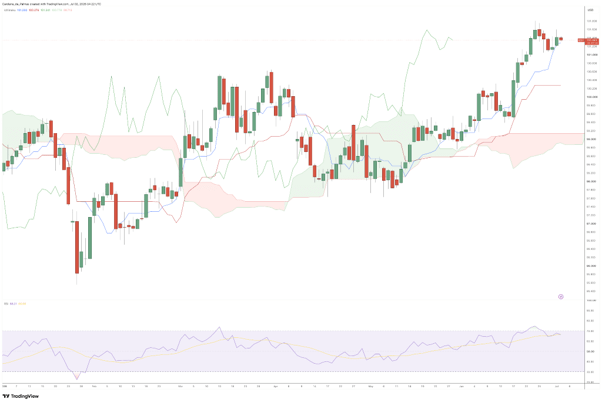
Dollar Index Daily Chart – Source: TradingView
Growing policy uncertainty surrounding tariffs, sanctions and international trade has reinforced concerns that reserve assets should be more diversified. As geopolitical tensions have intensified, central banks increasingly view reserve management not only through the lens of liquidity and returns but also through resilience against political risk.
The survey highlights a growing belief that the international monetary system is gradually evolving towards a multipolar structure. Nearly four out of five central banks expect reserve currencies to become more diversified over time, with greater roles for smaller developed-market currencies alongside traditional reserve assets. Norwegian krone, New Zealand Dollar and Pound Sterling have attracted increasing attention as reserve diversification tools, even though their global market share remains modest.
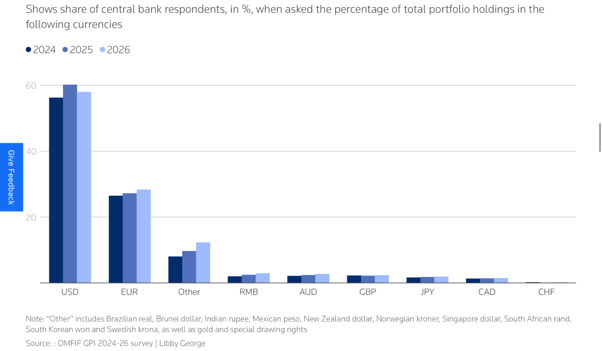
Source: Reuters
The findings reinforce a broader trend often described as de-dollarization. According to JPMorgan, the Dollar’s share of global foreign exchange reserves has already fallen to its lowest level in two decades. Rather than replacing the Dollar with a single rival, central banks appear to be building more diversified reserve portfolios designed to reduce concentration risk while preserving liquidity.
Why Is Gold Becoming a Strategic Reserve Asset Again?
If reserve managers are reducing their long-term dependence on the Dollar, gold has emerged as one of the primary beneficiaries.
The survey shows that gold has become the preferred asset class for reserve expansion over the next two years. A net 30% of central banks intend to increase their gold holdings, while most respondents expect prices to remain well supported, with 61% forecasting bullion to trade between $5,000 and $6,000 per ounce by mid-2027.
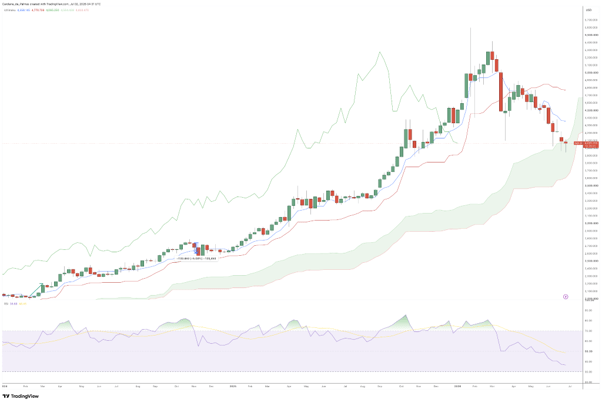
Weekly Gold Price Chart – Source: TradingView
The renewed appetite for gold extends well beyond price expectations. Central banks increasingly view bullion as a strategic asset capable of providing protection against geopolitical shocks, financial sanctions and structural changes in the international monetary system. More than half of respondents identified geopolitical risk as their primary motivation for accumulating additional gold reserves, a notable increase from the previous survey.
Unlike sovereign bonds or foreign currencies, gold carries no counterparty risk and cannot be frozen by another government. Those characteristics have become increasingly valuable as geopolitical fragmentation has accelerated and reserve managers seek assets that remain outside the direct control of any single country.
This helps explain why gold now sits at the centre of reserve management strategies despite trading near record highs. More than 80% of central banks already hold bullion, and relatively few respondents believe current prices are sufficiently elevated to discourage additional purchases. Instead, reserve managers increasingly appear willing to prioritize long-term resilience over short-term valuation.
While the Dollar is likely to remain the world’s primary reserve currency for years to come, gold is steadily strengthening its position as the preferred hedge against geopolitical uncertainty and systemic financial risk.
Why Is Artificial Intelligence Becoming the Next Strategic Tool for Central Banks?
Reserve diversification is only one part of the transformation taking place inside central banks. Institutions are also rapidly modernizing the way they analyse information, supervise financial institutions and manage increasingly complex datasets through artificial intelligence.
According to the OMFIF survey, more than two-thirds of central banks plan to expand AI integration over the near term, while almost none believe current implementation levels are sufficient. Adoption is already widespread among advanced economies, where nearly 90% of central banks report using AI in some capacity, compared with less than half of their counterparts in emerging markets.
Most current applications remain focused on improving operational efficiency. Central banks are deploying AI to automate administrative processes, analyse large volumes of economic and financial data and improve internal research capabilities. However, the technology’s strategic importance is expected to expand significantly over the coming years.
The Bank for International Settlements argues that generative artificial intelligence, particularly large language models, has created new opportunities for central banks to process the enormous quantities of textual information they produce and consume. Applications range from monetary policy research and macroeconomic forecasting to financial supervision, payment system oversight and statistical production. By accelerating document analysis and extracting insights from unstructured data, AI has the potential to improve both the speed and quality of policy decisions.
The World Bank also sees AI becoming increasingly important for financial supervision, particularly in emerging economies. As central banks oversee faster payment systems and more digital financial services, AI-powered supervisory technologies can detect patterns across vast datasets that would be impossible to identify manually. These capabilities could strengthen risk detection, improve regulatory oversight and support financial inclusion.
At the same time, both institutions emphasize that stronger governance frameworks will be essential. The growing ability of AI to infer information across multiple datasets raises important questions around privacy, cybersecurity, accountability and transparency. As adoption accelerates, central banks will need to ensure that advances in technology are matched by equally robust safeguards.
The survey suggests that reserve managers increasingly view artificial intelligence not simply as an efficiency tool but as a strategic capability. Just as gold is becoming an essential component of reserve diversification, AI is rapidly becoming an essential component of the modern central bank.
Sources: Reuters, CNN, World Bank, BIS, OMFIF Global Public Investor Report, Bank for International Settlement
The information provided does not constitute investment research. The material has not been prepared in accordance with the legal requirements designed to promote the independence of investment research and as such is to be considered to be a marketing communication.
All information has been prepared by ActivTrades (“AT”). The information does not contain a record of AT’s prices, or an offer of or solicitation for a transaction in any financial instrument. No representation or warranty is given as to the accuracy or completeness of this information.
Any material provided does not have regard to the specific investment objective and financial situation of any person who may receive it. Past performance is not a reliable indicator of future performance. AT provides an execution-only service. Consequently, any person acting on the information provided does so at their own risk. Forecasts are not guarantees. Rates may change. Political risk is unpredictable. Central bank actions may vary. Platforms’ tools do not guarantee success.