

Kraken 2025 results: Revenue $2.2 billion (+33%), EBITDA $531 million (+26%)

US based crypto exchange operator Kraken has released some summary financial and operating information for 2025, showing some nice top and bottom line growth at the company.
We’d note that the results are for Kraken operator Payward Inc. Kraken remains the flagship multi-asset platform, but Payward’s infrastructure also powers:
- NinjaTrader, a leading retail futures platform,
- CF Benchmarks, a global index and reference data provider,
- Breakout, a crypto-native proprietary trading and evaluation platform, and
- xStocks, a global tokenized equities platform.
Financial summary
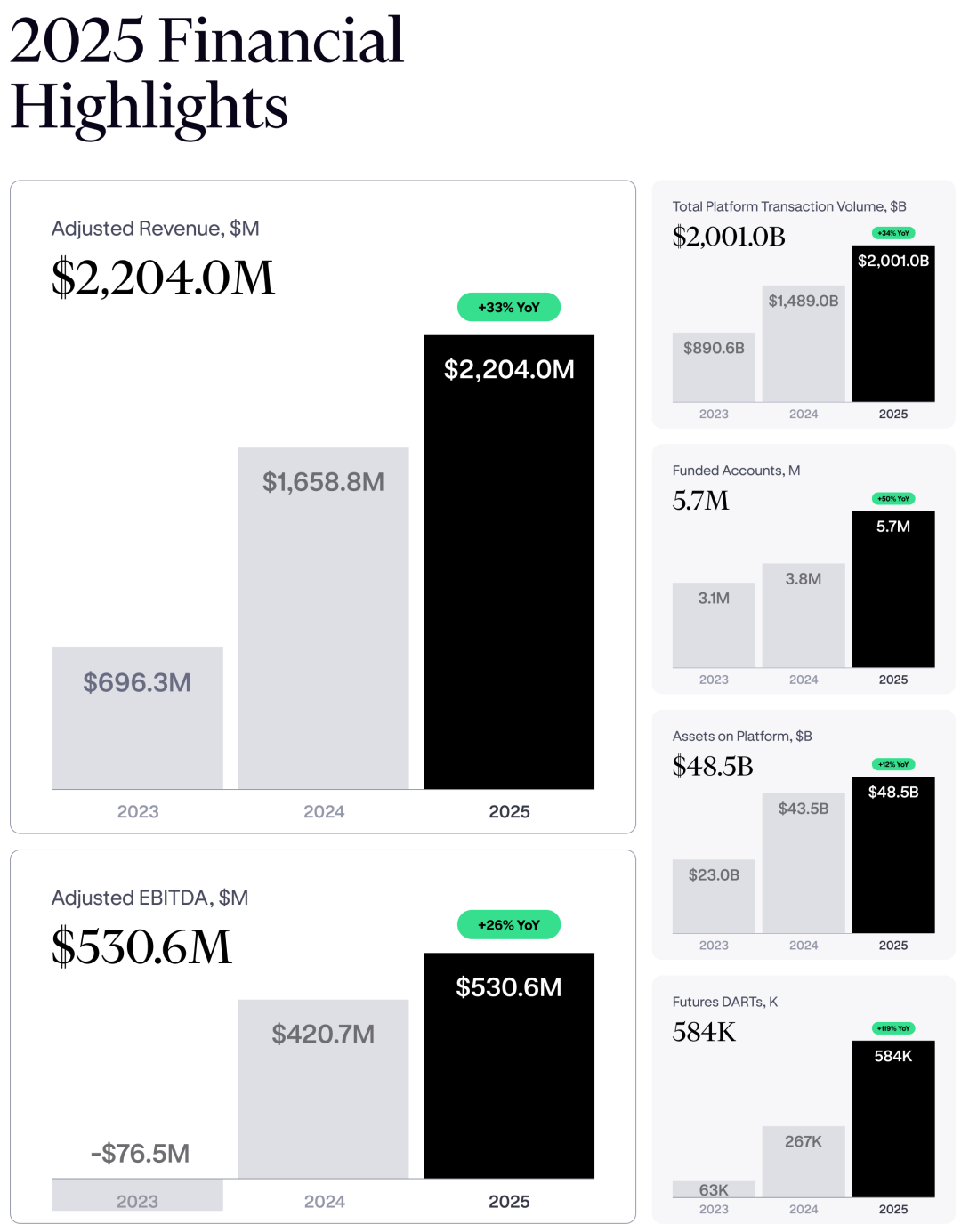
Kraken, whose parent company Payward Inc filed for an IPO late last year, said that 2025 established a new baseline for its scale and earnings power. Adjusted revenue reached $2.2 billion, representing 33% year-over-year growth, driven by broad-based performance across trading and asset-based businesses.
Adjusted EBITDA totaled $531 million, up 26% year-over-year, reflecting meaningful operating leverage inherent in the unified platform.
Revenue was well balanced, with approximately 47% from trading-based revenue and 53% from asset-based and other revenue. Trading revenue was supported by deep liquidity and sustained engagement, while asset-based revenue scaled with assets on platform through custody, yield, payments, and financing.
Transaction volumes
Total platform transaction volume reached $2.0 trillion, up 34% year-over-year. Assets on platform increased to $48.5 billion, up 12% year-over-year. Funded accounts grew to 5.7 million, a 50% increase versus 2024. Futures DARTs rose 119%, driven by NinjaTrader and Breakout integration and expanded futures offerings.
Q4 2025 summary
Q4 2025 demonstrated the resilience of Payward’s infrastructure during heightened volatility. Despite industry-wide softness, the platform generated $625 million in adjusted revenue and $84 million in adjusted EBITDA. Q4 Revenues were actually down from Q3 2025 levels, when Kraken brought in a record $648 million in quarterly Revenues.
During October’s historic liquidation event, in which more than $19 billion in leveraged positions were liquidated across the industry in roughly 24 hours, Payward’s platform operated without disruption. Execution quality, risk systems, and liquidity held up precisely as designed.
Proof of Reserves
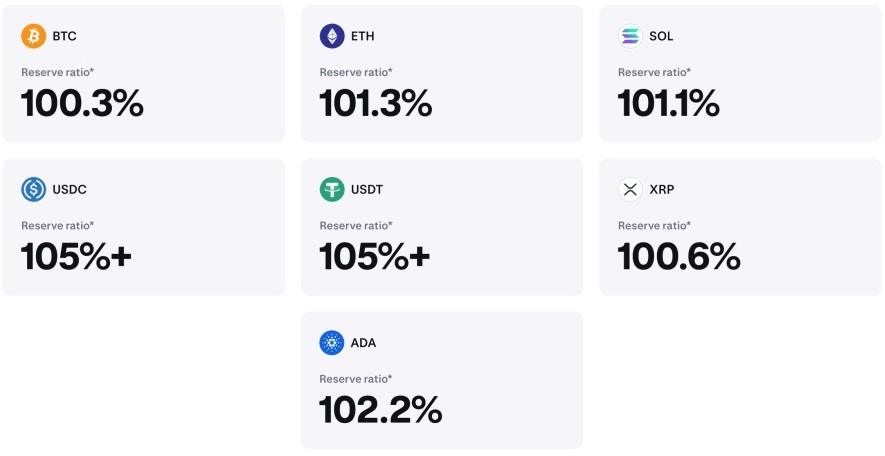
Payward completed its latest quarterly Proof of Reserves as of December 31, 2025. Clients can independently verify that their assets are fully backed on-chain and included in the report, which is validated by a third-party accounting firm.
Kraken pioneered regular Proof of Reserves and remains one of the few platforms to conduct this process consistently.
Looking ahead
Payward enters the next phase of its evolution with a clear objective: to increase throughput on a unified global financial infrastructure while preserving the risk, trust, and regulatory invariants that define the platform.
The company’s strategy is not driven by adding standalone products or chasing short-term cycles. It is driven by compounding efficiency across a single system. As assets on platform grow, collateral becomes more productive. As liquidity deepens, trading volume scales without requiring higher take rates. As settlement, custody, and payments converge on the same rails, new asset classes can be introduced without fragmenting risk or operations.
In practical terms, Kraken believes the next phase of growth will come from three reinforcing vectors.
First, expanding the set of assets that can operate natively on the platform. Crypto was the first asset class to move onto programmable, always-on rails. Tokenized equities, FX, futures, and real-world assets extend that same infrastructure into larger, more durable markets. Because Payward’s architecture is asset-agnostic, these additions increase platform throughput rather than complexity.
Second, increasing the productivity and duration of assets on platform. Custody, payments, yield, financing, and settlement activity allow balances to support multiple economic uses over time. This improves capital efficiency and drives a growing share of asset-based revenue that is less sensitive to trading volatility.
Third, global expansion that is additive rather than extractive. Payward is not replicating infrastructure market by market. A single global core supports localized onramps, compliance, and distribution. As adoption accelerates in regions where legacy financial rails are inefficient, the same platform enables new financial activity without requiring incremental reinvention.
Risk management remains central to this strategy. Margin will continue to be designed as a safety mechanism rather than a revenue lever. Positions remain fully collateralized, liquidation remains deterministic, and the platform will continue to prioritize predictable behavior under stress over peak-cycle optimization.
Looking forward, Payward’s focus is not on maximizing any single metric in isolation. It is on maximizing long-run, risk-adjusted throughput across a growing set of asset classes and geographies. The financial results in 2025 reflect the early stages of this compounding model. The years ahead are about scaling it responsibly.